The International Association of Health Policy (IAHP) is a scientific, political, and cultural organisation founded in 1977. It is an international network of scholars, health workers, and activists with the aim of promoting the scientific analysis of public health issues and a forum for international comparisons and debate on health policy issues.
WE WILL DEFEAT THOSE WITH OUR HUNGER WHO ARE TRYING TO DISCIPLINE US WITH HUNGER!
WE HAVE BEEN IN AN INDEFINITE HUNGER STRIKE FOR OUR JOB, BREAD AND HONOUR SINCE MARCH 9th, 2017.
“Now, you are on such a decision point that
it is not possible to defend anything by yourself,
either you will surrender
or you will be on the side of resistance
to protect the light of the life
Kemal ÖZER
We are the public servants protecting the light of the life. We are teachers, academicians, sociologists, medical staff, and office workers. We have been purged from our jobs under a state of statutory decree declared within the scope of state of emergency in Turkey.
AKP goverment have declared 25 statutory decrees since the declaration of the state of emergency. 11 of them was related to the dismissal of public servants from their jobs. Overall, more than hundred thousand public servants have been purged so far and we are a part of this group. One night, without any explanation, we were told that we do not have jobs anymore.
We are the children of working families, we are revolutionist/democratic people. We came to these positions through sacrifices and our efforts. We did not cheat in the exams. We were not favored by anyone. We did not steal. We did not take advantage of any state power for our own benefit. During the time we worked in the public, we believed in the “service for people, knowledge for people, and education for people” ideaology and fought for it. We have been subjected to mobbing, administrative investigations, banishments, and suspensions from our jobs just because we defend the rights of the people and demand free education and healthcare for everyone.
Today they are trying to test us with our bread, our labour and our honour by taking our jobs. AKP government, who used to have a very close relationship with the Gulen Movement, wants us to pay the price of their conflict of interest with Gulenists. We do not accept this! Since November 9th, 2016, we have been sitting in front of the Human Rights Monument in Yüksel Street, Ankara, to protest this situation, claiming “We Want Our Jobs Back”. Since then, the police have assaulted us 27 times where we have been detained everytime and tortured. But we never give up protesting and will continue to ask for our jobs back.
Beyond the regular daily sitting protests in Yuksel Street in Ankara, we distributed leaflets, went around the neighborhoods to talk to people, knocked the doors and told people our story, and collected signatures. We handed in the collected signatures to the public authorities. We used every possible channel available to spread our word. Even the trees, the birds, the stone walls did hear the sound of our voice, but the ones who took our bread from us, who are responsible for our case, did not. They actually did, but they pretended that they didn’t hear.
On the 120th day of our protest, two of our friends, Academician Nuriye Gulmen and Teacher Semih Özakça started an indefinite hunger strike in order to reflect the determination of their request and raise further awareness. The demand of the hunger strike is very clear: We want our job back! The message from the protestors is very simple: We are sacred to our labour and bread, we do not accept it to be taken away, and we will never accept it, no matter what the price will be!We will not buckle under your starvation policies! We will not get used to injustice!
Day after day our shrinking body will be the picture of justice. We call upon all the people of Turkey and the world: be with us in the battle of bread and honor! When this struggle comes to an end, our victory will be the victory of all workers against the enemies of bread and honor. We are in front of the Human Rights Monument for 24 hours and 7 days. Come and join our struggle, and we will gain the victory together.
Evaluation of 1 year of the EU-Turkey Readmission Deal
4 April 2017
A year ago, when the EU-Turkey Readmission Agreement was signed, we said, “this agreement is an official human trafficking agreement. By closing its borders, thus blocking the land routes for refugees, Europe has pushed the refugees to the sea, to a path to death.” It was not enough that people were dying in the seas, that now with this deal, they want to kill the refugees’ hopes to live! With this agreement, the EU is trying to stop the refugees from fighting for their lives and to paralyze them! Today, we are witnessing how humanity and the hopes of people who are stripped off everything but their lives clash with the calculations of the prosperous West. We said, “we should never forget this deal and ensure it goes down in history as a deal of shame”.
Now it has been one year since the deal has been implemented. Back then, there were about 2 million Syrian refugees in Turkey and many were trying to cross to Europe through the Balkans. The agreement designated Turkey to become a buffer country keeping the refugees outside of the EU borders and to become an open-air prison. In February 2016, NATO ships were sent to Turkey’s shores to prevent passage through the Aegean Sea! In fact, the EU has been executing war politics against immigrants and refugees. These war measures have significantly reduced refugee transits in the Aegean Sea to Europe.
Since 10 March, 2016, refugees who had crossed from Turkey to Greece, have been kept on the Greek islands and forced to wait for their return to Turkey.
For every Syrian refugee sent back to Turkey, one Syrian refugee from the Turkish camps was supposed to be resettled to the EU member states and this exchange was meant to cover 72,000 refugees.
In fact, this agreement was completely in breach with international law and many refugees appealed to the Greek courts with justified arguments, such as “Turkey cannot not be defined as a safe third country”, or “I do not want to be sent back, I demand that my asylum application must be accepted here.” Unfortunately, the Greek judges rejected the demands. The refugees have been trying to appeal these decisions, but the appeals cases at the Greek Supreme Courts have not yet been concluded.
Today, the EU seems content about the agreement thinking it managed to get the refugee migration outside of its borders under control. It even wants to use it as a model for other countries, such as Libya or in Sub-Saharan Africa. It is trying, in particular, to make a similar deal with Libya for the Central Mediterranean Migration Route.
After the deal, the crossings from Turkey to Greece have actually showed a dramatic decline by 98%. With the fact that refugee deaths in the Aegean Sea have declined, the EU is trying to legitimize this agreement. Approximately 70 people have died or got lost in the Aegean Sea since the agreement. This number was 1,100 in the period of 2015-2016. However, with the EU’s closure of the Aegean Sea route, refugee transits and deaths on the Central Mediterranean route, which is much riskier and more lethal, have increased. Nobody talks about the 649 people who have died on this route in the first three months…
It is clear that Turkey is not a safe third country for asylum seekers and refugees: Turkey is not giving refugee status to anyone outside of Europe. 3.5 million Syrians are under temporary protection – a guest status – in Turkey. The situation of the hundreds of thousands of people from other countries is even worse. No refugee application is accepted. Moreover, Turkish law does not allow people who are not of Turkish descent or culture to settle in Turkey. These two conditions make it impossible for Turkey to be a safe third country within international law. By declaring Turkey as a safe third country and aiming to keep migration outside of EU borders, the EU – under the leadership of Germany and the Netherlands – has ignored human rights and EU values and law.
Without lifting the geographical limitation of the 1951 Geneva Convention and making changes in the law, Turkey cannot develop protection, settlement, integration, and naturalization for the Syrians. Everyone, above all the EU, knows this!
On the other hand, even if the numbers decrease, the crossings and deaths in the Aegean Sea continue.
When the refugees could not resolve their problems with the Greek justice system, they turned to the EU judicial authorities for the injustices they have experienced under the agreement. However, the EU General Court did not accept the case. It was said that the agreement has not yet been ratified by the European Parliament and is therefore not an EU agreement! Even this is clear proof of the EU’s political manoeuvring around human rights.
According to the figures of the European Commission, 1,487 people have been returned from Greece in one year. Only 3,565 Syrians were relocated from Turkey to EU countries. The fact that this low figure cannot compare to the total target of 72,000 people shows that the agreement is not working. Moreover, given the fact that there are 3.5 million Syrians in Turkey, it is clear that there is no shared responsibility regarding the agreement and that Europe is reluctant to even admit the small group of 72,000 people.
To put it simply, no country besides Germany, France and the Netherlands, accepts EU refugee quotas, and the EU does not exert pressure on its Member States. The agreement is completely blocked in this direction.
The other great tension is experienced in Turkey-EU relations. Turkey was supposed to benefit from this deal in two ways: 1) Turkey’s EU membership negotiations – which had been shelved for a long time – were to be revitalized, and 2) Turkey was to receive a 3-billion-Euro pay-out to care for the refugees. Staying on the road to the EU is one thing, but it is ironic that nowadays, the President proposed to have a referendum on giving up EU candidacy for good. The issue of visa liberalisation for Turkish citizens is not even mentioned anymore. It is said that the European Commission will give 1.5 million Euros for 39 projects in Turkey for 2016-17, but this information is not openly and transparently shared with the public.
What is mostly happening is that the refugees become the matter of dirty political bargains and threats. With daily statements like “beware or we will send the refugees”, the lives of the refugees are played with.
This deal stripped the refugees off their rights to make their case. This is the most important and brutal outcome.
Human rights and EU values, if there were any, have greatly eroded. The policy of keeping the refugee issue outside of the EU borders is an attack on rights-based politics.
This agreement concerns only Syrian refugees, but has paved the way for aggravating the situation of refugees from other countries.
To conclude, this agreement is as embarrassing today as it was one year ago on the day it was signed.
Day by day, the parties have been gradually departing from human rights.
The EU has closed its eyes to sharing responsibility for the situation of refugees in Turkey.
The EU does not care about the facts, that refugees in Turkey live as guests under a temporary protection regime, that they do not have permanent residence permits, that they do not have refugee status, that only 10,000 of them have official documents and insurance with limited working permits, whereas the remaining hundreds of thousands work unregistered and uninsured as cheap labourers under hard conditions, that women are married off as 2nd or 3rd wives, or forced to prostitution by crime organizations, that child labour has significantly increased, that 400,000 Syrian school-aged children are not in school, that there are 400,000 undocumented Syrian babies born in Turkey, and that 3.5 million Syrians experience problems with access to accommodation and health care!
The deal has negatively affected the Turkey-EU relations.
There is yet no lasting peace in Syria and the migration out of Syrian will continue. Furthermore in 2016, Turkey prevented Syrians from crossing into Turkey; 424,641 people were picked up on the Turkish-Syrian border. The building of a 911-km-long wall is in process and is planned to be completed by the end of the year. The EU’s policy of militarizing the borders set a bad example for Syrian’s neighbouring countries. Only two out of eighteen transit points on the Turkish-Syrian border are still open and only seriously ill Syrians are taken into Turkey for medical care. So far, there has not been a serious return movement from Turkey to Syria. Only 23, 926 Syrians returned to Jarabulus in 2016.
With 4 million refugees, Turkey has become the largest refugee-hosting country in the world. Day by day, this situation has been negatively affecting the country’s domestic politics, economy, and foreign policy, and with no permanent and sustainable solution in sight, the refugees will continue to be used as political pawns.
The EU has not offered any humanitarian solution to the refugees. The problem remains as it is without any change. It is only addressed partially and kept outside of EU borders for the time being.
Human rights violations against refugees on Greece’s mainland as well as islands have been hurting the EU’s reputation. The EU is facing serious problems regarding its reputation and future. By closing their national borders and not taking in refugees, the EU’s member states are not acting according the Union’s spirit and laws.
Things to do:
1. The proxy wars of the imperialist states in Syria must end and a lasting peace must be established.
2. The EU and other international institutions, the United States, the European states etc., especially the states militarily active in Syria, should accept and share responsibilities towards the refugees.
3. The EU countries need to abandon the rhetoric and politics defining immigrants and refugees as “internal enemies”, and not to surrender to policies of recent years that serve increasingly as a form of neo-racism discriminating against certain cultures, ethnicities, and religions. The EU member states’ politics to protect against so-called “illegal immigration” is not working and threatens not only the lives of immigrants and refugees but also the future of the EU and the democratic foundations and human rights of its Member States.
4. Borders must be opened for refugees and immigrants and a safe passage must be provided.
5. Turkey should grant refugee status to all refugees from Syria and other countries.
6. To those who want it, a pathway to citizenship should be provided.
7. To ensure social integration, a safe legal status, such as permanent residence permit, the closest thing to citizenship, needs to be provided. Other areas of social integration need to be addressed as well, such as work life, family reunification, education, health, shelter, fight against discrimination, the ability to live out one’s own identity and culture, and the right to political participation.
8. The EU-Turkey relationship must no longer be based on dirty bargaining about refugees, and instead be continued on open and transparent grounds of progress in democracy and human rights.
***
Verein Brücker der Völker Kritik nach einem Jahr EU-Türkei-Abkommen 4. April 2017
Als vor einem Jahr das EU-Türkei-Rückführungsabkommen unterzeichnet wurde, sagten wir: „Dieses Abkommen ist ein offizielles Menschenhandelsabkommen. In dem sie ihre Grenzen dicht macht und so die Landrouten blockiert, zwingt die EU die Flüchtlinge in die Meere, auf einen Weg in den Tod.“ Es reichte nicht, dass die Menschen in den Meeren starben; mit diesem Deal wollen sie nun die Lebenshoffnung der Flüchtlinge töten. Mit diesem Abkommen versucht die EU die Flüchtlinge daran zu hindern, um ihr Überleben zu kämpfen und sie zu lähmen! Wir sind heute Zeuge davon, wie Humanität und die Hoffnungen von Menschen, die alles bis auf ihr Leben verloren haben, mit dem Kalkül des wohlhabenden Westens kollidieren. Wir sagten: „Wir dürfen dieses Abkommen niemals vergessen und müssen dafür sorgen, dass es als Abkommen der Schande in die Geschichte eingeht.“
Nun ist es ein Jahr her, dass das Abkommen in Kraft trat. Damals gab es 2 Millionen syrische Flüchtlinge in der Türkei und viele versuchten durch die Balkanländer nach Europa zu gelangen. Das Abkommen sah vor, dass die Türkei als Pufferzone die Flüchtlinge von den EU-Grenzen fernhält und somit ein Freiluftgefängnis wird. Im Februar 2016 wurden NATO-Schiffe Richtung türkischer Küste geschickt um das Überqueren der Ägäis zu verhindern. Tatsächlich führt die EU eine kriegerische Politik gegen Migranten und Flüchtlinge. Diese Kriegsmaßnahmen haben die Migration über die Ägäis Richtung Europa gründlich verringert.
Seit dem 10. März 2016 werden Flüchtlinge, die über die Türkei nach Griechenland gekommen waren, auf den griechischen Inseln festgehalten und müssen auf ihre Rückführung in die Türkei warten.
Für jeden syrischen Flüchtling, der in die Türkei zurückgeschickt wird, soll ein syrischer Flüchtling aus den türkischen Camps in die EU-Mitgliedsstaaten überführt werden und dieser Austausch sollte 72.000 Flüchtlinge abdecken.
Fakt ist, dass dieses Abkommen gegen Internationales Recht verstößt und viele Flüchtlinge appellierten an die griechischen Gerichte mit legitimen Argumenten, wie „die Türkei kann nicht als sicherer Drittstaat definiert werden“, oder „Ich möchte nicht zurückgeschickt werden, sondern verlange, dass mein Asylantrag hier anerkannt wird.“ Leider haben die griechischen Richter diese Forderungen abgelehnt. Die Flüchtlinge versuchen die Entscheidungen anzufechten, jedoch laufen die Verfahren in den Obersten Gerichten Griechenlands noch.
Heute scheint die EU zufrieden mit dem Abkommen zu sein mit der Annahme, dass sie die Migration außerhalb ihrer Grenzen unter Kontrolle habe. Sie möchte es sogar als Modell für andere Länder, wie z.B. Libyen oder in Subsahara-Afrika verwenden. Insbesondere für die Zentral-Mediterrane-Migrationsroute möchte sie einen ähnlichen Deal mit Libyen abschließen.
Nach dem Abkommen sind die Übergänge von der Türkei nach Griechenland um 98% zurückgegangen. Mit der Tatsache, dass weniger Flüchtlinge in der Ägäis starben, versucht die EU dieses Abkommen zu legitimieren.
Seit dem Abkommen starben in der Ägäis ungefähr 70 Menschen oder werden vermisst. Im Zeitraum von 2015-16 war diese Zahl noch 1100. Jedoch steigen, seitdem die EU die Ägäische Route dicht machte, Flüchtlingsbewegungen und -tode auf der Zentral-Mediterranen Route, die viel riskanter und tödlicher ist. Niemand spricht über die 649 Menschen, die in den ersten drei Monaten auf dieser Route starben…
Es ist offensichtlich, dass die Türkei kein sicherer Drittstaat für Asylsuchende und Flüchtlinge ist: die Türkei gewährt nämlich keinem außerhalb Europas Flüchtlingsstatus. 3,5 Millionen Syrer leben in der Türkei unter temporärem Schutz – als Gäste. Die Lage der Hundertausenden von Menschen aus anderen Ländern ist sogar noch schlimmer. Kein Flüchtlingsantrag wird angenommen. Hinzu kommt, dass es die türkische Gesetzgebung nicht erlaubt, sich in der Türkei niederzulassen, wenn man nicht türkischem Ursprungs ist oder der türkischen Kultur abstammt. Diese zwei Bedingungen machen es unmöglich, dass die Türkei nach internationalem Recht ein sicherer Drittstaat ist. Indem sie die Türkei als sicheren Drittstaat einstuft und darauf abzielt die Migrationsströme außerhalb der EU-Grenzen zu halten, verletzt die EU – unter der Führung von Deutschland und den Niederlanden – Menschenrechte und EU-Werte und -Gesetze.
Die Türkei kann keinen Schutz, Niederlassung, Integration und Einbürgerung für Syrer entwickeln, wenn sie nicht die geografische Limitierung der 1951 Genfer Konvention aufhebt und Gesetzesänderungen vornimmt. Dies ist jedem, allen voran der EU, bekannt!
Andererseits, auch wenn die Zahlen zurückgehen, so gehen die Migration und das Sterben in der Ägäis weiter…
Einige Flüchtlinge, die ihre Probleme nicht innerhalb des griechischen Justizsystems lösen konnten, wandten sie sich an das Gericht der Europäischen Union für die Ungerechtigkeiten, die sie unter dem Abkommen erlitten. Das Gericht nahm die Fälle jedoch nicht an. Grund dafür war, dass das Abkommen noch nicht vom EU-Parlament ratifiziert wurde und somit kein EU-Abkommen darstellt! Sogar dies ist ein Beweis dafür, wie die EU mit politischem Manöver Menschenrechte umgeht.
Laut Angaben der Europäischen Kommission wurden in einem Jahr 1.487 Menschen von Griechenland zurückgeführt. Nur 3.565 Syrer wurden aus der Türkei in EU-Länder überführt. Die Tatsache, dass diese niedrige Zahl dem Ziel von 72.000 Menschen nicht einmal nahekommt, zeigt, dass dieses Abkommen nicht funktioniert. Außerdem, beruhend auf dem Fakt, dass es 3,5 Millionen Syrer in der Türkei gibt, ist es offensichtlich, dass es keine Teilung der Verantwortung durch das Abkommen gibt und dass Europa sich sogar windet, die kleine Anzahl von 72.000 Menschen aufzunehmen.
Einfach ausgedrückt, kein Land außer Deutschland, Frankreich und den Niederlanden akzeptiert EU-Flüchtlingsquoten und die EU übt keinen Druck auf ihre Mitgliedsstaaten aus. Dieses Abkommen ist in diese Richtung völlig blockiert.
Die andere große Spannung liegt in den EU-Türkei-Beziehungen. Die Türkei sollte von diesem Deal zweierlei profitieren: 1) Die Verhandlungen zur EU-Mitgliedschaft – lange Zeit auf Eis gelegt – sollten wieder aufgenommen werden, und 2) die Türkei sollte für die Versorgung der Flüchtlinge 3 Mrd. Euro erhalten. Auf dem Pfad zur EU-Mitgliedschaft zu bleiben ist eine Sache, jedoch hat es eine gewisse Ironie, dass heutzutage der Präsident ein Referendum zur Aufgabe der EU-Kandidatur vorschlägt. Das Thema der Visa-Aufhebung für türkische Staatsbürger wird nicht einmal mehr erwähnt. Es wird gesagt, dass die Europäische Kommission 1,5 Mio. Euro für 39 Projekte in der Türkei für 2016-17 zur Verfügung stellen wird, jedoch wird diese Information nicht offen und transparent der Öffentlichkeit mitgeteilt.
Tatsache ist, dass die Flüchtlinge Gegenstand von schmutzigen politischen Geschäften und Drohungen werden. Mit täglichen Aussagen wie „Passt auf, sonst lassen wir alle Flüchtlinge durch“, wird das Leben von Flüchtlingen aufs Spiel gesetzt.
Dieses Abkommen nahm den Flüchtlingen das Recht, ihre Rechte einzufordern. Dies ist das wichtigste und brutalste Ergebnis.
Menschenrechte und EU-Werte, wenn sie denn existieren, wurden drastisch ausgehöhlt. Die Politik, das Flüchtlingsproblem außerhalb der EU-Grenzen zu halten, ist ein Angriff auf eine auf Menschenrechten basierende Politik.
Dieses Abkommen betrifft zwar nur syrische Flüchtlinge, aber ebnet den Weg für eine Verschlechterung der Situation für Flüchtlinge aus anderen Ländern.
Abschließend kann gesagt werden, dass dieses Abkommen heute genauso beschämend ist, wie am Tag der Unterzeichnung vor einem Jahr.
Die Parteien entfernen sich von Tag zu Tag mehr von Menschenrechten.
Die EU verschließt ihre Augen davor, Verantwortung für die Situation der Flüchtlinge in der Türkei zu übernehmen und zu teilen. Sie kümmert es nicht, dass Flüchtlinge in der Türkei als Gäste unter temporärem Schutz leben, dass sie keine langfristige Aufenthaltsgenehmigung haben, dass sie keinen Flüchtlingsstatus haben, dass nur 10.000 von ihnen mit offiziellen Papieren und Versicherung eine eingeschränkte Arbeitserlaubnis besitzen, dass die restlichen Hunderte von Tausenden schwarz und ohne Versicherung als billige Tagelöhner unter schweren Bedingungen arbeiten, dass Frauen als 2. oder 3. Ehefrauen verheiratet werden, oder von kriminellen Organisation zur Prostitution gezwungen werden, dass Kinderarbeit drastisch zugenommen hat, dass 400.000 syrische schulpflichtige Kinder nicht zur Schule gehen, dass 400.000 in der Türkei geborene syrische Babys nicht dokumentiert sind und dass 3,5 Mio. Syrer an schwerem Zugang zu Unterkünften und Gesundheitsversorgung leiden!
Das Abkommen hat die EU-Türkei-Beziehungen geschädigt. Es gibt immer noch keinen anhaltenden Frieden in Syrien und die Migrationsströme aus Syrien werden nicht aufhören. Auch in 2016 hat die Türkei Syrer davon abgehalten, die Grenzen zu überqueren; 424.641 Menschen wurden an der türkisch-syrischen Grenze aufgegriffen. Es wird eine 911-km-lange Mauer errichtet und soll bis zum Jahresende fertiggestellt werden. Die Politik der EU die Grenzen zu militarisieren setzt ein schlechtes Beispiel für Syriens Nachbarländer. Nur zwei der insgesamt achtzehn Transitstellen an der türkisch-syrischen Grenze sind noch offen und nur schwerkranke Syrer werden in die Türkei zur Behandlung durchgelassen. Bisher gab es noch keine große Bewegung zurück aus der Türkei nach Syrien. In 2016 kehrten nur 23.926 Syrer nach Dscharabulus zurück.
Mit 4 Mio. Flüchtlingen ist die Türkei das größte Aufnahmeland der Welt. Diese Situation wirkt sich von Tag zu Tag schlimmer auf die Innenpolitik, Wirtschaft sowie Außenpolitik aus und ohne Aussicht auf eine langfristige und nachhaltige Lösung werden die Flüchtlinge weiterhin als politische Spielfiguren verwendet.
Die EU hat den Flüchtlingen keine humanitäre Lösung angeboten. Das Problem hält an ohne einen Schritt vorwärts. Es wird nur teilweise adressiert und außerhalb der EU-Grenzen gelassen.
Menschenrechtsverletzungen gegen Flüchtlinge auf dem Festland und den Inseln Griechenlands kratzt am Ruf der EU. Sie sieht ernsthaften Problemen bezüglich ihres Rufs und ihrer Zukunft entgegen. Indem sie ihre nationalen Grenzen dicht machen und keine Flüchtlinge aufnehmen, agieren die Mitgliedsländer nicht im Sinne des Geistes und den Gesetzen der Union.
Was zu tun ist:
1. Die Stellvertreterkriege der imperialistischen Staaten müssen beendet und ein anhaltender Frieden muss eingeleitet werden.
2. Die EU und andere internationale Institutionen, die Vereinigten Staaten, die europäischen Länder etc., vor allem die Staaten, die in Syrien militärisch aktiv sind, müssen ihre Verantwortung gegenüber Flüchtlingen annehmen und teilen.
3. Die EU-Länder müssen ihre Rhetorik und Politik aufgeben, die Einwanderer und Flüchtlinge als „interne Feinde“ definiert, und dürfen sich nicht der Politik aus den letzten Jahren hingeben, die mehr und mehr als eine Art Neo-Rassismus dazu dient, gegen bestimmte Kulturen, Ethnien und Religionen zu diskriminieren. Die Politik der EU-Mitgliedsstaaten, sich vor sogenannter „illegaler Einwanderung“ zu schützen, funktioniert nicht und bedroht nicht nur das Leben der Migranten und Flüchtlinge, sondern auch die Zukunft der EU und die demokratischen Grundsätze und Menschenrechter ihrer Mitgliedsstaaten.
4. Grenzen müssen für Flüchtlinge und Migranten geöffnet und ein sicherer Transit muss gewährleistet werden.
5. Die Türkei sollte allen Flüchtlingen aus Syrien und anderen Ländern Flüchtlingsstatus gewähren.
6. Diejenigen, die es wünschen, sollten die Möglichkeit zur Einbürgerung erhalten.
7. Um ein gutes Miteinander (soziale Integration) sicherzustellen, muss ein sicherer legaler Status, wie eine langfristige Aufenthaltsgenehmigung, was der Staatsbürgerschaft am nächsten kommt, gewährleistet werden. Auch andere Bereiche der sozialen Integration müssen adressiert werden, wie z.B. Arbeitsverhältnisse, Familienzusammenführung, Bildung, Gesundheit, Unterkunft, Anti-Diskriminierungsmaßnahmen, die Möglichkeit seine Identität und Kultur auszuleben und das Recht auf politische Partizipation.
8. Die EU-Türkei-Beziehung darf nicht länger über schmutzige Geschäfte auf den Rücken der Flüchtlinge ausgetragen werden, sondern muss auf offener und transparenter Basis und Fortschritt von Demokratie und Menschenrechten fortgeführt werden.
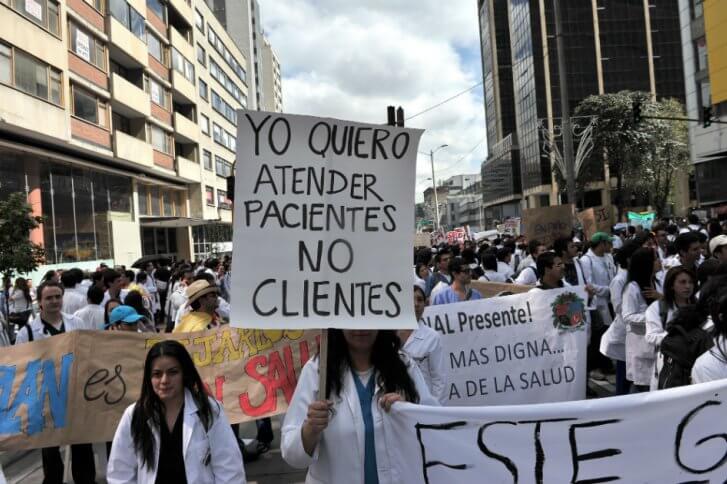
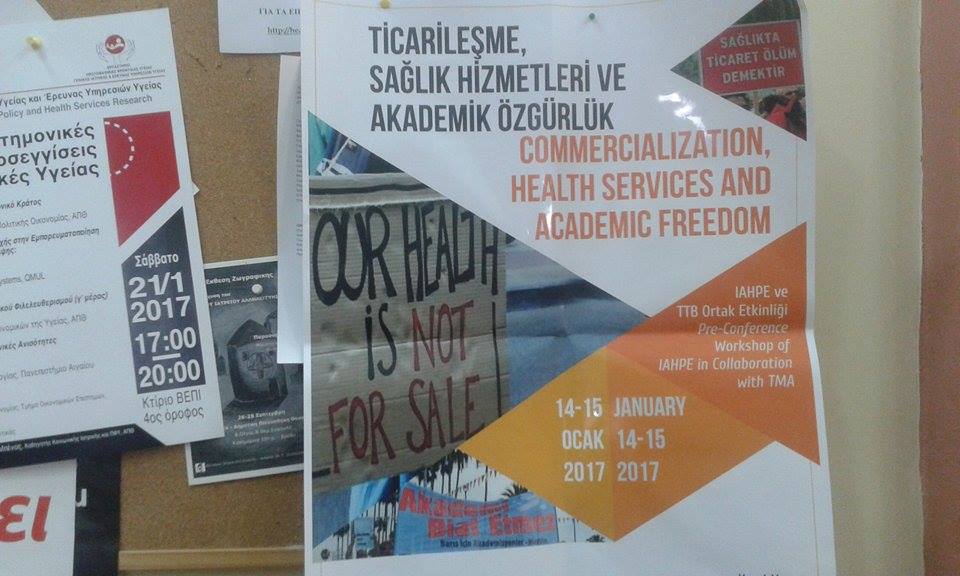
In Thessaloniki, Greece, doctors, nurses, hospital administrative staff and citizens gathered outside Ippokrateio and Yiorgos Genimatas Hospital, holding an “Our Health Is Not For Sale” banner.
18ο Συνέδριο Διεθνούς Ένωσης Πολιτικής Υγείας (ΙΑΗPE)
21-24 Σεπτεμβρίου, Θεσσαλονίκη – Πρόσκληση για συμμετοχή
Ευρωπαϊκές πολιτικές για την υγεία στην εποχή της κρίσης και της αναδιάρθρωσης του καπιταλισμού
Η Διεθνής Ένωση Πολιτικής Υγείας (International Association of Health Policy – IAHPE), είναι μια επιστημονική, πολιτική και πολιτιστική οργάνωση, που ιδρύθηκε το 1977. Πρόκειται για ένα διεθνές δίκτυο ακαδημαϊκών, εργαζόμενων στο χώρο της υγείας και ακτιβιστών/τριών, σκοπός του οποίου είναι η προώθηση της επιστημονικής ανάλυσης ζητημάτων δημόσιας υγείας και η δημιουργία ενός χώρου συζήτησης και σύγκρισης πολιτικών για την υγεια σε διεθνές επίπεδο. Το 18ο Συνέδριο της IAHPE διοργανώνεται φέτος στη Θεσσαλονίκη, από τις 21 ως τις 24 Σεπτεμβρίου 2017, υπό την αιγίδα του Τμήματος Ιατρικής του Αριστοτελείου Πανεπιστημίου Θεσσαλονίκης, και σε συνεργασία με το Πανεπιστήμιο Queen Mary του Λονδίνου.
Ακολουθώντας μια παράδοση 40 χρόνων, η Διεθνής Ένωση Πολιτικής Υγείας θα δώσει έμφαση στις σύγχρονες εξελίξεις στις ευρωπαϊκές πολιτικές υγείας στα συμφραζόμενα της καπιταλιστικής κρίσης και της καπιταλιστικής οικονομικής αναδιάρθρωσης. Το συνέδριο, λοιπόν, θα καλύψει τις εξής θεματικές:
Συμφωνίες διεθνούς εμπορίου και η επίδρασή τους στο αγαθό της υγείας στην Ευρώπη
Ιδιωτικοποίηση και εμπορευματοποίηση των υπηρεσιών φροντίδας υγείας στην Ευρώπη
Η κρίση στην Ευρωζώνη και η επίδρασή της στην υγεία και την μεταρρύθμιση πολιτικής υγείας
Η προσφυγική κρίση και οι επιπτώσεις της στην υγεία και την κοινωνία
Ακαδημαϊκές ελευθερίες σε κίνδυνο στην Ευρώπη
Κοινωνικά κινήματα και υγεία στην Ευρώπη
Κάλεσμα για υποβολή περιλήψεων
Το πρόγραμμα του συνεδρίου περιλαμβάνει τις διαλέξεις κεντρικών ομιλητών, συζητήσεις σε πάνελ και ανακοινώσεις. Οι συζητήσεις θα εστιάσουν στις βασικές θεματικές του συνεδρίου, ενώ οι ανακοινώσεις –προφορικές και πόστερ–, αναγνωρίζονται ως ακαδημαϊκά ισότιμες παρουσιάσεις στο συνέδριο.
Η διαδικασία κατάθεσης των περιλήψεων έχει ως εξής:
Στην αρχή της περίληψης γράφετε το όνομα, την ιδιότητα και την ηλεκτρονική διεύθυνση του/της συγγραφέα που πρόκειται να παρουσιάσει την ανακοίνωση.
Ακολουθείτε την κλασική δομή της περίληψης: τίτλος παρουσίασης, συγγραφείς και ιδιότητες, και σώμα της περίληψης (μέχρι 500 λέξεις), που περιλαμβάνει την Εισαγωγή, την Μέθοδο, τα Αποτελέσματα και τα Συμπεράσματα.
Νέα προθεσμία για την υποβολή περιλήψεων: 30 Ιουνίου 2017
Σε εύλογο χρονικό διάστημα θα σας γνωστοποιηθεί η απόφαση της επιτροπής αξιολόγησης για τη συμμετοχή και το είδος της ανακοίνωσής σας (προφορική παρουσίαση ή πόστερ).
Συμμετοχή
Συμμετέχοντες/ουσες με πλήρη απασχόληση και μισθό: 100 €
Άνεργοι, επισφαλώς εργαζόμενοι και φοιτητές: δωρεάν
XVIII Conference of the International Association of Health Policy in Europe, 21-24 September 2017, Thessaloniki-Greece
European health policies in the era of capitalist crisis and restructuring
The International Association of Health Policy in Europe in collaboration with Aristotle University of Thessaloniki and Queen Mary University of London are inviting you to the XVIII IAHPE Conference that will be held in Thessaloniki on the 21st until the 24th September 2017. IAHPE following its 40 years tradition will focus on the contemporary developments in European health policies within the context of capitalist crisis and capitalist economicrestructuring. The conference will be covering the following themes:
International trade agreements and their impact on Europe’s environment and health
Privatization and marketization of healthcare services in Europe
Eurozone crisis and its impact on health and health policy reform
Refugee crisis and its health and social implications
The programme of the conference will include keynote speakers, panel discussions and papers presentations. The panels will be stressing on the main objects of the Conference with the help of invited speakers.
The papers presentations will be allocated in oral presentations and posters, both having equal academic recognition as presentations in the Conference.
The process of admission of presentations abstracts in the Conference is as follow:
at the head of the abstract write the name, affiliation and e-mail of the author that is going to present the paper in the conference
follow the classic abstract’s structure – title of the presentation, authors with affiliations, and the body of the abstract up to 500 words including Introduction, Methods, Results, Conclusions
Deadline of abstracts submission (extended) 30 July 2017
In due time you will receive the decision of the peer review committee regarding the admission of your presentation and in case of positive answer its allocation in oral or poster presentation.
Fees Participants with full time job and salary: 100€ Unemployed, precarious workers, students: free of charge
Supported by
Guidelines
Tritis Septemvriou Street – Campus of Aristotle University of Thessaloniki
OASTH lines 2, 8, 14, 78 Bus Stop University of Macedonia. 17, 37 Bus Stop Fititiki Leschi. Further info: http://www.oasth.gr/index.php
18ο Συνέδριο Διεθνούς Ένωσης Πολιτικής Υγείας (ΙΑΗPE)
21-24 Σεπτεμβρίου, Θεσσαλονίκη – Πρόσκληση για συμμετοχή
Ευρωπαϊκές πολιτικές για την υγεία στην εποχή της κρίσης και της αναδιάρθρωσης του καπιταλισμού
Η Διεθνής Ένωση Πολιτικής Υγείας (International Association of Health Policy – IAHPE), σε συνεργασία με το Αριστοτέλειο Πανεπιστήμιο Θεσσαλονίκης, το Πανεπιστήμιο Queen Mary του Λονδίνου και το Πανεπιστήμιο Αιγαίου της Σμύρνης σας προσκαλούν στο 18ο Συνέδριο της Ένωσης, που θα διοργανώνεται στη Θεσσαλονίκη από τις 21 ως τις 24 Σεπτεμβρίου 2017.
Ακολουθώντας μια παράδοση 40 χρόνων, η Διεθνής Ένωση Πολιτικής Υγείας θα δώσει έμφαση στις σύγχρονες εξελίξεις στις ευρωπαϊκές πολιτικές υγείας στα συμφραζόμενα της καπιταλιστικής κρίσης και της καπιταλιστικής οικονομικής αναδιάρθρωσης. Το συνέδριο, λοιπόν, θα καλύψει τις εξής θεματικές:
Συμφωνίες διεθνούς εμπορίου και η επίδρασή τους στο αγαθό της υγείας και το περιβάλλον στην Ευρώπη
Ιδιωτικοποίηση και εμπορευματοποίηση των υπηρεσιών φροντίδας υγείας στην Ευρώπη
Η κρίση στην Ευρωζώνη και η επίδρασή της στην υγεία και την μεταρρύθμιση πολιτικής υγείας
Η προσφυγική κρίση και οι επιπτώσεις της στην υγεία και την κοινωνία
Ακαδημαϊκές ελευθερίες σε κίνδυνο στην Ευρώπη
Κοινωνικά κινήματα και υγεία στην Ευρώπη
Κάλεσμα για υποβολή περιλήψεων
Το πρόγραμμα του συνεδρίου περιλαμβάνει τις διαλέξεις κεντρικών ομιλητών, συζητήσεις σε πάνελ και ανακοινώσεις. Οι συζητήσεις θα εστιάσουν στις βασικές θεματικές του συνεδρίου, ενώ οι ανακοινώσεις –προφορικές και πόστερ–, αναγνωρίζονται ως ακαδημαϊκά ισότιμες παρουσιάσεις στο συνέδριο.
Η διαδικασία κατάθεσης των περιλήψεων έχει ως εξής:
Στην αρχή της περίληψης γράφετε το όνομα, την ιδιότητα και την ηλεκτρονική διεύθυνση του/της συγγραφέα που πρόκειται να παρουσιάσει την ανακοίνωση.
Ακολουθείτε την κλασική δομή της περίληψης: τίτλος παρουσίασης, συγγραφείς και ιδιότητες, και σώμα της περίληψης (μέχρι 500 λέξεις), που περιλαμβάνει την Εισαγωγή, την Μέθοδο, τα Αποτελέσματα και τα Συμπεράσματα.
Νέα προθεσμία για την υποβολή περιλήψεων: 30 Ιουλίου 2017
Σε εύλογο χρονικό διάστημα θα σας γνωστοποιηθεί η απόφαση της επιτροπής αξιολόγησης για τη συμμετοχή και το είδος της ανακοίνωσής σας (προφορική παρουσίαση ή πόστερ).
Συμμετοχή
Συμμετέχοντες/ουσες με πλήρη απασχόληση και μισθό: 100 €
Άνεργοι, επισφαλώς εργαζόμενοι και φοιτητές: δωρεάν
Πώς θα φτάσετε στο Συνέδριο
Tο κτίριο του ΚΕΔΕΑ, όπου θα διεξαχθεί το συνέδριο είναι στην οδό 3ης Σεπτεμβρίου – Πανεπιστημιούπολη)
Εξυπηρετούν οι γραμμές του ΟΑΣΘ 2, 8, 14, 78 Στάση Πανεπιστήμιο Μακεδονίας. 17,37 Στάση Φοιτητική Λέσχη. Περισσότερες Πληροφορίες: http://www.oasth.gr/index.php
Επικοινωνία
Για περισσότερες πληροφορίες, στείλτε μήνυμα στην ηλεκτρονική διεύθυνση της IAHPE
XVIIIème Conférence de l’ ΙΑΗPE, 21-24 / 9, Thessalonique (Grèce) –
Appel à contribution
XVIIIème Conférence de l’Association internationale de la politique de la santé en Europe, du 21 au 24 septembre 2017 à Thessalonique-Grèce.
Politiques européennes de santé à l’ère de la crise capitaliste et de la restructuration
L’Association internationale de la politique de la santé en Europe en collaboration avec l’Université Aristote de Thessalonique et l’Université Queen Mary de Londres, vous invitent à la XVIIIème conférence de l’IAHPE, qui se tiendra à Thessalonique du 21 au 24 septembre 2017. L’IAHPE après sa tradition de 40 ans, se concentrera sur les développements contemporains des politiques sanitaires européennes dans le contexte de la crise capitaliste ainsi que de la restructuration économique capitaliste. La conférence couvrira les thèmes suivants:
Les accords commerciaux internationaux et leur impact sur la santé et l’ environment de l’Europe • Privatisation et commercialisation des services de santé en Europe • La crise de la zone euro et son impact sur la réforme de la santé et de la politique de santé • La crise des réfugiés et ses implications sociales et de santé • La liberté universitaire menacée en Europe • Les mouvements sociaux et la santé en Europe
Appel à contribution
Le programme de la conférence comprendra des conférenciers principaux, des tables rondes et des présentations-exposés. Les tribunes souligneront les principaux objectifs de la Conférence avec l’aide de conférenciers invités.
Les exposés seront attribués dans des présentations orales et des présentations des documents, toutes les deux ayant la même reconnaissance académique que les présentations lors de la Conférence.
Le processus d’admission, des résumés des présentations à la Conférence, est le suivant:
à la tête de l’abstrait, écrivez le nom, l’affiliation et le courrier électronique de l’auteur qui présentera la contribution dans la conférence • suivre la structure classique du résumé – titre de la présentation, auteurs avec affiliations et le corps de l’abstrait jusqu’à 500 mots incluant Introduction, Méthodes, Résultats, Conclusions • envoyer le résumé en tant que document joint à l’adresse électronique IAHPEconference2017@gmail.com
Date limite de soumission des résumés le 30 juillet 2017.
En temps voulu, vous recevrez la décision du comité scientifique par les pairs concernant l’admission de votre présentation et, en cas de réponse positive, la répartition en présentation orale ou par présentation des documents.
Frais
Participants à temps plein et salaire: 100 €
Chômeurs, travailleurs précaires, étudiants: sans frais
7 April: World Health Day in the streets of Brussels and across Europe against health commercialisation
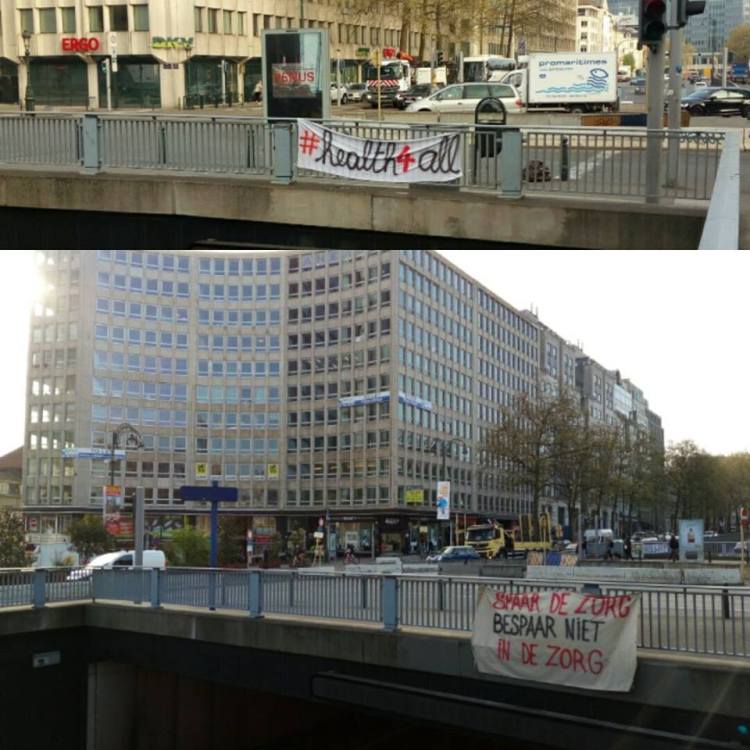
Different networks of trade unionists, citizen collectives, NGOs and social movements have planned a series of actions in several European cities this World Health Day (Friday 7 April 2017). A rallying cry will be heard from activists in Madrid, Barcelona, Zaragosa, Paris, Nice, Brussels, Milan, Florence, Bologna and many other cities across Europe (see map of actions). Our message is simple: governments should invest more in quality health care for all and end considering health as a commodity. OUR HEALTH IS NOT FOR SALE!
We want to send a strong message to the European institutions and their Member States, highlighting:
the negative consequences of prolonged austerity on the quality and accessibility of health care;
trade, fiscal and single market EU policies encouraging the growth of private for-profit insurances and providers in the health sector, with a negative impact on the already widening health inequalities.
We want these policies be reversed immediately because of their negative consequences on people’s health.
«All across Europe, millions of people are experiencing lower access to healthcare, higher waiting lists, closure and privatisation of health services, de-reimbursement of medicines… EU institutions and European governments are making people pay for the crisis bill. These policies have and would have catastrophic effects on people’s health!» warns Sebastian Franco, coordinator of the European network against health commercialisation.
Several national demonstrations in March align with the spirit of 7th April:
on March 4th in the UK, people marched to support the NHS against privatisation;
on March 7th in France, workers of the health sector went on strike;
on March 21st in Belgium, people demonstrated against the policies of the health minister.
ACTIONS
More than 50 actions will take place around Europe and the world showing growing concerns and convergence of social organisations against health commercialisation. Everywhere, we call the citizenry to show support hanging a white sheet from the window with a message supporting #health4all.
In Brussels, two events will be organized:
A rally at 11am in front of the national Ministry of Health,
Boulevard du Jardin Botanique 50, 1000 Brussels
A roundtable at 2pm, International Auditorium, Avenue Roi Albert II no 5 «Consequences of health commercialisation on the working conditions and on the quality of health care».
CONTACTS
Contact in Brussels
Sebastian Franco, European Network against Health commercialisation
Alexis Benos, IAHPE, People’ s Health Movement Greece
abenos@gmail.com ; +30 6985 02 02 40
The following organisations are supporting the mobilisation:
Europe : European network against health commercialisation, European federation of Public service Unions (EPSU), People’s Health Movement Europe, Alter Summit
Belgium: Centrale générale des services publics (CGSP)-ALR, Centrale Nationale des Employés (CNE), LBC-NVK (Vakbond voor bedienden en kaderleden), Conseil Bruxellois de Coordination Sociopolitique (CBCS), Fédération des Maisons Médicales, M3M, Médecins du Monde Belgique, Médecine pour le Peuple, Memisa, Plate-forme d’action Santé et Solidarité
France: Act-Up Paris, Act-Up Toulouse, Association nationale des centre d’IVG (ANCIC), ATTAC, CADTM, Collectif national pour le droit des femmes (CNDF), Collectif 20° Tenon, Coordination nationale des associations pour le droit à l’avortement et à la contraception (CADAC), Convergence des collectifs de défense et de développement des services publics, Coordination de défense et de promotion des centres de santé, Coordination nationale des comités de défense des hôpitaux et maternités de proximité, COSS 33 – Coordination santé solidarité Gironde, Ensemble pour une santé solidaire , La santé n’est pas une marchandise, Résistance sociale, SERPSY, Union nationale des Groupements Mutualistes Solidaires, Fédération SUD Protection Sociale, Fédération SUD Santé Sociaux, Hôpital Debout, Syndicat de la médecine générale (SMG), Union nationale de la psychiatrie (USP), Union syndicale Solidaires, Ensemble!, Nouveau Parti Anticapitaliste, Parti Communiste français, Parti de Gauche, Psy soins accueil
Italy: Rete Sostenibilità e Salute, Medicina Democratica Onlus, Forum Salute Italia, CUB sanità, Coordinamento Nazionale Unitario Pensionati di Oggi e di Domani (CoNUP), Illuminiamo la Salute – Libera Società Italiana di Medicina delle Migrazioni (SIMM), No Grazie, Grup-pa – Rete PHM Italia, Rete italiana per l’insegnamento della salute globale (RIISG), Comitato Toscano Sanità, Comitato Veneto, Sensibilità Chimica, SIAL Cobas, Osservatorio Molisano sul Diritto Alla Salute, Presidio di Salute Solidale – Napoli, Rete per il Diritto alla Salute – Napoli, Forum per il diritto alla salute – Roma e Lazio, Gruppo Welfare Coalizione Civica per Bologna, Associazione Explore, Comitato Collaborazione Medica, Torino, Periodico Lavoro e Salute, #buongiornoLivorno, Io faccio la mia parte Onlus Napoli, Gruppo Prometeo – Bologna, Movimento per i diritti del malato – Brescia, Nessuno escluso – Modena, Collettivo Autogestito Casarossa40,ACLI Gallarate, ADL Varese, Legambiente Gallarate, Centro per la salute G.A. Maccaro Catellanza, Gallarate in movimento, Casa delle Donne “Anna Andriulo”Gallarate, Sinistra Italiana Gallarate e Busto Arsizio, Rifondazione Comunista Gallarate, Busto a Sinistra, Rete per il diritto alla salute Milano e Lombardia, PCI provincia di Varese, Individualità e Singoli attivisti di Busto e Gallarate
Spain: Coordinadora Mareas Blancas estatales
***
7 Απριλίου: Παγκόσμια Ημέρα Υγείας
στους δρόμους των Βρυξελλών και σε όλη την Ευρώπη
ενάντια στην εμπορευματοποίηση της υγείας
Δίκτυα συνδικαλιστών, συλλογικότητες πολιτών, ΜΚΟ και κοινωνικά κινήματα έχουν σχεδιάσει σειρά δράσεων σε διάφορες ευρωπαϊκές πόλεις για τη φετινή Παγκόσμια Ημέρα Υγείας (Παρασκευή 7 Απριλίου 2017). Καλέσματα για συγκεντρώσεις θα γίνουν από ακτιβιστές στη Μαδρίτη, τη Βαρκελώνη, τη Σαραγόσα, το Παρίσι, τη Νίκαια, τις Βρυξέλλες, το Μιλάνο, τη Φλωρεντία, τη Μπολόνια και πολλές ακόμα πόλεις σε όλη την Ευρώπη. Το μήνυμά μας είναι απλό: οι κυβερνήσεις πρέπει να επενδύσουν περισσότερο στην ποιοτική φροντίδα για όλους και να σταματήσουν να θεωρούν την υγεία ως εμπόρευμα.
Η ΥΓΕΙΑ ΜΑΣ ΔΕΝ ΕΙΝΑΙ ΓΙΑ ΠΟΥΛΗΜΑ!
Θέλουμε να στείλουμε ένα ισχυρό μήνυμα στους ευρωπαϊκούς θεσμούς και τα κράτη-μέλη της Ευρωπαϊκής Ένωσης, επισημαίνοντας:
Τις αρνητικές επιπτώσεις της παρατεταμένης λιτότητας στην ποιότητα της φροντίδας υγείας και την πρόσβαση σε αυτήν·
Τις πολιτικές της Ευρωπαϊκής Ένωσης για το εμπόριο, τα δημοσιονομικά και την ενιαία αγορά, που ενθαρρύνουν την ανάπτυξη της κερδοσκοπικής ιδιωτικής ασφάλισης και των ιδιωτών παρόχων στον τομέα υγείας, με συνέπεια τη διεύρυνση των ήδη υπαρκτών ανισοτήτων στην υγεία.
Θέλουμε οι πολιτικές αυτές να αντιστραφούν αμέσως, εξαιτίας των αρνητικών συνεπειών τους για την υγεία των ανθρώπων.
«Σε ολόκληρη την Ευρώπη, εκατομμύρια άνθρωποι έχουν δυσκολότερη πρόσβαση στη φροντίδα υγείας, υφίστανται την ταλαιπωρία σε όλο και μεγαλύτερες λίστες αναμονής, το κλείσιμο και την ιδιωτικοποίηση των υπηρεσιών υγείας. Οι θεσμοί της Ευρωπαϊκής Ένωσης και οι ευρωπαϊκές κυβερνήσεις υποχρεώνουν τους λαούς να πληρώσουν αυτοί για την κρίση. Οι πολιτικές αυτές έχουν και θα έχουν καταστροφικές συνέπειες για την υγεία των ανθρώπων», προειδοποιεί ο Σεμπαστιάν Φράνκο, συντονιστής του Ευρωπαϊκού Δικτύου ενάντια στην εμπορευματοποίηση της υγείας.
Στο πνεύμα του καλέσματος της 7ης Απριλίου, μέσα στον Μάρτιο έγιναν συγκεντρώσεις σε διάφορες χώρες:
Στις 4 Μαρτίου στη Βρετανία, πολίτες διαδήλωσαν για να στηρίξουν το Εθνικό Σύστημα Υγείας ενάντια στην ιδιωτικοποίηση.
Στις 7 Μαρτίου στη Γαλλία, εργαζόμενοι στην υγεία κατέβηκαν σε απεργία.
Στις 21 Μαρτίου στο Βέλγιο, πολίτες διαδήλωσαν ενάντια στην πολιτική του υπουργείου Υγείας.
ΔΡΑΣΕΙΣ
Την Παρασκευή 7 Απριλίου, θα λάβουν χώρα περισσότερες από 50 δράσεις σε ολόκληρη την Ευρώπη και τον κόσμο. Η κινητοποίηση αυτή απηχεί την ολοένα μεγαλύτερη μέριμνα, αλλά και τη σύγκλιση των κοινωνικών οργανώσεων, ενάντια στην εμπορευματοποίηση της υγείας. Καλούμε παντού τους πολίτες να δείξουν τη στήριξή τους, κρεμώντας ένα λευκό σεντόνι στο παράθυρο με το υποστηρικτικό μήνυμα #health4all.
Στις Βρυξέλλες θα οργανωθούν δύο δράσεις:
Μια διαδήλωση στις 11 π.μ., μπροστά στο υπουργείο Υγείας (Boulevard du Jardin Botanique 50, 1000 Βρυξέλλες).
Ένα στρογγυλό τραπέζι στις 2 μ.μ., στο International Auditorium (Avenue Roi Alber II no 5), με θέμα «Συνέπειες της εμπορευματοποίησης της υγείας στις συνθήκες εργασίας και την ποιότητα της φροντίδας υγείας».
Στη Θεσσαλονίκη, έχει προγραμματιστεί για τη 1 μ.μ. συγκέντρωση στο Ιπποκράτειο Νοσοκομείο.
ΕΠΑΦΕΣ
Στο Βέλγιο (Βρυξέλλες)
Sebastian Franco, European Network against Health commercialisation
Την κινητοποίηση στηρίζουν οι παρακάτω οργανώσεις:
Ευρώπη: Ευρωπαϊκό Δίκτυο Ενάντια στην Εμπορευματοποίηση της Υγείας, Ευρωπαϊκή Ομοσπονδία Συνδικάτων στις Δημόσιες Υπηρεσίες, People’s Health Movement Europe (PHM), Alter Summit
Bέλγιο: Centrale générale des services publics (CGSP)-ALR, Centrale Nationale des Employés (CNE), LBC-NVK (Vakbond voor bedienden en kaderleden), Conseil Bruxellois de Coordination Sociopolitique (CBCS), Fédération des Maisons Médicales, M3M, Médecins du Monde Belgique, Médecine pour le Peuple, Memisa, Plate-forme d’action Santé et Solidarité
Γαλλία: Act-Up Paris, Act-Up Toulouse, Association nationale des centre d’IVG (ANCIC), ATTAC, CADTM, Collectif national pour le droit des femmes (CNDF), Collectif 20° Tenon, Coordination nationale des associations pour le droit à l’avortement et à la contraception (CADAC), Convergence des collectifs de défense et de développement des services publics, Coordination de défense et de promotion des centres de santé, Coordination nationale des comités de défense des hôpitaux et maternités de proximité, COSS 33 – Coordination santé solidarité Gironde, Ensemble pour une santé solidaire , La santé n’est pas une marchandise, Résistance sociale, SERPSY, Union nationale des Groupements Mutualistes Solidaires, Fédération SUD Protection Sociale, Fédération SUD Santé Sociaux, Hôpital Debout, Syndicat de la médecine générale (SMG), Union nationale de la psychiatrie (USP), Union syndicale Solidaires, Ensemble!, Nouveau Parti Anticapitaliste, Parti Communiste français, Parti de Gauche, Psy soins accueil
Iταλία: Rete Sostenibilità e Salute, Medicina Democratica Onlus, Forum Salute Italia, CUB sanità, Coordinamento Nazionale Unitario Pensionati di Oggi e di Domani (CoNUP), Illuminiamo la Salute – Libera Società Italiana di Medicina delle Migrazioni (SIMM), No Grazie, Grup-pa – Rete PHM Italia, Rete italiana per l’insegnamento della salute globale (RIISG), Comitato Toscano Sanità, Comitato Veneto, Sensibilità Chimica, SIAL Cobas, Osservatorio Molisano sul Diritto Alla Salute, Presidio di Salute Solidale – Napoli, Rete per il Diritto alla Salute – Napoli, Forum per il diritto alla salute – Roma e Lazio, Gruppo Welfare Coalizione Civica per Bologna, Associazione Explore, Comitato Collaborazione Medica, Torino, Periodico Lavoro e Salute, #buongiornoLivorno, Io faccio la mia parte Onlus Napoli, Gruppo Prometeo – Bologna, Movimento per i diritti del malato – Brescia, Nessuno escluso – Modena, Collettivo Autogestito Casarossa40, ACLI Gallarate, ADL Varese, Legambiente Gallarate, Centro per la salute G.A. Maccaro Catellanza, Gallarate in movimento, Casa delle Donne “Anna Andriulo”Gallarate, Sinistra Italiana Gallarate e Busto Arsizio, Rifondazione Comunista Gallarate, Busto a Sinistra, Rete per il diritto alla salute Milano e Lombardia, PCI provincia di Varese, Individualità e Singoli attivisti di Busto e Gallarate
Ισπανία: Coordinadora Mareas Blancas estatales
Ελλάδα:
***
7 avril: Journée Mondiale de la Santé δans les rues de Bruxelles et à travers l’Europe contre la commercialisation de la Santé
Différents réseaux de syndicats, collectifs citoyens, ONGs et mouvements sociaux organisent une série d’actions dans plusieurs villes européennes pour la Journée Mondiale de la Santé (vendredi 7 avril 2017). Un cri de ralliement se fera entendre à Madrid, Barcelone, Saragosse, Paris, Nice, Bruxelles, Milan, Florence, Bologne et encore d’autres villes à travers l’Europe (voir carte des actions). Notre message est simple: les gouvernements doivent plus investir dans des soins de santé de qualité et arrêter de considérer la santé comme une marchandise. NOTRE SANTÉ N’EST PAS À VENDRE!
Nous voulons envoyer un message ferme aux institutions européennes et à ses États membres, mettant en lumière:
les conséquences négatives d’une austérité prolongée sur la qualité et l’accessibilité aux soins de santé;
les politiques intérieures, fiscales et commerciales qui favorisent la croissance des assurances et services commerciaux dans le secteur de la santé qui renforcent encore plus les inégalités de santé.
Nous exigeons que ces politiques soit stoppées à cause de leurs conséquences très négative pour la santé des populations.
“Partout en Europe, des millions de personnes expérimentent une diminution de l’accès aux soins de santé, des listes d’attentes plus longues, la fermeture et la privatisation des services de santé, une diminution des remboursements des médicaments… Les institutions européennes et les gouvernements nationaux font payer aux gens la facture de la crise économique. Ces politiques ont et auront des effets catastrophiques sur la santé des personnes!” avertit Sebastian Franco, coordinateur du Réseau européen contre la commercialisation de la Santé.
Plusieus manifestations au mois de mars s’inscrivent dans l’esprit du 7 avril:
le 4 mars au Royaume-Uni, marche en soutien du NHS contre sa privatisation
le 7 mars en France, les travailleur.euses de la santé ont fait grève
le 21 mars en Belgique, travailleur.euses et usagers.ères ont manifesté contre les politiques de la Ministre de la santé.
ACTIONS
Plus de 50 actions sont prévues en Europe et dans le Monde, exprimant une inquiétude croissante et une convergence des organisations sociales contre la commercialisation de la santé. Partout, nous appelons la citoyenneté à montrer son soutien en faisant pendre de sa fenêtre un drap blanc avec un message s’inscrivant en soutien à #health4all.
A Bruxelles, deux événements sont prévus:
Rassemblement à 11h devant le SPF Santé, Bd du Jardin Botanique 20 à Bruxelles
Une table rond à 14h, Auditorium International, Av du Roi Albert II no 5 “Conséquences de la commercialisation de la santé sur les conditions de travail et la qualité des soins de santé
CONTACTS
Contact in Brussels
Sebastian Franco, European Network against Health commercialisation
Alexis Benos, IAHPE, People’ s Health Movement Greece
abenos@gmail.com ; +30 6985 02 02 40
Les organisations suivantes soutiennent la mobilisation:
Europe : European network against health commercialisation, European federation of Public service Unions (EPSU), People’s Health Movement Europe, Alter Summit
Belgium: Centrale générale des services publics (CGSP)-ALR, Centrale Nationale des Employés (CNE), LBC-NVK (Vakbond voor bedienden en kaderleden), Conseil Bruxellois de Coordination Sociopolitique (CBCS), Fédération des Maisons Médicales, M3M, Médecins du Monde Belgique, Médecine pour le Peuple, Memisa, Plate-forme d’action Santé et Solidarité
France: Act-Up Paris, Act-Up Toulouse, Association nationale des centre d’IVG (ANCIC), ATTAC, CADTM, Collectif national pour le droit des femmes (CNDF), Collectif 20° Tenon, Coordination nationale des associations pour le droit à l’avortement et à la contraception (CADAC), Convergence des collectifs de défense et de développement des services publics, Coordination de défense et de promotion des centres de santé, Coordination nationale des comités de défense des hôpitaux et maternités de proximité, COSS 33 – Coordination santé solidarité Gironde, Ensemble pour une santé solidaire , La santé n’est pas une marchandise, Résistance sociale, SERPSY, Union nationale des Groupements Mutualistes Solidaires, Fédération SUD Protection Sociale, Fédération SUD Santé Sociaux, Hôpital Debout, Syndicat de la médecine générale (SMG), Union nationale de la psychiatrie (USP), Union syndicale Solidaires, Ensemble!, Nouveau Parti Anticapitaliste, Parti Communiste français, Parti de Gauche, Psy soins accueil
Italy: Rete Sostenibilità e Salute, Medicina Democratica Onlus, Forum Salute Italia, CUB sanità, Coordinamento Nazionale Unitario Pensionati di Oggi e di Domani (CoNUP), Illuminiamo la Salute – Libera Società Italiana di Medicina delle Migrazioni (SIMM), No Grazie, Grup-pa – Rete PHM Italia, Rete italiana per l’insegnamento della salute globale (RIISG), Comitato Toscano Sanità, Comitato Veneto, Sensibilità Chimica, SIAL Cobas, Osservatorio Molisano sul Diritto Alla Salute, Presidio di Salute Solidale – Napoli, Rete per il Diritto alla Salute – Napoli, Forum per il diritto alla salute – Roma e Lazio, Gruppo Welfare Coalizione Civica per Bologna, Associazione Explore, Comitato Collaborazione Medica, Torino, Periodico Lavoro e Salute, #buongiornoLivorno, Io faccio la mia parte Onlus Napoli, Gruppo Prometeo – Bologna, Movimento per i diritti del malato – Brescia, Nessuno escluso – Modena, Collettivo Autogestito Casarossa40,ACLI Gallarate, ADL Varese, Legambiente Gallarate, Centro per la salute G.A. Maccaro Catellanza, Gallarate in movimento, Casa delle Donne “Anna Andriulo”Gallarate, Sinistra Italiana Gallarate e Busto Arsizio, Rifondazione Comunista Gallarate, Busto a Sinistra, Rete per il diritto alla salute Milano e Lombardia, PCI provincia di Varese, Individualità e Singoli attivisti di Busto e Gallarate
Spain: Coordinadora Mareas Blancas estatales
***
7 April: Wereldgezondheidsdag in de Brusselse straten en in heel Europa tegen de commercialisering van de gezondheid
Verschillende netwerken van vakbondsmensen, burgercollectieven, NGO’s en sociale bewegingen hebben een reeks acties gepland in verschillende Europese steden op Wereldgezondheidsdag (vrijdag 7 april 2017). Activisten laten samen hun stem horen in Madrid, Barcelona, Saragossa, Parijs, Nice, Brussel, Milaan, Firenze, Bologna en vele andere steden over heel Europa (zie de actiekaart). Onze boodschap is eenvoudig: regeringen moeten meer investeren in een kwaliteitsvolle gezondheidszorg voor iedereen, en ermee ophouden gezondheid te beschouwen als een koopwaar. ONZE GEZONDHEID IS NIET TE KOOP!
We willen een sterke boodschap sturen naar de Europese instellingen en de Lidstaten, waarin we het volgende benadrukken:
de negatieve gevolgen van een langdurig soberheidsbeleid op de kwaliteit en toegankelijkheid van de gezondheidszorg;
het EU-beleid op gebied van handel, begroting en eenheidsmarkt is gericht op de versterking van winstgerichte privé-verzekeringen en dienstverleners in de gezondheidssector, met negatieve gevolgen voor de nu reeds toenemende ongelijkheid in de gezondheid.
We willen dat het beleid onmiddellijk verandert, omwille van de negatieve gevolgen voor de volksgezondheid.
«Overal in Europa ondervinden miljoenen mensen een moeilijkere toegang tot de gezondheidszorg, langere wachtlijsten, sluiting en privatisering van gezondheidsdiensten, niet-terugbetaling van geneesmiddelen… De EU-instellingen en Europese regeringen doen de mensen betalen voor de crisis. Een dergelijk beleid heeft catastrofale gevolgen voor de gezondheid!», waarschuwt Sebastian Franco, coordinator van het Europees netwerk tegen de commercialisering van de gezondheidszorg.
Reeds in maart waren er verschillende nationale betogingen in het kader van de Wereldgezondheidsdag:
op 4 maart was er een demonstratie in het Verenigd Koninkrijk tegen de privatisering van de National Health Service;
op 7 maart gingen de Franse gezondheidswerkers in staking ;
op 21 maart werd er in België betoogd tegen het beleid van de minister van gezondheid.
ACTIES
Verspreid over Europa en de wereld zullen er meer dan 50 acties zijn als uiting van de groeiende bezorgdheid en de toenemende eensgezindheid van sociale organisaties tegen de commercialisering van de gezondheid. We roepen overal de burgers op om hun steun te betuigen door een wit laken uit het venster te hangen met een boodschap ter ondersteuning van #health4all.
In Brussel zijn er twee acties gepland:
Een bijeenkomst te 11u voor het federaal ministerie van gezondheid,
Kruidtuinlaan, 50, 1000 Brussel.
Een rondetafel te 14u, Internationaal Auditorium, Albert II laan, 5, «Gevolgen van de commercialisering van de gezondheid op de arbeidsomstandigheden en de kwaliteit van de gezondheidszorg».
CONTACTEN
Contact in Brussel
Sebastian Franco, Europees Netwerk tegen de commercialisering van de gezondheid,
Alexis Benos, IAHPE, People’ s Health Movement Greece
abenos@gmail.com ; +30 6985 02 02 40
De volgende organisaties ondersteunen de mobilisatie:
Europa: European network against health commercialisation, European federation of Public service Unions (EPSU), People’s Health Movement Europe, Alter Summit
België: Centrale générale des services publics (CGSP)-ALR, Centrale Nationale des Employés (CNE), LBC-NVK (Vakbond voor bedienden en kaderleden), Conseil Bruxellois de Coordination Sociopolitique (CBCS), Fédération des Maisons Médicales, M3M, Médecins du Monde Belgique, Médecine pour le Peuple, Memisa, Plate-forme d’action Santé et Solidarité
Frankrijk: Act-Up Paris, Act-Up Toulouse, Association nationale des centre d’IVG (ANCIC), ATTAC, CADTM, Collectif national pour le droit des femmes (CNDF), Collectif 20° Tenon, Coordination nationale des associations pour le droit à l’avortement et à la contraception (CADAC), Convergence des collectifs de défense et de développement des services publics, Coordination de défense et de promotion des centres de santé, Coordination nationale des comités de défense des hôpitaux et maternités de proximité, COSS 33 – Coordination santé solidarité Gironde, Ensemble pour une santé solidaire , La santé n’est pas une marchandise, Résistance sociale, SERPSY, Union nationale des Groupements Mutualistes Solidaires, Fédération SUD Protection Sociale, Fédération SUD Santé Sociaux, Hôpital Debout, Syndicat de la médecine générale (SMG), Union nationale de la psychiatrie (USP), Union syndicale Solidaires, Ensemble!, Nouveau Parti Anticapitaliste, Parti Communiste français, Parti de Gauche, Psy soins accueil
Italië: Rete Sostenibilità e Salute, Medicina Democratica Onlus, Forum Salute Italia, CUB sanità, Coordinamento Nazionale Unitario Pensionati di Oggi e di Domani (CoNUP), Illuminiamo la Salute – Libera Società Italiana di Medicina delle Migrazioni (SIMM), No Grazie, Grup-pa – Rete PHM Italia, Rete italiana per l’insegnamento della salute globale (RIISG), Comitato Toscano Sanità, Comitato Veneto, Sensibilità Chimica, SIAL Cobas, Osservatorio Molisano sul Diritto Alla Salute, Presidio di Salute Solidale – Napoli, Rete per il Diritto alla Salute – Napoli, Forum per il diritto alla salute – Roma e Lazio, Gruppo Welfare Coalizione Civica per Bologna, Associazione Explore, Comitato Collaborazione Medica, Torino, Periodico Lavoro e Salute, #buongiornoLivorno, Io faccio la mia parte Onlus Napoli, Gruppo Prometeo – Bologna, Movimento per i diritti del malato – Brescia, Nessuno escluso – Modena, Collettivo Autogestito Casarossa40, ACLI Gallarate, ADL Varese, Legambiente Gallarate, Centro per la salute G.A. Maccaro Catellanza, Gallarate in movimento, Casa delle Donne “Anna Andriulo”Gallarate, Sinistra Italiana Gallarate e Busto Arsizio, Rifondazione Comunista Gallarate, Busto a Sinistra, Rete per il diritto alla salute Milano e Lombardia, PCI provincia di Varese, Individualità e Singoli attivisti di Busto e Gallarate
The South Centre is pleased to announce the publication of Policy Brief No. 37 entitled “The Need to Avoid “TRIPS-Plus” Patent Clauses in Trade Agreements”by Martin Khor, Executive Director of the South Centre.
A recent article in a prestigious journal reminds us of how the intellectual property chapter of free trade agreements can prevent the sick from getting treatment. This article also critiques the TPP clauses and warns that they should not be translated to national laws or copied into other FTAs being negotiated.
Today we live in a society where everything from air to water becomes for sale and produced for profit. From health to education and from shelter to water almost every product and/or service we know for years as “public” and as a “right” has been marketized for a long time and sold for a certain price.
What we have been experiencing for years clearly shows that the increasing tendency of commodification, which is an important aspect of neoliberalism, leads to a series of important social costs, from the unemployment to the destruction of nature, despite claims on increase of wealth. Moreover these social costs are paid by the working class constituting the majority of the population. It is critically important to understand the dynamics behind the tendency toward commodification and the conditions in which today’s capitalism is in, so that the struggles that arise against it can be successfully accomplished.
The aim of this study is to put forth that the increasing tendency of marketization in the production of public goods and services today is closely related to the tendecies of the development of capitalist mode of production in general, as well as to the structural crisis that marked the last 25-30 years of capitalism in particular.
“Public” goods and social rights in capitalism
While evaluating public goods and social rights, my starting point will be three basic premises which I will try to justify in the next section:
1- No commodity should be required intrinsically as a public good.
Social rights (education, health, shelter, etc.) are not given, but “vested” rights.
3- When interpreting the history of capitalism, market-state antinomy is far from being explanatory.
The fact that the original source of wealth in a capitalist society lies in the sphere of production is the result of the dual character of a commodity in capitalist production. Every commodity, including labor power, has a contradictory nature. A commodity is produced both to meet a need (use value) and to be sold (exchange value). However in such a society where the means of production are privately owned and labor is for sale, creating exchange values (not only to sell but beyond that to sell for making profit) gets ahead of creating use values.
It is the dynamic of class struggle that fosters continously this contradiction, which is peculiar to capitalist societies. For on the one hand, the working class wants to keep the use values as much as possible under the name of “public utiliy” and on the other hand the capitalist class wants to convert these use values into exchange value as much as possible by distroying them.
We can argue that in the light of these determinations, no good or service (software program, seed, health etc.) is intrinsically public, as long as capitalist production conditions persist. Because the legitimacy of a need in bourgeois society and the widely acceptance of a need (its recognition as a right) are two separate matters. More specifically: On the one hand, capital in general needs a “healthy” labor force to work (which also serves the legitimacy of this system), on the other hand, each individual capital wants to spend less to keep workers healthy. At the same time, the capitalist’s need is to provide cheap labor, while the laborer’s need is to obtain a viable wage income. Both needs are equally legitimate in capitalism! In such an exchange relation realized on the basis of equal rights, both capital is indifferent to the reproduction of the workers (for health situation etc.) and also only to compromise with the struggle. Which side’s need will be recognized as a “right” depends on the political and class power balances in the country. In the section that reveals that the determination of normal working day is a result of intense struggles, Marx expresses the capitalists’ indifference to the labor force as follows:
In every stockjobbing swindle every one knows that some time or other the crash must come, but every one hopes that it may fall on the head of his neighbour, after he himself has caught the shower of gold and placed it in safety. Après moi le déluge![After me, the flood]is the watchword of every capitalist and of every capitalist nation. Hence Capital is reckless of the health or length of life of the labourer, unless under compulsion from society.[2]
Marx explains in the section where he discusses the factors determining the limits of a workday, that there is no limit of the workday and therefore of the surplus labour, because of its nature based on commodity exchange and that it is power that will be determinant between equal rights:
We see then, that, apart from extremely elastic bounds, the nature of the exchange of commodities itself imposes no limit to the working-day, no limit to surplus-labour. The capitalist maintains his rights as a purchaser when he tries to make the working-day as long as possible, and to make, whenever possible, two working-days out of one. On the other hand, the peculiar nature of the commodity sold implies a limit to its consumption by the purchaser, and the labourer maintains his right as seller when he wishes to reduce the working-day to one of definite normal duration. There is here, therefore, an antinomy, right against right, both equally bearing the seal of the law of exchanges. Between equal rights force decides. Hence is it that in the history of capitalist production, the determination of what is a working-day, presents itself as the result of a struggle, a struggle between collective capital, i.e.,the class of capitalists, and collective labour, i.e.,the working-class.[3]
If we are to gather up our thoughts up to the present: We can assert that under the capitalist mode of production, in a given country and in a certain period, the basic factors determining whether a good or service has a “public” character and implies a “social right” and to what extent it is subject to commodification, are: 1) the requirements of capital accumulation (profitability of the conditions of production) and 2) power balance of class struggles.
The result we have is that it is class struggle that determines whether a product or service could be considered as “public”; and a “social right” is not intrinsically a “right”; actually they are vested rights. In other words, we state that the assumption that a society has general, common, and public interests, and accordingly demand for a minimum human need/right which all classes will accept and define it as legitimate, does not coincide with the capitalist reality.
On the other hand, it should be noted that almost all rights (education, health, shelter, etc.) defined as “social rights” are ultimately part of the costs of reproduction of the labor force. This point, that is, the existing social rights, in fact, are derived from the “right to work” and getting a job, being employed is the precondition of all other social rights. Because, as we shall see in the future, under the conditions when capital accumulation loses its vitality and profitability of production diminishes, structural unemployment would tend to increase. It is clear that the pressure on existing “social rights” (wage erosion, the state’s rising debts, etc.) will increase.
The main function of the state in a capitalist society is not to abolish the structural contradiction between labor and capital but rather to intervene in the direction of its existence and its continuity. In other words, it aims to “manage” the accumulation of capital in favor of profitable conditions of production; not to provide a “social consensus”. Countries (and states) themselves are embedded in capitalist economic relations. Government and state officials in a country have strong reasons to follow policies that support capital accumulation. In this respect, the understanding of capitalism on the basis of market-state dualism, which is also common today, is not realistic because it is based on the assumption that the state is independent of capital accumulation, neutral and can protect “public interest”, but actually “there is no state above the classes”. We can say that the function of the state in a capitalist economy is not being a “referre” in the context of capitalist production relations but rather being a “guard” of the system based on the basis of the private ownership of the means of production and the wage-labor-capital relation.
2 – What is neoliberalism?
The view that neoliberalism is the product of an ideology/mentality among the various left circles and currents is very common and it is also argued that its main aim is the withdrawal of the state from the economy (due to the “financial crisis” of the state). From this point of view, public expenditure is on the rise due to the high social expenditures and social wages, and the budget deficits that are caused by them are deterring private sector investments. We are convinced that neoliberalism is not a false mentality or the product of politics, and that the important historical transformations behind neoliberal transformation in world capitalism lay behind it. Before addressing this view, we would like to touch on the historical background and dynamics of the period from 1945 to 1970 when the practices of the “welfare state” were more common on the world scale. This period was historically quite a product of specific conditions and factors.
We can summarize these conditions and factors as follows:
The Great Depression has become is a threat to the capitalist world.
In particular, the widespread massive workers’ struggles, especially in the European countries, which followed the Second World War against the world economic crisis, which began in 1929 and deepened in many countries in Europe, were intensified.
The increase of the influence and hegemony of the Soviet Union on the world working class as a positive experiment of the post-October Revolution of 1917.
The revival of capital accumulation on the world scale in the wake of World War II.
The “welfare state” practices under these conditions and factors were the result of the international bourgeoisie having to make concessions in the face of the relative superiority of the working class in the political power balance. Let us emphasize in particular: These practices were not often the result of a policy of providing a kind of “social consensus” between social classes with the aim of stimulating demand, in the direction of continuing the existence of capital accumulation, as claimed. And even though it was not against it. Because, despite a growing public sector, capital accumulation did not slow down. A new period in which profitable production conditions prevailed (but only after the Second World War!) but also the increase in public expenditures was largely financed by taxes paid by laborers. In other words, this “concession” (increased social spending, social state practices) met the bourgeoisie not from its own pocket, but to a large extent from the taxes paid by laborers.
In summary, the period in which the state functions as a “collective insurer” was the product of specific historical conditions; It would be more appropriate to endure it as shift in the balance of forces of the class struggles during the period in favor of the laborers. As a matter of fact, in the post-1970 deepening economic crisis and under the changing conditions of power balance that have been deteriorated against the laborers, this tolerance has shifted to an immediate and brutal attack. For us, the true meaning of neoliberalism lies in the fact that the international bourgeoisie has not been able to produce a solution to the long-term crisis of the ongoing world economy since 1970s and has adopted a new strategy of attack on the working class. It is also necessary to add that the balance of power between the classes led by the collapse of the Soviet Union since the early 1990s has turned against the working class.
What is the purpose of neoliberalism?
We have noted that capitalism is going through a structural long-term crisis that has arisen as a result of the tendency of declining rate of profit, and as a consequence, the state’s “insurer” function has become a burden for capital. Although various Keynesian methods were followed, it was not possible to get out of the crisis and the international bourgeoisie had utilized neoliberal strategy as an attack to labour since the 1980s. The main goal in neoliberalism is to clean up the obstacles in front of capital accumulation so that the capitalists can make more profitable production. In other words, the aim is to eliminate the unprofitable units of the capital and to direct them to new investment areas that may be more profitable. The way to bring this strategy into life in order to eliminate all the obstacles in front of the capital logic is to atomize and discipline the world working class. For this reason, the attack against all the vested “rights” that the laborers had in the past was initiated.
In particular, it is worth emphasizing: Neoliberalism does not mean that the state has less intervention in the economy. The most important point is not the downsizing of the state, nor the strengthening of the markets against the states. One of the main tendencies of capitalist development is continuing growth of the state. As a matter of fact, in the last 25-30 years, the state (public expenditures, etc.) continued to grow. What is changing is not the function of the state in the capitalist economy (to ensure the continuity of capital accumulation), but rather the way it intervenes to the economy.
We observe that the neoliberal policies that were practiced for about 30 years since 1980s led to the following social consequences around the world:
The state has grown rather than to shrink (public expenditures, social expenditures).
Real wages tend to fall.
The angle between labor productivity and real wages (which approximately indicates that the exploitation rate is tendentially increasşng)
Fixed capital investments realized by the private sector are gradually slowing down.
Average profit rates continue to decline in many key sectors that are leading the global economy.
Unemployment rate is increasing.
Income distribution is deteriorating.
Working conditions (increasing workload, working hours, precarity, subcontracting, de-unionization) are worsening.
Borrowing is increasing in almost every sector from households to corporations and governments.
The meaning of neoliberalism for the health sector
Based on our findings on neoliberalism, we want to reach some conclusions about the health sector in Turkey. First of all, it is worth mentioning that health services have previously included some practices in commodification. In the past, when the stae was fully controlling the health sector many services (such as referral paper, health card, health insurance, drugs from pharmacy, sending patients to private health center for inspection etc.) Today, some of the goods and services produced in public enterprises are also preserving their commodity character. With neoliberalism commodification is more increasing, these servises are more encircled with market relations. This is one dimension of neoliberal politics in health.
The other dimension is the course of health expenditures. The share of health expenditures within national income or within the state budget does at least not decrease by years and public health expenditures are on the rise! However, when we look at who finances these public expenditures, we see the recognize the real meaning of neoliberalism much better. While the burden on public and private employers is reduced in health expenditures, the so-called private households, consiting highly from working class, are responsible for these expenditures.
There is another dimension that we particularly want to highlight. The ultimate goal of the neoliberal policies in the health sector is to open a new door of exploitation for capital through privatizations. In the first part of the article we tried to mention. The ultimate goal of commodification (marketization) is to increase the surplus value, in other words to maximize profit, not to increase productivity and/or reduce labor costs (for reasons of “savings”, “performance” criteria etc) as claimed.
This means that in the present-day capitalism under the influence of neoliberalism, the main purpose is to control the labor process (“subsumption of the capital”) to create more surplus value, by opening the public services to market relations and privatizations step by step. We can concretize these determinations through the health sector as follows: In the sphere of circulation (hospital construction via public-private-partnerships, transfer of health care services to contractors, subcontracting practices, lower wages/salaries etc. for health workers, pricing of health services, opening of private hospitals, subcontracting workers, employing imported doctors, etc.). growing commodification practices are important. These practices, on the one hand, contribute to the deterioration of the income distribution against the laborers, and on the other hand they function as a kind of “Trojan horse” of privatization. But what is more important for the capital logic is to get whole control over the labor process (diagnosis, treatments, etc.), especially in the sphere of production in order to get more surpus value from wage labour. Turning the hospital from a commercial enterprise to a large factory aims to make private sector investments profitable for medical device manufacturers, drug companies, private hospital owners. In other words, the basic strategy of neoliberal policies focused on privatization, which is called “transformation in health”, is to bring health workers as well as labourers in all public services to the real subsumption of the capital in the production/labor process. An important consequence of this transformation is increasing proletarianization of doctors and resemblance of their working conditions to the working class.
3- How to struggle?
Throughout this article we have put forward two basic views. The first is that the rights and needs have a opposite and contradictory character in bourgeois society, that rights and needs can vary according to class interests, and that the state is not above social classes and independent in defining them. Moving from here we have the following conclusion: It is not correct to define a need as a right from the beginning and lay claim to use value (to bring out a useful product in the labor process) while objecting or revolting against the exchange value (the sale of the product as a commodity). Because in capitalism, two are intertwined and form a contradictory unity and contain different class interests. To view one side of the contradiction as a “natural” right and to see the other one, that is the exchange relation, as the source of social inequality is to ignore the essence of the capitalist relations of production (that the labor power itself is for sale therefore open to exploitation in the production process).
A correct approach should try to find a solution transcending this contradiction. This is a contradiction (between use value and exchange value) which is specific to the capitalist mode of production. The political implication of such an appraoch is that a discourse based on the slogan “health is a right” or “health is not a commodity” will not be sufficient to win the struggle. By shifting the axes of the struggle between capital and labor to the problem of between individual and state, rights-based struggles aim at reducing or removing the poverty resulting from this contradiction, rather than to abolish the capital-wage labor contradiction itself. Likewise, we believe that gains from rights struggle will be limited if they only try to rectify distribution in the sphere of circulation as a strategy to expand first the state and/or “public” sphere (by “surrounding” it, trying to democratize it) without aiming to transform production relations. If a right will be defended, it would be more appropriate to struggle over a political line that defends first the right to work (job security and removal of unemployment) and everyone else’s livable wage income.
Secondly we have tried to set forth that neoliberalism is not a failure of a certain political regime of capitalism, but rather a manifestation of and a reaction to the overaccumulation and profitability crisis deepening for a longer time. It is an expression of the crisis of the capitalist system itself. This means that policies that states are following, are not a consequence of false, “unfair” politics, which also favour financial markets. They are a part of the attack strategy to labour to open the way for the capital accumulation in crisis. We emphasized that in contemporary capitalism the real problem lies not in the state (in the policies it follows) but in the crisis of the capital. In that case, it is not possible for us to win in a struggle that only takes the state as interlocutor, does not battle against the capital and can not become independent from the capital, especially under conditions of crisis when class interests come face to face so sharply. The struggle for a health system to be shaped on the basis of social needs should be built around demands that include the right to work and job security, livable income, worker’s control, and the prohibition of subcontracting. Realizing these demands will be possible to the extent if it could be a part of a general expropriation strategy that takes possession of existing firms in public ownership, re-debates private property and aims to de-commodificate labour power.
[2]https://www.marxists.org/archive/marx/works/1867-c1/ch10.htm. Chapter 10, section 5. The footnote to this proposition also reveals that capital’s attitude towards workers is not unique to the neoliberal period: “But though the health of a population is so important a fact of the national capital, we are afraid it must be said that the class of employers of labour have not been the most forward to guard and cherish this treasure…. The consideration of the health of the operatives was forced upon the mill-owners.” (Times, November 5th, 1861.)