Venezuela resisting!

By Gregory Wilpert
April 15th

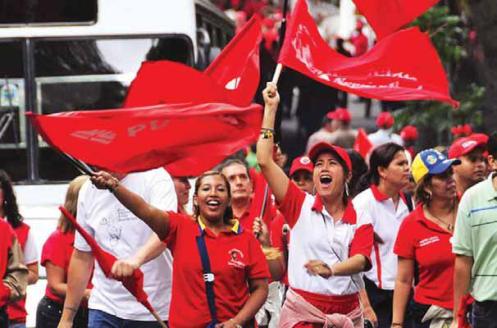
It looks like Venezuela is not just another banana-oil republic after all. Many here feared that with the April 11 coup attempt against President Hugo Chavez, Venezuela was being degraded to being just another country that is forced to bend to the powerful will of the United States. The successful counter-coup of April 14, though, which reinstated Chavez, proved that Venezuela is a tougher cookie than the coup planners thought.

Pablo Rodriguez of the daily newspaper Pagina 12 of Buenos Aires, Argentina, reporting from Caracas, Venezuela.

At 5:23 a.m. the English language email newsletter of Vheadline.com reports from Caracas:

With a South American tropical dawn just hours away, Venezuela has announced a new Military High Command for the transition to a new Presidency of the Republic… at 4:30 a.m. VET they were named as Army C-i-C General Efrain Vasquez Velasco, General Ramirez Poveda, General Alfonso Martinez and General Jesus Pereira.”

A subsequent update from Vheadline editor Roy Carson informs that the same business magnate who led the coup has now been installed as unelected “president” of Venezuela:

Federation of Chambers of Commerce & Industry (Fedecamaras) president Pedro Carmona Estanga has been appointed the interim President of Venezuela.”

resident Hugo Chavez, elected in 1998 and 2000 by landslide margins, was placed under arrest and his held in a military prison. He is 47, the same age as Simón Bolívar was at the end of his road. From a democratically elected government to an unelected military junta and its imposed “president”. These are your U.S. tax dollars at work. Yesterday was a bloody day in Venezuela. After a march by 50,000 people that resulted in between 10 and 30 deaths and 95 wounded, the military commanders asked President Hugo Chavez to resign, marking the end of the “Bolivarian Revolution.”

“The Armed Forces are not for attacking the people. I order all my commanders, who are my strength and the nation to comply with their duty. This is not a Coup D’Etat. It is not insubordination. It is an act of solidarity with the Venezuelan people. Chavez, I was faithful to you until the end. I served you until this afternoon. But the deaths of today cannot be tolerated. I am obligated to make this decision. Generals, comply with your duty. This is an accompaniment to all the Venezuelan people after an excess.” While the general comandante of the Army, General Efraín Vásquez, said these words, officials of the Armed Forces and National Guard appeared at dawn on the screen of Radio Caracas Television asking the forces loyal to Chavez not to resist them.

The Interior Minister, Rafael Vargas, said from the presidential palace of Miraflores, where a group of tanks had been placed in a defensive position, that “Chavez is still and always will be in the presidential palace. The conspiracy has failed.”

A Coup d’etat, one more for Latin America, was in march and marks the end of the “Bolivarian Revolution” and of its leader, Lieutenant Colonel Hugo Chavez Frias. And later came a day which reminded of the Caracazo of 1989 that left nearly 1,000 deaths (according to extra-official sources): the anti-Chavez demonstration convened by businessmen and union leaders and its subsequent repression left between 10 and 30 dead and 90 wounded.

According to the versions of Chavez supporters, at around 9 p.m. there were still 15,000 to 20,000 people around the Miraflores Palace, the majority of them poor. An hour later, the magnitude of the matter was clear. Congressman Jorge Barreto, of the pro-Chavez Fifth Republic movement, was making declarations on the only TV channel that stayed on the air: Channel 8, the State TV station, that during the entire afternoon had broadcast from the palace. Suddenly, the image disappeared from the airwaves, and it was known that a group from the Army had ordered the total evacuation of the studios. At this hour, various commanders of the National Guard (the fourth branch of the military) resigned their posts and pleaded publicly with Chavez, through private channels, to resign to avoid a “bloodbath.”

A Violent Day

atin America well knows what began to happen last night. And Venezuela, in particular, knows what happened in the afternoon: The Caracazo, that revolt that ended in 1,000 deaths (unofficial sources), happened almost 13 years ago, and Vasquez’s words alluded to that. Yesterday, the country, above all the capitol, lived a repetition of history. If in 1989 the poor came down from the hills and filled the streets to reject an economic adjustment package by then president Carlos Andres Perez, yesterday was a curious alliance between the business class and unions that filled the center of Caracas asking for the resignation of the principle emergent leader of Venezuela post-Caracazo, President Hugo Chavez Frias, leader of the “Bolivarian Revolution,” in the middle of a strike that had lasted three days. According to unofficial sources, there were between 10 and 30 deaths in the confrontations between demonstrators, security forces and the “Boliviarian Defense Committees” near the Miraflores Palace.

In the morning, emboldened by the notable success of the call for a strike that began in the principal business of the country, Petroleum of Venezuela (PDVSA), the president of the national Chamber of Commerce, Pedro Carmona Estanga, and the leader of the powerful Venezuela Workers Federation (CTV), Carlos Ortega, called for marches in the streets to demand the resignation of Chavez. “I ask for Chavez’s resignation and I don’t rule out that this human river will head to Miraflores,” Carmona declared before the march reached the Presidential Palace. The “human river” numbered some 50,000 persons, who came from the comfortable neighborhoods of the city, to which hundreds more joined. It was at this moment that rumors of every kind circulated: That Chavez was already under arrests in Tiuna Fortress, the principal military prison in Caracas; that a group of military officers already forced him to resign; that he had sent his defense minister, Jose Vicente Rangel, to speak with the media because he was already no longer in control.

In the afternoon, when the march headed toward Miraflores, Chavez made his show of force. First, the high military command met in front of the cameras in the Defense Ministry offices to signal that they supported the government. Minutes later, Chavez, who had disappeared mysteriously in the past three days, gave a speech to the nation, with a painting of Simon Bolivar behind him, the Venezuelan flag to his right and in his hand the Bolivarian constitution that he got approved two years go, when he was indisputably a popular leader. The Venezuelan president turned all his fury toward the media: “They are instigating a conspiracy. They want to create the impression that Venezuela is ungovernable.” With respect to (union leader) Ortega and (business leader) Carmona he said that, together with the media, “they are involved in an insurrectional plan that is risky because it is not going to succeed,” and ordered the immediate suspension of the frequencies of almost all the private television chains, citing the broadcasting laws, from the times of the Caracazo, that prohibit the transmission of violent acts. One of the TV channels had printed, over the images of the streets, the slogan “NOT ONE STEP BACK.” It was a war that the government and the media had fought for days, on the occasion of the strike in the petroleum company over the decision by Chavez to replace its board of directors.

At that point, the streets near Miraflores were in chaos. While Chavez spoke inside the palace, outside the demonstration marched closer. The president had deployed some 1,000 soldiers to guard the palace. In addition to the National Guard and the police, the “Bolivarian Committees” had placed themselves outside the palace. The demonstration could not get more than a couple blocks from Miraflores. “I call upon the people to not fall into provocations,” the president said. But the gunshots, rock throwing and tear gas began to dominate the stage.

At this moment, almost all the television media stopped broadcasting in Venezuela, and their images were only seen outside of the country. Sources close to Chavez say that a number of the deaths were among sympathizers of the president and explained that the metropolitan police had shot against the multitute that surrounded the Miraflores Palace. Among the dead, the driver for Vice President Diosdado Cabello, shot in the face.

The day before yesterday, while the general strike was continued for an undetermined length of time, a general, active and with his own gun, Nestor Gonzales, accused Chavez of being a “traitor” by permitting the FARC to operate in Venezuela. A large sector of the leadership of the National Guard criticized the government for the “partisan manner” in which it repressed the demonstrators with respect to Chavez supporters, and General Alberto Camacho resigned his post as vice minister of Citizen Security and called for “a provisional junta.” This accumulation of “desertions” was finalized at night with the declaration by General Vasquez.

Health Implications of the israeli invasion 12 April 2002

Health Implications of the Detoriorating Situation

reported by Palestine Emergency Committee

Jerusalem 1:39pm Thu Apr 11 ’02

link to jerusalem.indymedia

“We are getting reports of pure horror. In the name of human decency the Israeli military must allow our ambulances safe passage to help evacuate the wounded and deliver emergency supplies of medicines and food.” (UNRWA, April 7, 2002) incursions. Due to unprecedented restrictions on humanitarian access the exact number of the dead and injured as well as the situation of household food and water reserves and damage to essential infrastructure has been extremely difficult to assess.” (UN Office for the Coordination of Humanitarian Affairs -OCHA, April 5, 2002)

“Humanitarian crisis looming as over one million people enter day 10 of total curfew.13. Lastly, tremendous psycho-social consequences can be expected in the population, not only among those who are victims of violence but also among those who have been witnesses to house-to-house searches, arbitrary detention of family members, military assaults on neighborhoods, executions and street killings.

Objectors imprisoned in Israel

Over the last couple of days, four new objectors have been imprisoned for their refusal to serve in the Israeli army altogether or specifically in the Palestinian Occupied Territories. Three other objectors were released from prison at the end of last week. All in all, the number of objectors that we know of, currently held in Israel’s military prisons now reaches 10.

Some of the information below is taken from recent postings by Yesh-Gvul and from an article in IMC-Israel. My apologies to those who already received part of the information through one of these sources.

A Recommended Action section follows.

Courage to refuse

1. ILAN WINDHOLZ

Objector Ilan Windholz, aged 18, was sentenced on Sunday (24 Mar.) to 28 days in prison due to his objection to service in the Israeli army. In a brief statement he prepared for the occasion of his imprisonment he wrote:

“I, Ilan Windholz, hereby declare that I am unwilling to serve in any military unit, combatant or non-combatant, which fortifies our control over the Territories and/or the Palestinian people, and protects and strengthens the settlements and the occupation. I therefore request to be exempted from service in the Israeli army on grounds of conscience and ideology – an ideology opposed to the conceptions held by the Israel Defence Forces and the governments of the State of Israel since 1967. I am willing to bear the consequences of my stand, imprisonment included”.

Ilan Windholz was only transferred to Military Prison No. 4 the 26 March, after being held in detention for two days. We suppose that the reason for this is the great amount of people with whom the military prison system has to deal these days. Ilan’s prison address appears below.

2. DAVID PERLMAN

Objector David Perlman was sentenced on Sunday (24 Mar.) to 14 days in prison, which he now spends in Military Prison No. 4. Perlman is among the signatories of the Courage to Refuse declaration. He is also well-known as an activist in environmentalist groups and a member of a community theatre.

After reporting to his reserves base, Perlman was announced that he was to be stationed to perform some tasks in the Occupied Territories. At that point he notified the army that he refuses to perform this duty and sked to be re-stationed elsewhere. The army then proposed to station him in a military base near the Ma’ale Edomim settlement, Outside Israel’s 1967 borders. He was assured that there he would not be stationed for such activates that would require him to act immorally. “Other soldiers on base will do all the immoral things” he was told.

In response, Perlman claimed that: “If instead of stationing me in the Occupied Territories they would station me in a place where the Israeli Defence Forces’ activities are indeed necessary in my view, such as on the international border with other countries and in similar places, I would not have refused. However, once I made my decision of principle to avoid service in the Territories, i.e. performing acts that I consider to be immoral and unjust, and even not indirectly or remotely justifiable, I decided to stand my ground of principle and to refuse to perform any action or course of action taking part in the military occupation, one way or another”.

“I immigrated to Israel 7 years ago, out of my free will and my identification with the Jewish identity. It was also my choice to enlist in the army, despite the fact that I had the opportunity of avoiding regular military service. Today I told the officer who judged me that the same principles that led me to immigrate to Israel and to recruit to guarding this country, are also the principles that led me to taking this step of refusal”.

3. PIKI BEN-SHALOM

Major (res.) Piki Ben-Shalom of Jerusalem was sentenced to 28 days for refusing service in the Occupied Territories. He is also a signatory of the “Courage to Refuse” declaration (www.seruv.org.il). See the Recommended Action section for his prison address.

Incidentally, Piki Ben-Shalom is the highest-ranking officer so far to be imprisoned for objection since the beginning of this Intifada.

4. SHACHAR TZUR

Capt. (res.) Shahar Tzur (30) was also sentenced to 28 days in prison.  Tzur is married, a resident of Haifa and a student of architecture at the Technion. He too is a signatory of the “Courage to Refuse” declaration (www.seruv.org.il). See the Recommended Action section for his prison address.

Calls of support can be made to Tzur’s wife Hagar – ++972- (0)4-828-36-27.

5. THREE OBJECTORS RELEASED FROM PRISON

Three objectors were released last Friday (22 Mar.) from prison, after the completion of their prison terms. They are Igal Rosenberg, Sharon Shamila and Ohad Matalon (formerly announced as O.M.) Shamila and Matalon are both reservists and do not face further imprisonment at least until they are called up again next year. Igal Rosenberg, on the other hand, is a draft resister. This prison term was his second in a raw, and a third term is quite possible and even likely. We will update you on developments in his case as they happen.

First of all, please circulate this information as widely as possible, through e-mail, Internet, conventional and alternative media, personal communication, etc.

You can messages of support to the imprisoned objectors at the following addresses:

Ilan Windholz,
Military personal number 7265473
Military Prison 4
Military Postal code 02507
IDF,
Israel

David Perlman,
Military personal number 5188146
Military Prison 4
Military Postal code 02507
IDF, Israel

Piki Ben-Shalom
Military personal number 4609194
Military Prison 6
Military Postal Number 03734
IDF, Israel

Shachar Tzur,
Military personal number 5067698,
Prison no. 6,
Military Postal code 03734,
IDF,
Israel

Also, please send letters of protest on behalf of the objectors to:

Mr. Binyamin Ben-Eliezer,
Minister of Defence,
Ministry of Defence,
37 Kaplan st.,
Tel-Aviv 61909,
Israel.
e-mail: mailto:sar@mod.gov.il
Fax: ++972-3-696-27-57 / ++972-3-691-69-40 / ++972-3-691-79-15

Copies can be sent to the commanders of the prisons at:

Commander of Military Prison No. 6,
Military Prison No. 6,
Military postal number 03734,
IDF
Israel.
Fax: ++972-4-869-28-84

Commander of Military Prison No. 4,
Military Prison No. 4,
Military postal number 02507,
IDF
Israel.
Fax: ++972-3-957-52-76

Addresses of additional military and government officials, as well as those of some Israeli media, to which you can send copies of your appeals, can be found at this web addressA standard sample letter is available at the bottom of the same web page. However note that it would be advisable to adjust your letter to the particular circumstances of the case.

A critique of WHO Macroeconomics report, by D Banerji

D Banerji, New Delhi

A critique of the report of the WHO commission on Macroeconomics and Health as highlighted in INHP Bulletin 10 March 2002

The Report on of the WHO initiated Commission on Macroeconomics and Health is a very disappointing document. It is ahistorical, apolitical and atheoretical. It is biased. Its contents are so highly skewed that it glosses over some of the such crucial interdisciplinary dimensions of the disciplines of health economics as epidemiology, choice of technology, cultural anthropology, sociology, political science and political economy and organisation and management (Banerji 1994). One can not also rule out possibilities of market considerations in its advocacy for focussing on select few communiicable diseases – Malaria, Poliomyelitis, AIDS and TB – as `international public good’; such programmes involve massive expansion of markets for vaccines, cold chain equipment, diagnostic kits antiretroviral and antituberculosis drugs, Control/eradication of these communicable diseases also help international business personnel to penetrate the hitherto untapped markets to sell their goods. Use of the eighteenth century economic concept of `Public Good’ seems to have a resonance of the (in)famous exclamation made by Marie Antoinette in the same century!

A very brief mention of three of the classic landmarks in the growth of concepts of public health is being made to underline some of the major infirmities in the Report.

  1. The Alma Ata Declaration of 1978 (WHO 1978): health as a fundamental human right; people (rather than the technology driven agenda of the rich countries) are the prime movers in the growth and development of their health services; intersectoral action in health; social control over the health services that are meant to serve them; coverage of the entire population; providing services in an integrated form; use of appropriate technology; use of the relevant elements from the traditional systems of medicine; use of only essential drugs, and so on.
  2. As early as in 1975, in his seminal publication, Medical Nemesis, Ivan Illich (1975) had produced convincing evidence about some very disturbing aspects of practice of Western medicine. He pointed out that market driven practice of medicine has been instrumental in causing various kinds of serious iatrogenic consequences, mystification of medical practice and promotion of unjustified dependence of people on an increasingly powerful medical profession. He had summed up these undesirable aspects by calling it `medicalisation’ of life of people. As the situation deteriorated further in the years that followed, he coined the term `systematisations of medicine’, `corporatisation of medicine’. He calls its present more advanced stage as `conglamoratisation of medicine’ (personal communication, 2000).
  3. Even earlier, in 1946, as a counterpart of the post-war Beveridge Committee of the UK, the report of the Bhore Committee set up by the then British Indian Government (Government of India 1946) proclaimed that `inability to pay should not be allowed to come in way of seeking health services by all the citizens of the country’.

Apparently, the Commission suffered from such massive blindspots that they could not see the significance of such critical concepts of public health practice in their study of the macroeconomic aspects of health. Even within this narrow vision, which is confined to the economic concept of a public good, there have been great deal of ambivalence in defining the scope of this obviously utopian concept, both globally as well as nationally. This is manifested in their identifying global health good only to a few of the numerous communicable diseases; the enormous task of combating such problems as undernutrition and malnutrition, maternal mortality and morbdity, anaemia and pneumonia seem to have entirely escaped their attention span while they made recommendation for making health as a global public good. Also, considering the very narrow vision of the Commission, it is not unexpected that they overlooked the patently poor performance of the earlier global initiatives in health for which the rich countries have poured in billions of dollars (Banerji 1999). Also, dutifully following its very distorted thinking, The IPHN Bulletin starts by entioning,`The World Health Organization is calling for a massive investment by the rich governments of the world into the health of the world’s poor’. The figure given by the Commission is US$27 billion annually by 2007′, which is `estimated to save 8million lives per year’.

It is interesting that the `eminent’economist and a former Finance Minister of India, Man Mohan Singh has been quoted as observing, `We have an historical opportunity to combine and use resources and know how to ensure better health and economic growth in just a couple of decades. If we want security in our lifetime and the future generations, we can not afford to miss this opportunity’. Milan Kundera has observed that `Man’s struggle against oppression is a struggle between memory and forgetfulness’. Man Mohan Singh conveniently `forgets’ that as the then Union Finance Minister who initiated infamous structural adjustment programme in India in 1992, he presided over the decimation of the health services in the country by inflicting a massive 20 per cent cut in the Union Health Budget (excluding the annual inflation of over 10 per cent). Ironically, Singh’s knife fell particularly severely on the malaria programme – a cut of 40 per cent (World Bank 1992).

REFERENCES

Banerji, D (1992): A Simplistic Approach to Health Policy Analysis: World
Bank Team on the Indian Health Sector, International Journal of Health
Services, vol.24; pp.151-159.
Banerji, D (1999): A Fundamental Shift to Approach to International Health by WHO, UNICEF and the World Bank:Instances of Practice of Intellectual Fascism and Totalitarianism in Some Asian Countries, International Journal of Health Services, vol.29, pp.227-225.
Government of India, Health Survey and Development Committee (1946). Reoprt Delhi, Publications Division.
Illich,I (1975) Medical Nemesis, London, Penguin.
World Bank (1992) India:Health sector Financing, Washington D C,
World Health Organization and UNICEF (1978): Primary Health Care: Report of the International Conference on Primary Health Care, Alma Ata, USSR, Geneva, WHO

site’s moderator note:follow the ongoing debate in BMJ

Coalition Soldiers in Afghanistan are Endangering Aid Workers

by Michelle Kelly (a nurse who has worked recently in Kandahar) and Morten Rostrup (international president of Médecins Sans Frontières (MSF)/Doctors Without Borders) office@london.msf.org

Published on Thursday, January 31, 2002 in the Guardian of London

We were driving into Kandahar town after a medical assessment in Daman, a neighboring village where there were numerous cluster bombs scattered in the fields, many of which were undetonated. Through the dust we spotted a big Ford pick-up with a westerner sitting in the back. He was wearing a T-shirt, and when we got closer we could see his machine gun, partly concealed. He was one of the soldiers of the international coalition force, based near the airport in Kandahar.

International military personnel must wear something that allows them to be recognized in order to separate themselves properly from international aid workers. Coalition forces who wear civilian clothes misrepresent their role. This practice jeopardizes the safety of humanitarian workers and endangers the humanitarian work, which is urgently needed and anticipated by the Afghan people. 

Read the full article at Common Dreams News Center

I Forum Internacional em Defesa da Saude (english / spanish / portuguese)

TO ALL PARTICIPANTS OF THE 2nd WORLD SOCIAL FORUM

Conclusions of the 1st International forum for the Defense of the Health of People

HEALTH AS AN ESSENTIAL HUMAN NEED, A RIGHT OF CITIZENSHIP AND
A PUBLIC GOOD

HEALTH FOR ALL IS POSSIBLE AND NECESSARY …

Organizers:
Latin American Association of Social Medicine � ALAMES

Brazilian Center for Studies on Health – CEBES
Porto Alegre City Government � PMPA / Municipal Health Secretary � SMS
Rio Grande do Sul State Government / State Health Secretary

The participants of the 1st International Forum for the Defense of the Health of People, accomplished in Porto Alegre � Brazil, on January 29th and 30th, call on all the people of the world, all women and men who feel responsibilities, challenges and the imperative to build fair and equitative societies as theirs… to gather around these words to make them publicized and transformed on sustained actions…

We understand that this 2nd World Social Forum starts a new step on the fight for the universalization of social rights, and particularly the right to health, as an expression of the right of life, since in our understanding health is the expression of conditions and quality of life, not only the occasional access to health services.

We want to denounce to the world the devastating effects of the macroeconomic adjustment policies and the militarization of international relationships over the possibility and quality of people´s life, as well as to affirm that these effects are not neoliberal economic policies exceptional accidents, but the real essence of a logic that aims the maximization of profits, the destruction of States´s social welfare measures and the very identity of the national states, dividing the world through a huge social apartheid where regions, countries and continents are relegated to the condition of spectators of the immense accumulation of international capital. It results in a very unmerciful side of the so called economic or capital globalization: the deep inequity established as a perpetuating logic for the social injustice, making every day richer the riches and desperately poorer the poor people, making weak the infants´s and seniors´s lives and giving to poverty a feminine profile. As a result of these inequities, the poor of the world look at the rich countries as from the other side of the shopping malls windows, searching for the paradise, which is denied to them by the same world economic order renown as a socially segregating and ecologically unsustainable model, by means of economic migrations.

We understand that the Argentinean tragedy is the direct consequence of the sustained and faithful application of neoliberal principles, which ignore interests and needs of the citizens, a awaited and lots of times denounced product of a logic that cares for capital�s health but not for the people’s health.

We would like to alert all of you that the world-widening of the capital is not an abstraction, since it defines life quality possibilities, as well as it is not made by abstract beings like the World Bank and IMF, since these organisms reflect all the directives of the big capitalistic conglomerates that dominate the world nowadays, supported by their political managing of governments of many rich and poor countries, which dominant classes are committed to the health of their and other one’s capital instead of to the health and welfare of their own people. So, we affirm that the fight place against the bad dominant world order finds its expression in every town, region and continent by means of a possible and necessary fight that call on every woman and man to defend their dignity and the dignity of future generations towards a fair, equitative and solidarian world.

We understand that we are frequently trapped within a social fascism where those options, which are offered to us, are so bad and poor that all we have is resistance fights only, for fear that the future may be even worse. Laws are often disrespected and violated by their own formal guardians, generating rights�s vulgarization and the loss of meaning of formal freedoms. Only politicization of the debate and its essencialization can give us political power and creativity to create another world with the defense of social rights and the unvulgarization of life.

Health as a complete expression of economical and social determinations about health conditions is a fight field for the full respect of social, economical and cultural people’s rights. For us, health is an essential human right, a primary right of citizenship and a public good. It also is a duty of the State, which is desired to be the undertaker of public interest, defending those interests in the market arena, avoiding the purchasing of health. So, we defend the State come back to its citizen and life’s defense functions through the assurance of dignity on politics as a public and democratic place. We revindicate that all states defend social welfare and health systems where universalization, integrality and equity are the founding characteristics inserted and respected within their constitutional and legal texts, as well as in the organization and financing of health systems and services.

We demand from politics and economy to have their ethical principles to defend human beings dignity recovered and to pronounce the world widening of solidarity and life defense with all economical effort directed towards people�s needs satisfaction, which includes the right to life in the first place.

It is a scandal that economical adjustments and efficiency searches for the health sector never demand prices and pharmaceutical costs control, since medicines industry are directly linked to the wild accumulation in health sector, imposing exorbitant prices within the Third World and blocking those initiatives for development of national pharmaceutical industries. We demand exclusive patent rights are broken, giving rise to a wider perspective of social and economical development for medication and health equipment.

We want to manifest our extreme suspicion about all speeches of international financing agencies, governments and political parties from rich and poor countries that speak about poverty and the need to fight it without mentioning the need to change economical development model which is generating unemployment, destruction of social rights warranties and making the inequity abyss deeper.

We challenge these organisms, governments and corporations to accept a public and democratic debate of a development with a human face.

By no means we deny the need for reforming health systems and states so that they can be closer to the integral and equitative human development ideals. What we do not accept is the imposition of one only logic focused on the interests of international capital market.

In a moment of a great scientific development of humanity, the themes of ethics and equity are even more important to defend health as a public good. Specifically in relation to the human genome charting, it sounds essential to assure the right of humankind, since genetical inheritance is inherited by every human being, avoiding a purchasing that would increase inequities and would have devastating effects over people�s access to science progress.

Facing all these elements, we propose:

  • a strong and steady manifestation against neoliberal logic and its consequences over the right to life;
  • solidarity to the Argentinean people and to all countries where neoliberalism destroys social rights and the specific worry with the increasing war and its internationalization in Colombia;
  • a strong resistance against integration to Americas Free Commerce Zone � ALCA, understood as an additional attack against our economies and our sovereignty;
  • a search for the essence and politicization of the debate, with the collective building of a Political Agenda for Defense of Health as a Right, defining health as an Essential Human Need, as Public and Citizenship Policy, as a Public Good and Duty of the State. By Public Policy Agenda we mean the democratic and participative process of building of what our societies, in each town, region and continent, want and need, having in mind the concrete accomplishment of agreements that warrant under participation human dignity and an ethics beyond immediate financial interests. There is an urge for a world public debate about a development model towards equity. As part of this effort, we propose the agreement to the elaboration of an alternative report on equity on life and health conditions;
  • the reivindication for People�s Representation Councils beside organisms like MERCOSUL and the World and Pan-American Health Organizations, aiming to express directly our needs, without the frequently irresponsible mediation of our governments;
  • the inclusion in each country�s judicial legislation about the right to health, under universality, integrality and equity, with the assignation of enough resources to answer to social needs on life and health quality, mobilizing national and international capital to fight against those programs that focus on poverty without warranting universal rights, proposing universality with equity as a superior way of social justice;
  • for the same reason, we condemn and repel Colombia�s health care model, known as structured pluralism, which usage has been taking to increasing exclusion and inequities, and we affirm that no country should adopt such a model, which is contrary to the interests of people�s health;
  • we also alert against and condemn the attempts of Paraguayan government to reform, without any social participation, the Law n. 1032 and the Sanitary Code, besides trying to make private the Social Welfare Institute (IPS), making even weaker all the warranties of social rights in the country, applying the questioned principles of the Colombian system;
  • we support the attempts of constitutional reform in Uruguay to warrant the right to health of all Uruguayans and not only the indigent ones, like it is presently established by law;
  • we affirm the defense and warranty of the right to health in Brazil through the warranty of enough resources and the accomplishing of universality, equity and integrality as principles not warranted to all population by the Brazilian State yet;
  • we condemn all and every form of violation of the rights to health by public or private institutions, with special emphasis on the control of violations caused by the states and governments themselves, searching for the constitution of an International Observatory to observe and control these violations and to show them to the International Justice Court;
  • we reivindicate from governments to adopt one figure public goals for all health and quality of life indicators, reducing inequities related to not answered needs, reducing maternal and infants mortality rates, unemployment, lack of proper housing, etc to one figure only, in the same way it is done for economical or capital�s health goals…

We call on you to make a formal and fraternal international call to all workers, organizations and inhabitants so that in those countries where there are multinational pharmaceutical industries with subsidiaries in Argentina or not, to break all privilege or right to patents or property over medicines which are asked and needed to allow the survival of Argentinean population: medication is a public good, as Brazil and South Africa have shown and done in relation to drugs against AIDS;

We reivindicate that Health as a Right of Humanity to be one of the central themes on the 3rd World Social Forum in 2003;

That Health of the People be one of the central themes on the Rio + 10 Forum, which will happen in Africa in 2002;

That we formally protest against the violation of union manifestation rights in Uruguay and against civil rights violations of Paraguayan citizens who are members of the Patria Libre Movement and were victims of arbitrary imprisonment and persecuted by the police on behalf of the Paraguayan Government;

We call for a wide process of mobilization towards the accomplishing of the 2nd International Forum for the Defense of the Right to Health of People in Porto Alegre on January of 2003, before the 3rd World Social Forum;

And a wide and transectoral calling on the 1st World Health Forum, to be performed in the first semester of 2004 in Porto Alegre also;

That all individuals and governmental or non governmental organizations who and which agree with the principles and guidelines proposed on this document gather to the invitation for our meetings in 2003 and 2004, as well as in the proposed initiatives;

That we organize a continental protest against the transformation of health in a purchased good, with all workers from public services who work under the contribution regimens, stopping all the charging of their care for one day, while those where there is no charge that work wearing some sign to show to patients the aim of the demonstration for the right to health.

We propose and we invite you to act on our places of life as citizens of the world, fighting for a society oriented towards social justice and equity, where respect for human dignity goes beyond the wild accumulation of capital. We call on you to reflect about and to act, moved by hope and indignation.

Porto Alegre, January 30th, 2002.

For contacts and manifestation, please write to alames@movinet.com.uy or armandon@portoweb.com.br or joser@sms.prefpoa.com.br

***

La Salud como Necesidad Humana Esencial, Derecho de Ciudadanía y Bien Público

Una Salud para todos es posible y necesaria…

Organizadores:
Associação Latino Americana de Medicina Social -ALAMES
Centro Brasileiro de Estudos em Saúde � CEBES
Prefeitura de Porto Alegre �PMPA / Secretaria Municipal de Saúde de Porto Alegre � SMS
Governo do Estado do Rio Grande do Sul / Secretaria Estadual da Saúde

L@s participantes del I Fórum Internacional por la Defensa de la Salud de los Pueblos, realizado en Porto Alegre � Brasil, del 29 al 30 de enero de 2002, convocan a todos los pueblos del Mundo, a todas las mujeres y hombres que sienten como suyos las responsabilidades, desafíos y el imperativo de construir sociedades justas y equitativas… para que se sumen a estas palabras difundiéndolas y trasformándolas en acciones sostenidas…

Entendemos que este II Fórum Social Mundial, abre una nueva etapa en la lucha por la universalización de los derechos sociales, y particularmente por el derecho a la salud, como expresión del derecho a la vida, entendiendo salud como la expresión de las condiciones y la calidad de vida y no simplemente el acceso eventual a los servicios de salud.

Queremos denunciar al Mundo los efectos devastadores de las políticas de ajuste macroeconómico y de la militarización de las relaciones internacionales, sobre la posibilidad y la calidad de vida de los pueblos, y afirmar que estos efectos no son accidentes excepcionales de las políticas económicas neoliberales, sino que son la esencia misma de una lógica que objetiva la maximización del lucro, la destrucción de la capacidad de seguridad social de los Estados y la misma identidad de los estados nacionales, dividiendo el mundo a través de un inmenso apartheid social, donde regiones, países y continentes son relegados a la condición de espectadores de la monstruosa acumulación de capitales internacionales. De esto resulta la faz más despiadada de la llamada globalización económica o mundialización del capital: la profunda inequidad que se establece como una lógica perpetuadora de la injusticia social, tornando a los ricos cada día más ricos y a los pobres desesperadamente más pobres. Con la fragilización de la vida infantil y de la vejez y la feminización de la pobreza. Como fruto de estas inequidades, los pobres del mundo miran a los países ricos como del otro lado de las vidrieras del shopping mundial, buscando en desesperadas migraciones económicas el paraíso que el mismo orden económico mundial les niega, y que ya sabemos es un modelo de desarrollo socialmente segregador y ecologicamente insostenible.

Así es que entendemos que la tragedia Argentina es la consecuencia directa de la aplicación sostenida y fiel de los principios neoliberales, ignorando los intereses y necesidades de los ciudadanos, producto esperado y muchas veces denunciado de una lógica que cuida de la salud del capital y no de la salud de los pueblos.

Asimismo queremos alertarles que la mundialización del capital no es una abstracción, pues define la posibilidad de la calidad de vida, la salud y por ende la posibilidad de la vida humana, y además no es hecha por entes abstractos como el Banco Mundial y el FMI, pues estos organismos reflejan las directivas de los grandes conglomerados capitalistas que hoy dominan el mundo, apoyados en el manejo político de gobiernos de muchos países ricos y pobres, cuyas clases dirigentes están comprometidas con la salud del capital, suyo y ajeno, más que con la salud y bienestar de sus própios pueblos. Así es que afirmamos que el espacio de lucha contra el perverso orden mundial dominante encuentra su expresión en cada ciudad, región y continente, a través de una lucha posible y necesaria que convoque cada mujer y cada hombre a defender su dignidad y la dignidad de las generaciones futuras hacia un mundo justo, equitativo y solidario.

Entendemos que estamos frecuentemente atrapados en un fascismo social donde las opciones que nos ofrecen son tan malas y pobres que nos resta solamente luchas de resistencia, por temor de que el futuro pueda ser aún peor. Las leyes son frecuentemente no respetadas y violadas por sus propios guardianes formales, generando la banalización de los derechos y el vaciamiento del sentido de las libertades formales. Solamente la politización del debate y su esencialización pueda darnos potencia política y creatividad para crear otro mundo con la defensa de los derechos sociales y la desbanalización de la vida.
La salud como expresión compleja de las determinaciones económicas y sociales sobre las condiciones de vida, es un campo de lucha por el pleno respeto a los derechos sociales, económicos y culturales de los pueblos. Para nosotros y nosotras, salud es un derecho humano esencial, derecho fundamental de ciudadanía y un bien público. Y también es un deber del Estado, al cual lo deseamos como garantizador del interés público, defendiendo esos intereses en la arena del mercado, evitando la mercantilización de la salud. Así es que defendemos el rescate del Estado para sus funciones de defensa del ciudadano y de la vida, a través de la afirmación de la dignidad de la política como espacio público y democrático. Así es que reivindicamos que los estados defendan sistemas de seguridad social y salud, donde la universalidad, la integralidad y la equidad sean sus características fundantes, plasmadas y respetadas en los textos constitucionales y legales y en la organización y financiamiento de los sistemas y servicios de salud.
Exigimos de la política y de la economía su recuperación hacia principios éticos que defiendan la dignidad del hombre y proclamen la mundialización de la solidaridad y de la defensa de la vida. Con todo el esfuerzo económico dirigido a la satisfacción de las necesidades de la gente, lo que incluye primeramente el derecho a la vida.

Nos escandaliza que los ajustes y búsquedas de eficiencia económica para el sector salud nunca exijan el control de los precios y costos farmacéuticos, puesto que las industrias de fármacos están directamente vinculadas a la acumulación salvaje en el sector salud, imponiendo precios exorbitantes en el Tercer Mundo y bloqueando las iniciativas de desarrollo de industrias farmacéuticas nacionales. Exigimos así que se rompan los derechos exclusivos de patentes, generando una perspectiva ampliada de acceso social y económico a los medicamentos y equipamentos de salud.

Queremos manifestar nuestra extrema desconfianza hacia los discursos de las agencias financieras internacionales, gobiernos y partidos de países ricos y pobres, que hablan de la pobreza y de la necesidad de combatirla, pero sin hablar de la necesidad de cambiar el modelo de desarrollo económico que está generando desempleo, destrucción de las garantías de los derechos sociales y profundizando el abismo de las inequidades.

A estos organismos, gobiernos y corporaciones los desafiamos al debate público y democrático de un desarrollo con cara humana.

De ninguna manera negamos la necesidad de reforma en los sistemas de salud y en los estados para que se acerquen a los ideales de desarrollo humano integrales y equitativos, lo que no aceptamos es la imposición de una lógica única centrada en los intereses de mercado del capital internacional.

En un momento de gran desarrollo científico de la humanidad, se torna aún más importante el tema de la ética y de la equidad, con la defensa de la salud como un bien público, en particular en el tema del mapeo del genoma humano, nos parece esencial afirmar el derecho de la humanidad, puesto que el patrimonio genético es patrimonio de cada ser humano, evitando una mercantilización que aumentaría las inequidades y tendría efectos devastadores sobre el acceso de los pueblos del mundo a los avances de la ciencia.

Frente a todos estos elementos, proponemos:

  • la manifestación fuerte y firme en contra de la lógica neoliberal y sus consecuencias sobre el derecho a la vida;
  • la solidaridad con el pueblo de Argentina y de todos los países donde el neoliberalismo hace ruinas de los derechos sociales y la particular preocupación con la escalada guerrerista y la internacionalización de la guerra en Colombia;
  • rechazo a la integración a la Zona de Libre Comercio de las Américas � ALCA, entendida como un ataque más contra nuestras economías y nuestra soberanía;
  • la esencialización y politización del debate, con la construcción colectiva de una Agenda Política en Defensa de la Salud como Derecho, definida Salud como Necesidad Humana Esencial, Derecho Social y de Ciudadanía, Bien Público y Deber del Estado. Entendiendo como Agenda Política Pública al proceso de construcción democrática y participativa acerca de lo que quieren y necesitan nuestras sociedades, en cada ciudad, región, país y continente, pensando la materialización de acuerdos que garanticen participativamente la dignidad humana y la ética más allá de los intereses financieros inmediatos. Urge el debate público mundial acerca de un modelo de desarrollo hacia la equidad. Como parte de este esfuerzo proponemos la adhesión a la elaboración de un informe alterno de la equidad de las condiciones de vida y salud;
  • la reivindicación de la formación de Consejos de Representación de los Pueblos junto a los organismos como el MERCOSUR y las Organizaciones Mundial y Panamericana de la Salud, con el objetivo de expresar directamente nuestras necesidades, sin la mediación frecuentemente irresponsable de nuestros gobiernos;
  • la inclusión en los aparatos jurídicos de cada País del pleno derecho a la salud, con universalidad, integralidad y equidad, con asignación de recursos suficientes para responder a las necesidades sociales en calidad de vida y salud, movilizando capitales nacionales e internacionales. Combatiendo los programas de focalización a la pobreza sin la garantía de derechos universales, proponiendo universalidad con equidad, como forma superior de justicia social;
  • por esta misma razón condenamos y rechazamos el modelo de atención a la salud en Colombia, conocido como pluralismo estructurado, cuya aplicación ha conducido a la exclusión e inequidades crecientes, afirmamos que ningún País debe adoptar tal modelo, contrario a los intereses de la salud de los pueblos;
  • así mismo alertamos y condenamos los intentos del Gobierno Paraguayo para reformar, sin participación social, la Ley 1032 y el Código Sanitário, además de intentar privatizar el Instituto d Previsión Social � IPS, haciendo aún más frágil el aparato de garantías de derechos sociales en el País, aplicando los principios del perverso sistema colombiano;
  • apoyamos los intentos de reforma constitucional en Uruguay para garantizar el derecho a la salud de todos los uruguayos y no solamente a los �indigentes�, como hoy establece la Ley;
  • afirmamos además la defensa y garantía del derecho a la Salud en Brasil, a través de la garantía de recursos suficientes y la concreción de la universalidad, equidad e integralidad, como principios que el Estado Brasileiro aún no garantiza para toda su población;
  • la sanción de toda y cualquier violación de los derechos a la salud por parte de entes públicos o privados, con particular énfasis en el control de las violaciones provocadas por los propios estados y gobiernos, buscando la constitución de un Observatorio Internacional que monitoree estas violaciones y las presente frente a la Corte Internacional de Justicia;
  • exigir a los gobiernos y a las agencias multilaterales para que adopten metas públicas de un dígito para todos los indicadores de calidad de vida y salud, reduciendo las inequidades cuanto a las necesidades no satisfechas, reduciendo la mortalidad materna, infantil, el desempleo, la falta de viviendas adecuadas….a un dígito, tal cual lo hacen con las metas económicas o de salud del capital…

Les convocamos a hacer un formal y fraterno llamado internacional a todos los trabajadores, organizaciones y habitantes para que en aquellos países donde existan empresas multinacionales farmacológicas con subsidiarias en Argentina o no, para que rompan con todo privilegio o derecho de patente o propiedad sobre las drogas que se soliciten y permitan la subsistencia de la población argentina: el medicamento es un bien social, como Brasil y Sudáfrica lo han demostrado y hecho con las drogas contra el SIDA;

Reivindicamos que la Salud como Derecho de la Humanidad sea uno de los temas centrales del III Fórum Social Mundial, en 2003;

Que la Salud de Los Pueblos sea uno de los temas centrales del Fórum Rio + 10 que se celebrará en África, en 2002;

Que se proteste formalmente contra la violación de los derechos de manifestación sindical en Uruguay y contra las violaciones de los derechos civiles de ciudadanos paraguayos miembros del Movimiento Patria Libre, los cuales fueran víctimas de prisión arbitraria y persecución policial por parte del Gobierno Paraguayo;

Que se realice un amplio proceso de movilización hacia la realización del II Fórum Internacional en Defensa del Derecho a la Salud de los Pueblos, en Porto Alegre, en enero de 2003, antecediendo el III Fórum Social Mundial;

Que se produzca una convocatoria ampliada y transectorial hacia el I Fórum Mundial de la Salud, a realizarse en el primer semestre de 2004, también en Porto Alegre;

Que todos aquellos individuos y organizaciones gubernamentales o no, que esten de acuerdo a los principios y líneas de acción propuestos en este documento, se asocien en la convocatoria de nuestros eventos en 2003 y 2004, así como en las iniciativas aquí propuestas;

Que se organice una protesta continental en contra de la mercantilización de la salud, con los trabajadores de los servicios públicos que trabajen con regímenes de contribución suspendiendo la facturación de las atenciones por un día y aquellos donde no hay facturación diferenciada, trabajando con brazaletes o chapas y aclarando a los pacientes el objeto de la lucha por el derecho a la salud;

Nos proponemos y los invitamos, para actuar en nuestros espacios de vida como ciudadanos y ciudadanas del mundo, luchando por una sociedad orientada hacia la justicia social y la equidad, donde el respeto a la dignidad humana se posicione más allá de la acumulación salvaje del capital. Les convocamos a la reflexión y a la acción, movidos por la esperanza y la indignación.

Porto Alegre, 30 de enero de 2002

Para contactos y manifestaciones:
alames@movinet.com.uy o armandon@portoweb.com.br o joser@sms.prefpoa.com.br

A TOD@S @S PARTICIPANTES DO II FÓRUM SOCIAL MUNDIAL

CONCLUSÕES DO I FÓRUM INTERNACIONAL EM
DEFESA DA SAÚDE DOS POVOS
A Saúde como Necessidade Humana Essencial, Direito de Cidadania e Bem Público

Uma Saúde para todos é possível e necessária…

Organizadores:
Associação Latino Americana de Medicina Social-ALAMES
Centro Brasileiro de Estudos em Saúde � CEBES
Prefeitura de Porto Alegre �PMPA / Secretaria Municipal de Saúde de Porto Alegre � SMS
Governo do Estado do Rio Grande do Sul / Secretaria Estadual da Saúde

@s participantes do I Fórum Internacional em Defesa da Saúde dos Povos, realizado em Porto Alegre � Brasil, de 29 a 30 de janeiro de 2002, convocam a todos os povos do Mundo, a todas as mulheres e homens que sentem como suas as responsabilidades, desafios e o imperativo de construir sociedades justas e equitativas… para que se somem a estas palavras difundindo-as e transformando-as em ações sustentadas…

Entendemos que este II Fórum Social Mundial, abre uma nova etapa na luta pela universalização dos direitos sociais, e particularmente pelo direito à saúde, como expressão do direito à vida, entendendo saúde como a expressão das condições e da qualidade de vida e não simplesmente como o acesso eventual aos serviços de saúde.

Queremos denunciar ao Mundo os efeitos devastadores das políticas de ajuste macroeconômico e da militarização das relações internacionais, sobre a possibilidade e a qualidade de vida dos povos, e afirmar que estes efeitos não são acidentes excepcionais das políticas econômicas neoliberais, mas sim a própria essência de uma lógica que objetiva a maximização do lucro, a destruição da capacidade de seguridade social dos Estados e da própria identidade dos estados nacionais, dividindo o mundo através de um imenso apartheid social, onde regiões, países e continentes são relegados à condição de espectadores da monstruosa acumulação de capitais internacionais. Disto resulta a face mais impiedosa da chamada globalização econômica ou mundialização do capital: a profunda iniquidade que se estabelece como una lógica perpetuadora da injustiça social, tornando os ricos cada dia mais ricos e os pobres desesperadamente mais pobres. Com a fragilização da vida infantil e da terceira idade e a feminilização da pobreza. Como fruto destas iniquidades, os pobres do mundo assistem aos países ricos como se estivessem do outro lado das vitrines do shopping mundial, buscando através de desesperadas migrações econômicas, o �paraíso� que a mesma ordem econômica mundial lhes nega, e que já sabemos ser um modelo de desenvolvimento socialmente segregador e ecologicamente insustentável.

Por isso é que entendemos que a tragédia Argentina é a conseqüência direta da aplicação sustentada e fiel dos princípios neoliberais, ignorando os interesses e as necessidades dos cidadãos, sendo o produto esperado e muitas vezes denunciado de uma lógica que cuida da saúde do capital e ignora a saúde dos povos.

Da mesma maneira queremos alertá-los que a mundialização do capital não é uma abstração, pois define a possibilidade da qualidade de vida, a saúde e por ende da possibilidade da vida humana, e além disso não é feita por entes abstratos como o Banco Mundial e o FMI, pois estes organismos refletem as diretivas dos grandes conglomerados capitalistas que hoje dominam o mundo, apoiados no manejo político de governos de muitos países ricos e pobres, cujas classes dirigentes estão comprometidas com a saúde do seu capital e dos outros, mais que com a saúde e em estar dos seus próprios povos. Assim é que afirmamos que o espaço de luta contra a perversa ordem mundial dominante, encontra sua expressão em cada cidade, região e continente, através de uma luta possível e necessária que convoca cada mulher e cada homem a defender sua dignidade e a dignidade das gerações futuras em direção um mundo justo, equitativo e solidário.

Entendemos que estamos freqüentemente presos em uma situação de fascismo social onde as opções que nos oferecem são tão ruins e pobres, que nos fazem crer que somente nos restam as lutas de resistência, por temor de que o futuro possa ser ainda pior. As leis são freqüentemente desrespeitadas e violadas por seus próprios guardiães formais, gerando a banalização dos direitos e o esvaziamento do sentido das liberdades formais. Somente a politização do debate e sua essencialização podem nos dar potência política e criatividade para criar outro mundo com a defesa dos direitos sociais e a desbanalização da vida.

A saúde como expressão complexa das determinações econômicas e sociais sobre as condições de vida, é um campo de luta pelo pleno respeito aos direitos sociais, econômicos e culturais dos povos. Para nós, saúde é um direito humano essencial, direito fundamental de cidadania e um bem público. E também é um dever do Estado, ao qual desejamos como defensor do interesse público, defendendo estes interesses na arena do mercado, evitando a mercantilização da saúde. Por isso é que defendemos o resgate do Estado para suas funções de defesa do cidadão e da vida, através da afirmação da dignidade da política como espaço público e democrático. Portanto reivindicamos que os estados defendam sistemas de seguridade social e saúde, onde a universalidade, a integralidade e a equidade sejam suas características fundantes, plasmadas e respeitadas nos textos constitucionais e legais e na organização e financiamento dos sistemas e serviços de saúde.

Exigimos da política e da economia sua recuperação seguindo princípios éticos que defendam a dignidade do homem e proclamem a mundialização da solidariedade e da defesa da vida. Com todo o esforço econômico dirigido à satisfação das necessidades das pessoas, o que inclui primeiramente o direito à vida.

Nos escandaliza que os ajustes e esforços de eficiência econômica para o setor saúde nunca exijam o controle dos preços e custos farmacêuticos, posto que as industrias farmacêuticas estão diretamente vinculadas à acumulação selvagem no setor saúde, impondo preços exorbitantes ao Terceiro Mundo e bloqueando as iniciativas de desenvolvimento de industrias farmacêuticas nacionais. Exigimos portanto que se rompam os direitos exclusivos de patentes, gerando uma perspectiva ampliada de acesso social e econômico aos medicamentos e equipamentos de saúde.

Queremos manifestar nossa extrema desconfiança em relação aos discursos das agencias financeiras internacionais, governos e partidos de países ricos e pobres, que falam da pobreza e da necessidade de combatê-la, porém sem falar da necessidade de mudar o modelo de desenvolvimento econômico que está gerando desemprego, destruição das garantias dos direitos sociais e aprofundando o abismo das iniquidades.

A estes organismos, governos e corporações os desafiamos ao debate público e democrático sobre um desenvolvimento com face humana.

De nenhuma maneira negamos a necessidade de reforma nos sistemas de saúde e nos estados para que se aproximem aos ideais de desenvolvimento humano integrais e equitativos, o que não aceitamos é a imposição de uma lógica única centrada nos interesses de mercado do capital internacional.

Em um momento de grande desenvolvimento científico da humanidade, se torna ainda mais importante o tema da ética e da equidade, com a defesa da saúde como um bem público, em particular no tema do mapeamento do genoma humano, nos parece essencial afirmar o direito da humanidade, posto que o patrimônio genético é patrimônio de cada ser humano, evitando uma mercantilização que aumentaria as iniquidades e teria efeitos devastadores sobre o acesso dos povos do mundo aos avanços da ciência.

Frente a todos esses elementos, propomos:

  • a manifestação forte e firme contra a lógica neoliberal e suas conseqüências sobre o direito à vida;
  • a solidariedade com o povo da Argentina e de todos os países onde o neoliberalismo faz ruínas dos direitos sociais e a preocupação especial com a escalada da guerra e a internacionalização da guerra na Colômbia;
  • rechaço à integração como Zona de Livre Comércio das Américas � ALCA, entendida como mais um ataque contra nossas economias e nossa soberania;
  • a essencialização e politização do debate, com a construção coletiva de uma Agenda Política em Defesa da Saúde como Direito, definida Saúde como Necessidade Humana Essencial, Direito Social e de Cidadania, Bem Público e Dever do Estado. Entendendo como Agenda Política Pública ao processo de construção democrática e participativa sobre o que querem e necessitam nossas sociedades, em cada cidade, região, país e continente, pensando a materialização de acordos que garantam participativamente a dignidade humana e a ética para além dos interesses financeiros imediatos. Urge o debate público mundial sobre um modelo de desenvolvimento com o objetivo de alcançar a equidade. Como parte deste esforço propomos a adesão à elaboração de um informe alterno da equidade das condições de vida e saúde;
  • a reivindicação da formação de Conselhos de Representação dos Povos junto aos organismos como o MERCOSUR e as Organizações Mundial e Pan Americana da Saúde, com o objetivo de expressar diretamente nossas necessidades, sem a mediação freqüentemente irresponsável de nossos governos;
  • a inclusão nos aparatos jurídicos de cada País do pleno direito à saúde, com universalidade, integralidade e equidade, com alocação de recursos suficientes para responder às necessidades sociais em qualidade de vida e saúde, mobilizando capitais nacionais e internacionais. Combatendo os programas de focalização da pobreza sem a garantia de direitos universais, propondo universalidade com equidade, como forma superior de justiça social;
  • por esta mesma razão condenamos e rechaçamos o modelo de atenção à saúde em Colômbia, conhecido como pluralismo estruturado, cuja aplicação conduziu à exclusão e iniquidades crescentes, afirmamos que nenhum País deve adotar tal modelo, contrário aos interesses da saúde dos povos;
  • do mesmo modo alertamos e condenamos as tentativas do Governo Paraguaio para reformar, sem participação social, a Lei 1032 e o Código Sanitário, além de tentar privatizar o Instituto de Previsión Social � IPS, tornando ainda mais frágil o aparato de garantias dos direitos sociais do País, aplicando os princípios do perverso sistema colombiano;
  • apoiamos as tentativas de reforma constitucional no Uruguai, visando garantir o direito à saúde de todos os uruguaios e não somente aos �indigentes�, como hoje estabelece a Lei;
  • afirmamos além disso a defesa e garantia do direito no Brasil, através da garantia de recursos suficientes e a concretização da universalidade, equidade e integralidade, como princípios que o Estado Brasileiro ainda não garante para toda sua população;
  • a sanção de toda e qualquer violação dos direitos à saúde por parte de entes públicos ou privados, com particular ênfase no controle das violações provocadas pelos próprios estados e governos, buscando a constituição de um Observatório Internacional que monitore estas violações e as apresente frente à Corte Internacional de Justiça;
  • exigir aos governos e às agencias multilaterais que adotem metas públicas de um dígito para todos os indicadores de má qualidade de vida e saúde, reduzindo as iniquidades em relação às necessidades não satisfeitas, reduzindo a mortalidade materna, infantil, o desemprego, a falta de casas adequadas….a um dígito, tal qual o fazem com as metas econômicas ou de saúde do capital…

Os convocamos todas e todos a fazer um formal e fraterno chamado internacional a todos os trabalhadores, organizações e habitantes para que naqueles países onde existam empresas multinacionais farmacológicas com subsidiarias na Argentina ou não, para que rompam com todo privilegio ou direito de patente ou propriedade sobre as drogas que se solicitem e permitam a subsistência da população argentina: o medicamento é um bem social, como Brasil e África do Sul o demonstraram e fizeram com as drogas contra a SIDA;

Reivindicamos que a Saúde como Direito da Humanidade seja um dos temas centrais do III Fórum Social Mundial, em 2003;

Que a Saúde dos Povos seja um dos temas centrais do Fórum Rio + 10 que será celebrado na África, em 2002;

Que se proteste formalmente contra a violação dos direitos de manifestação sindical no Uruguai e contra as violações dos direitos civis de cidadãos paraguaios membros do Movimento Patria Libre, os quais foram vítimas de prisão arbitrária e perseguição policial por parte do Governo Paraguaio;

Que se realize um amplo processo de mobilização para a realização do II Fórum Internacional em Defesa do Direito à Saúde dos Povos, em Porto Alegre, em janeiro de 2003, antecedendo o III Fórum Social Mundial;

Que se produza uma convocatória ampliada e transetorial para o I Fórum Mundial da Saúde, a realizar-se no primeiro semestre de 2004, também em Porto Alegre;

Que todos aqueles indivíduos e organizações governamentais ou não, que estejam de acordo com os princípios e linhas de ação propostos neste documento, se associem na convocatória de nossos eventos em 2003 e 2004, assim como nas iniciativas aqui propostas;

Que se organize um protesto continental contra a mercantilização da saúde, com os trabalhadores dos serviços públicos que trabalhem com regimes diferenciados de contribuição dos segurados suspendendo a fatura dos atendimentos durante um dia e aqueles onde não há fatura diferenciada, trabalhando com braçadeiras ou adesivos e esclarecendo aos pacientes o objeto da luta pelo direito à saúde;

Nos propomos e os convidamos, para atuarmos em nossos espaços de vida como cidadãos e cidadãs do mundo, lutando por uma sociedade orientada pela justiça social e a equidade, onde o respeito à dignidade humana se posicione acima da acumulação selvagem do capital. Convocamos a todos para a reflexão e a ação, movidos pela esperança e a indignação.

Porto Alegre, 30 de janeiro de 2002

Para contatos e manifestações:
alames@movinet.com.uy
armandon@portoweb.com.br
joser@sms.prefpoa.com.br

Drug Policy in Latin America

On January 11th, Brazilian president Fernando Cardoso signed the new anti-drug law, that will become the most advanced law of its kind in Latin America, because, among other things, it makes a clear distinction between a drug trafficker and an addict.

Read more at Brazil new law

At the same time, Bolivia, trapped between the “war on drugs” and the free market, has entered the new year convulsed by protest, repression and death. The Bolivian president-by-default Jorge Quiroga decided to make the purchase and sale of coca leaf in the vast Chapare region, the eastern slope of the Andes mountains, illegal. Farmers have protested against coca eradication, since coca leaf is part of indigenous tradition and furthermore, since the government does not offer a realistic and viable solution for cultivations alternative to coca. More than 60 farmers have been killed during the past months by the military and the police and congressman Evo Morales, a leader of the farmers, after being stripped of his Congressional immunity, has started a hunger strike.

Read more at Repression vs Coca Growers

and El Mallku Speaks: Indigenous Autonomy & Coca

Danish Overseas Aid cut by 10 percent – Recortes de 10 per ciento de l’ asistencia Danesa

WE NEED YOUR SUPPORT!

Denmark’s newly elected Liberal-Conservative Government is planning to cut back Danish Overseas Development Aid by 10 percent.

This is equal to approx. USD 200 million a year – or a reduction from 1.0 to 0.90 percent of GNP. Furthermore, it is likely that the additional funds for the follow-up of the 1992 Rio World Summit will be cut by more than half. The exact figures will be published on January 29, 2002.

As Danish NGOs, we are deeply concerned about this. Government funds channelled through Danish NGOs face cuts as large as 10 percent. This will jeopardise many planned and existing projects. We fear that the consequences of these cuts will be felt most by our partners in the South. Furthermore, we believe that the Government’s proposed cuts will send a most unfortunate political signal to the rest of the world, as these cuts come due just before the March Conference on Financing for Development in Monterrey and given that Denmark will hold the Presidency of the European Union during the 2002 World Summit in Johannesburg.

The Danish Government has signed the International Development Targets of the UN Millennium Declaration, which aims to reduce the proportion of people living in extreme poverty (less than 1 US dollar per day) by half by 2015. This target is not going to be met unless the rich countries like Denmark provide more financial resources for the poorest countries in the world.

Therefore, we urge you to visit our Campaign site and to sign our petition to the Danish Government to NOT CUT AID – as international Development assistance is needed more than ever.

Both individuals and organisations can sign by visiting kan det passe (in Danish “kan det passe” means “is it really true?”).

PLEASE copy this text and send it to friends and colleagues.

The following Danish NGOs are behind this initiative:

Active Consumers Denmark, AIDS-Fond, ATTAC-Denmark, CARE Denmark, Caritas Denmark, DanChurchAid, Danish Association for International Co-operation, Danish Human Settlement Service, Danish Hunters Association, Danish Missionary Council Development Department, Danish Refugee Council, Danish Social Democratic Youth, Danish United Nations Association, Danish Youth Council, Danish-Ugandish Friendship Asociation, Danmission, DANTAN, Development organisation Ibis, DOF-BirdLife Denmark, Eco-net, Ecocouncil, Ghana Friendship groups in Denmark, Global Up-Skill, Greenpeace, International Student Centre, Interplan, Mundo, Nature and Youth, Nepenthes, NOAH, OVE International, Project Counceling Service, Save the Children – Denmark, South Africa Contact, Swallows, The Churches Third World Information, The Danish 92 Group, The Danish Family Planning Asociation, The Danish Outdoor Council, The Danish Society for the Conservation of Nature, the International Working Group for Indigenous Affairs, The LO/FTF council, WAITRO – World Association of Industrial and Technological Research Organizations, Women and Development, Womens Council in Denmark, Womens Workers Union in Denmark, World Wide Fund for Nature-Denmark, Sømændenes Forbund, Dansk Russisk Forening – Århus, DUI-LEG og VIRKE, Danske Kvinder med Handicap,Foreningen Bæredygtigt Miljø i Nordvestsjælland, Center for Konfliktløsning, GylleInfo, UBU-Ulandsforeningen for Bæredygtig Udvikling, Internationale Socialisters Ungdom, SID Industri Vestegnen, Mellemamerika Komitéen, Kritisk Forum v./Jørgen Hinkler, Hiv-Danmark, SID Industri Horsens, Aids-info/Fyn, Agendagruppen på Islands Brygge, www.nydansker.dk, Dansk Elgforbund, U-landsforeningen Diálogos, Grønne Familier, De Samvirkende Invalideorganisationer, Danmarks Bløderforening, Militærnægterforeningen, SFU- København, Dansk Kurdisk Forening, SiD, ch1 – din lokale portal Christianshavn og Holmen, Naturfolkenes Verden, Brovst Daghøjskole, Art In Defence Of Humanism, Farmaceuter uden Grænser, Studentermenigheden i Århus – SMÅ, Geografforbundet, ADRA Danmark, Dansk Handicap Forbund, SID Nørager.

***

El nuevo gobierno de derecha electo en Dinamarca está proponiendo, en estos días, recortes del orden del 10 por ciento al programa de asistencia Danesa a proyectos de ayuda en el extranjero.

Este valor es de aproximadamente USD 200 millones anualmente – o una reducción del 1.0 al 0.9 por ciento del Producto Bruto Interno. Además es probable que los fondos especiales propuestos para el seguimiento de la Cumbre de Rio de 1992 sean reducidos a más de la mitad. Las figuras exactas serán publicadas el 29 de Enero de 2002.

Como ONGs Danesas lo planteado nos preocupa profundamente. Los fondos canalizados a través de nuestras organizaciones enfrentan recortes de hasta el 10 por ciento. Esto ha de afectar a muchos de nuestros proyectos ya planificados y en marcha. Con estas reducciones, tememos que las consecuencias vayan a ser sentidas fundamentalmente por nuestros socios en el Sur. Además, pensamos que las acciones del gobierno enviarán una señal desafortunada al resto del mundo, al realizarse estas reducciones antes de la Conferencia sobre Financiamiento para el Desarrollo en Monterrey en Marzo, y dado que Dinamarca retendrá la Presidencia de la Unión Europea durante la Cumbre Mundial en Johannesburgo en 2002.

El Gobierno Danés ha firmado los Objetivos Internacionales de Desarrollo de la Declaración del Milenio de la ONU, cuyo fin es reducir la proporción de gente que vive en extrema pobreza (menos de 1 dólar por día) para mediados de 2015. Este objetivo no podrá ser logrado a menos que los países ricos, como Dinamarca, provea más recursos financieros para los países más pobres del mundo.

Es por esto, que les pedimos que urgentemente visiten nuestro sitio común de Campaña en el Internet y que firmen nuestra petición para que el Gobierno Danés NO CORTE LA AYUDA! * ya que la asistencia para el desarrollo internacional es más necesaria que nunca.

Individuos y organizaciones pueden firmar esta petición visitando kan det passe(en Danés *kan det passe* significa *es realmente cierto?*)

POR FAVOR copiar este texto y enviarlo a colegas y amigos.

Esta iniciativa es llevada adelante por las siguientes ONGs Danesas:

Active Consumers Denmark, AIDS-Fond, ATTAC-Denmark, CARE Denmark, Caritas Denmark, DanChurchAid, Danish Association for International Co-operation, Danish Human Settlement Service, Danish Hunters Association, Danish Missionary Council Development Department, Danish Refugee Council, Danish Social Democratic Youth, Danish United Nations Association, Danish Youth Council, Danish-Ugandish Friendship Asociation, Danmission, DANTAN, Development organisation Ibis, DOF-BirdLife Denmark, Eco-net, Ecocouncil, Ghana Friendship groups in Denmark, Global Up-Skill, Greenpeace, International Student Centre, Interplan, Mundo, Nature and Youth, Nepenthes, NOAH, OVE International, Project Counceling Service, Save the Children – Denmark, South Africa Contact, Swallows, The Churches Third World Information, The Danish 92 Group, The Danish Family Planning Asociation, The Danish Outdoor Council, The Danish Society for the Conservation of Nature, the International Working Group for Indigenous Affairs, The LO/FTF council, WAITRO – World Association of Industrial and Technological Research Organizations, Women and Development, Womens Council in Denmark, Womens Workers Union in Denmark, World Wide Fund for Nature-Denmark, Sømændenes Forbund, Dansk Russisk Forening – Århus, DUI-LEG og VIRKE, Danske Kvinder med Handicap, Foreningen Bæredygtigt Miljø i Nordvestsjælland, Center for Konfliktløsning, GylleInfo, UBU-Ulandsforeningen for Bæredygtig Udvikling, Internationale Socialisters Ungdom, SID Industri Vestegnen, Mellemamerika Komitéen, Kritisk Forum v./Jørgen Hinkler, Hiv-Danmark, SID Industri Horsens, Aids-info/Fyn, Agendagruppen på Islands Brygge, www.nydansker.dk, Dansk Elgforbund, U-landsforeningen Diálogos, Grønne Familier, De Samvirkende Invalideorganisationer, Danmarks Bløderforening, Militærnægterforeningen, SFU- København, Dansk Kurdisk Forening, SiD, ch1 – din lokale portal Christianshavn og Holmen, Naturfolkenes Verden, Brovst Daghøjskole, Art In Defence Of Humanism, Farmaceuter uden Grænser, Studentermenigheden i Århus – SMÅ, Geografforbundet, ADRA Danmark, Dansk Handicap Forbund, SID Nørager.

Svenska FN-förbundet
Tove Zetterström
Handläggare inför Johannesburg 2002/
Koordinatör Alert 2002
Box 15115
104 65 Stockholm
Tel. 08- 462 25 57
Fax 08- 641 88 76
E-post: tove.zetterström@sfn.se
Hemsida: www.sfn.se

Second Annual World Social Forum, Porto Alegre

From January 31 to February 4, heads of top transnational corporations and international political leaders will meet at the WORLD ECONOMIC FORUM (WEF) in New York City.

In dedicated and informed opposition, the Second Annual World Social Forum WSF is underway from January 31 to Febrary 5, in Porto Alegre, Brazil.

Here, representatives from international human  rights to labor to student organizations will stand in solidarity against corporate-centered globalization. The WSF states:

The alternatives proposed at the World Social Forum stand in opposition to a process of capitalist globalization commanded by the large multinational corporations and by the governments and international institutions at the service of those corporations’ interests….demonstrations are being organized by multiple groups in New York City.

Dr. Barghouthi’s Arrest by Israeli Army (5th January 2002)

Dr. Barghouthi’s Arrest, and the Israeli Military’s Brutal Treatment of Dr.Barghouthi and European Delegates

Dr.Barghouthi is the president of the Union of Palestinian Medical Relief Committees (UPMRC), which won the WHO World Health Award 2001

source: PHA, updated by Pam Zimkin

5 January 2002

The arrest of Dr. Mustafa Barghouthi – a physician and human rights activist, president of the Union of Palestinian Medical Relief Committees (UPMRC), which won the WHO World Health Award 2001, and director of the Health, Development, Information and Policy institute (HDIP)­ on Wednesday the 2nd of January by plain clothed Israeli police, was condemnable.
Arrested after participating in a morning press conference in East Jerusalem, Dr. Barghouthi was held for over four hours in the notorious Israeli detention center, “Maskopia”.

Dr. Barghouthi was finally deported from East Jerusalem to the West Bank at the Ram checkpoint, between Ramallah and Jerusalem. Upon his release, and waiting for his car to arrive to take him back to Ramallah, the doctor was talking with international delegates and press, who were with him at the time of his initial arrest.

It is at this point that the most horrific events of the day occurred.

According to witnesses at least three jeeps of Israeli soldiers arrived at
the checkpoint, and attempted, without reason, to re-take Dr. Barghouthi.
The events that followed illustrate the brutality of the Israeli
occupation, and their continued disproportionate use of force and violence against civilian Palestinians, and their foreign supporters.

For ten minutes the group was subjected to pushing, punching, being thrown to the ground and dragged along in addition to the soldiers firing tear gas and throwing sound bombs. They also opened fire above the heads of the people. In this aggressive and violent assault Ms. Luisa Morgantini, in her sixties, and Ms. Ulla Sandbaek, both members of the European Parliament, were thrown to the ground and physically attacked.

This vicious, unprovoked and completely unjustified attack against Dr.Barghouthi and the group must be condemned in the harshest terms. The fact that the Doctor was released, without charges, one hour later confirms that there was no reason for his detainment. Upon his release it became clear he had been beaten and suffered a fractured knee, in addition to lacerations and bruising to his face and body.

Dr. Barghouthi has continuously worked in the Palestinian health sector, to provide health care to the more than three million Palestinians in the West Bank and Gaza Strip; he was a member of the negotiating team in Madrid, and has over the years consistently advocated a non-violent, peaceful approach to the removal of the Israeli occupation of the West bank and Gaza Strip.

We all must denounce Dr. Barghouthi’s arrest for being in East Jerusalem which is part of the Occupied Territories, and his treatment at the hands of the Israeli police and Army, and therefore government. We must also criticize, and demand an explanation for, the violence use against the
foreign delegation and other people with Dr. Barghouthi at the time of the attack.

We are beginning a campaign of formal protest to the Israeli government and as part of this we would appreciate if you could please write/email/fax or call the Israeli Embassy in your country ­ for the relevant address information please seehttp://www.embassyworld.com/embassy/israel1.htm, in addition to asking your representatives to make an official protest to he Israeli government.

Also write to the following Israeli officials, remembering a fax is great deal more effective than an email:
Shimon Peres
Email: sar@mofa.gov.il
Fax: 972 2 5303367

Binyamin Ben Eliezer, Defense Minister
Email: sgansar@mod.gov.il or sar@mod.gov.il
Fax: 972 3 6976218

Uzi Landau, Minister for Internal Security
Email: sar@mops.gov.il
Fax: 972 2 5308151

Nissim Dahan, Health Minister,
Fax: 972 2 6787662

Sent by Pam Zinkin