Novartis threatens Indian generic drug industry

Date: 30 Dec 2009

For decades, India has been known as the “pharmacy of the developing world” for its ability to supply lifesaving generic drugs at a fraction of the cost of those with brand names. People living in India and throughout the Global South rely heavily on these affordable medicines, and without them antiretrovirals, cancer drugs, and hundreds of other basic medications would be out of reach for millions.

However, this fall Novartis appealed a case to the Indian Supreme Court pushing for a more aggressive patent law that would jeopardize the country’s generic drug industry. Currently, India’s law requires real innovation to obtain a new patent. Section 3(d) of the Indian patent law prohibits ‘evergreening,’ a strategy where pharmaceutical companies make small, trivial changes to existing medicines in order to extend the period of patent control on a drug, and thereby extend their profits as well. Removing Section 3 (d) would enable multinational corporations to gain monopolies over already existing drugs and prohibit cheaper generics.

Novartis is challenging Section 3 (d) in order to obtain renewed patent protection of a leukemia drug imatinib mesylate, which it markets as Glivec. Glivec is a drug that has been available for 16 years, but Novartis is seeking a new patent for a recently developed crystalline form. This change is simply a different form of the original compound and does not increase the drug’s efficacy. Gaining patent control would force generic versions out of the market, and put this drug (priced at $2,500 per month by Novartis compared to $175 per month for an Indian generic version) out of reach for 99% of patients who need it.

Novartis argues that “intellectual property rights are an essential safety net to protect the substantial investment of time and money required to bring a drug to market.” However, granting patents for drugs that are neither new nor more effective is not a rational use of intellectual property rights. Further, as Dr. Dabade pointed out in his presentation, it has been shown that more than 40% of the industry‘s research and development (R&D) is aimed at producing minor variations of existing drugs, not at turning out new ones, and that marketing costs are double what is spent on R&D.

This case could endanger the availability of affordable drugs around the world, as the fate of thousands of similar ‘evergreened’ patent requests pending in India rest on this decision. If Novartis wins, accessibility of essential medicines for millions will be eliminated, and pharmaceutical companies will rake in billions more, adding to their already bloated profits at the expense of the world’s poor.

Take a stand against corporate greed and placing profits before people’s lives. Please join us in the fight for health for all by signing the petition against Novartis.

Find more at  PHM   www.phmovement.org

Tobacco workers are resisting against neoliberal policies in Ankara

The reflections of the General Agreement on Trade of Services or GATS augmented in our daily lives. Contract based work, performance based payment and temporary working schedules, insecurity and unemployment are some of the results of GATS.

Since more than two months tobacco workers of recently privatized Factory of Turkish Monopoly of Tobacco and Alcohol Products (TEKEL) are resisting against neoliberal policies and insecure working which were forced by the government. After the privatization of TEKEL Factories the government made a legal arrangement. This arrangement is made in order to employ the unemployed workers of privatized factories as temporary staff. The workers are no more called as workers they called as temporary staff. They can work only 4-10 months a year, they loose their social rights. They can not become a member of any union because they are neither public servants nor workers. The government forces a contemporary slavery to the TEKEL workers.

by Feride Aksu

find more & photos

El Derecho a la Salud para todos en la Unión Europea

El Derecho a la Salud para todos en la Unión Europea

Declaración de Toledo

Los ciudadanos y ciudadanas de los países miembros de la Unión Europea disfrutan de unos niveles de salud y de bienestar social entre los más altos del mundo desarrollado, resultado de la acción política de los gobiernos, de la intervención del conjunto de los agentes sociales y del desarrollo de los sistemas sanitarios públicos. La salud es un logro social, es un logro de todos/as.

Los ciudadanos y ciudadanas otorgan una gran importancia a la salud individual y colectiva, y demandan mayoritariamente que las políticas públicas continúen el esfuerzo por mantener y mejorar los niveles de salud y bienestar actuales, afrontando los retos de futuro.

Los sistemas sanitarios de los países miembros de la Unión Europea han introducido, progresivamente, reformas en la organización, funcionamiento y mejora de la calidad de sus servicios de atención a la salud. No obstante, existen diferencias y desajustes internos que exigen adoptar medidas para mejorar sus niveles de ineficiencia y reducir los desequilibrios.

Las diferentes situaciones de partida de los sistemas sanitarios de cada país miembro exigen contextualizar estas medidas para lograr a medio largo plazo la convergencia en materia de salud y bienestar.

Las autoridades públicas de los estados miembros tienen la responsabilidad de garantizar el derecho a la salud y responder a las preocupaciones expresadas por los ciudadanos y los agentes sociales.

Sería necesario definir los contenidos del Art. II – 35 del proyecto de Constitución Europea, sobre el derecho a la protección de la salud, ampliando y concretando este derecho.

La Unión Europea se fundamenta sobre los valores indivisibles y universales de la dignidad humana, la libertad, la igualdad y la solidaridad; a dichos valores deber incorporarse también el derecho a la salud como un derecho básico.

Ante esta situación consideramos que existen algunos obstáculos a tener en cuenta:
Los criterios de convergencia económica están determinando el desarrollo y sostenimiento de los actuales niveles del Estado de Bienestar. Las medidas de contención del gasto público tienen un impacto negativo sobre el gasto social. No sólo importa el nivel global del gasto público sino también su distribución

El envejecimiento de la población, las nuevas estructuras familiares, la incorporación de la mujer al trabajo, la llegada de inmigrantes, sobre todo en los países del sur de Europa exige para responder a nuevas demandas y necesidades, un incremento del gasto social incompatible con la política de contención del gasto público.

La OMC (Organización Mundial del Comercio) declaró que los servicios públicos están excluidos del AGCS (Acuerdo General sobre el Comercio de Servicios). Sin embargo la Conferencia Intergubernamental de la Unión Europea celebrada en Niza concedió a la Comisión Europea mayor autonomía en las negociaciones del comercio de servicios. Se establecieron como excepciones los sectores de salud, educación y servicios sociales, sectores que todavía requieren del acuerdo por unanimidad de los países de la Unión Europea.

Ante esta situación proponemos:

  1. Que se escuchen las demandas de los ciudadanos y agentes sociales, para lo que consideramos necesario la creación de un grupo de presión en el que estos estén representados.
  2. Dicho grupo debería elaborar propuestas para corregir los desequilibrios en los niveles de salud y de desarrollo de los servicios sanitarios de los diferentes países miembros. Consideramos posible y necesario mantener el estado del bienestar dentro de una economía de mercado.
  3. En base a estas propuestas debería definir y exigir que se establezcan criterios e instrumentos de cooperación para garantizar el derecho a la salud, fortalecer la cohesión y lograr la convergencia europea en materia de políticas públicas de bienestar social y sanitaria.

Disintegrated and integrated care, by Jean-Pierre Unger et al

The authors are arguing that the  negative impact of neoliberal health policy on disease control and health care in low and middleincome countries justifies an alternative aid policy to improve both disease control and health care.

The authors  propose social-and-democrat health policy calls for networking, lobbying and training as a joint effort in which committed health professionals can lead the way.

unger-disintegratedhealth

unger-integratedhealth

World Health Organization and Radiations: Denounce the Cover Up

As the international health authority, the World Health Organization (WHO) is responsible for providing scientific and medical guidance to states in the interests of their population’s health. In line with its Constitution, that guidance must be free of all commercial interest. However, on 28 May 1959, the WHO signed an agreement with the International Atomic Energy Agency (IAEA) which prevents either organization from taking a public position on an issue which might harm the interests of the other party (WHA 12-40). The IAEA was established in 1957 to promote civil nuclear energy and in practice, in matters of radiation and health, the WHO is subordinate to the International Atomic Energy Agency.

“Independent WHO”
for the independence of the World Health Organization

More

www.independentwho.info

Chile’s Neoliberal Health Reform: An Assessment and a Critique

Jean-Pierre Unger, Pierre De Paepe, Giorgio Solimano Cantuarias, Oscar Arteaga Herrera

The Chilean health system underwent  drastic neoliberal reform in the 980s, with the creation of a dual system: public and private health insurance and public and private provision of health services.

• This reform served as a model for later World Bank–inspired reforms in countries like Colombia.

• The private part of the Chilean health system, including private insurers and private providers, is highly inefficient and has decreased solidarity between rich and poor, sick and healthy, and young and old.

• In spite of serious underfinancing during the Pinochet years, the public health component remains the backbone of the system and is responsible for the good health status of the Chilean population.

• The Chilean health reform has lessons for other countries in Latin America and elsewhere: privatisation of health insurance services may not have the expected results according to neoliberal doctrine. On the contrary, it may increase unfairness in financing and inequitable access to quality care.

Μore

Medical Education for the 21st Century – Teaching for Health Equity, 30 November to 3 December 2008, Havana, Cuba

IAHP and ALAMES join in organizing the Medical Education for the 21st Century: Teaching for Health Equity. This conference, will bring together health professionals and researchers in the fields of medical and health sciences education; public health; and basic, clinical and social sciences to exchange the latest thinking and construct new paradigms in medical and health sciences education. Conference participants are united by a common objective: making health care that responds to the needs and hopes of people around the world, especially to those of marginalized and discriminated populations, a reality.

The global shortfall of health workers needed to assure basic health services for the 1.3 billion people in the world who have no health care stands conservatively at 4.2 million. To address this shortage of health personnel, including physicians, it is imperative to recruit the right people, with the right knowledge base and skills, and place them in the right place at the right time, to do the right thing. All this requires training with science plus commitment, aimed at achieving equitable health coverage on a global scale.

More infromation at http://siglo21.sld.cu

FADSP is denouncing Madrid’s Regional Governement that abolishes Public Health Structures

IAHP executive expressed its solidarity to our friends of the Federación de Asociaciones para la Defensa de la Sanidad Pública www.fadsp.org “La IAHP (International Association of Health Policy) adhiere y se solidariza con la denuncia de la desaparición de la Dirección General de Salud Pública de Madrid, sustanciada por decreto el pasado 3 de abril. 
Esta medida aparece consecuente con aquellas políticas que tienden a minimizar la acción pública en salud y ,por ende, recortar derechos de ciudadanía, a fin de subordinar los servicios de salud a la lógica mercantil de la producción de ganancia.
Los acompañamos en esta denuncia y en las acciones que de ella se desprendan con el fin de preservar el derecho a la salud y la vida de los ciudadanos de Madrid”.

read more in the attached files in spanish, english or french.

Sign the relevant petition at http://saludpublicamadrid.blogspot.com/

madrid27spublichealthworkersstatement

comunicado_trabajadores_salud_publica

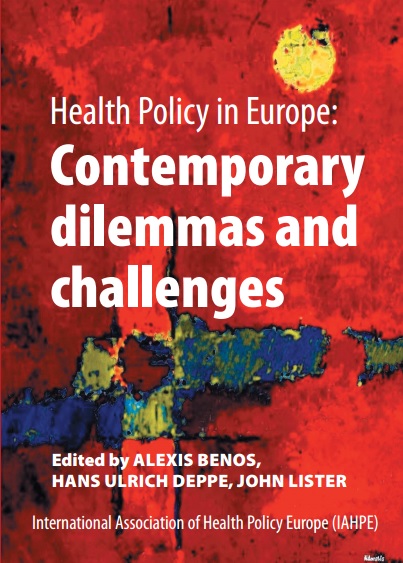
Health Policy In Europe: Contemporary dilemmas and challenges, a new book by IAHPE

IAHPE new book

This book is an effort to describe and critically analyse the recent experience of various European countries and discuss the dilemmas and challenges that confront health policy and policy-makers in this period of time and geopolitical setting, providing concrete evidence from various countries.

Specific chapters address issues in Germany, Sweden, the United Kingdom, Croatia, the Republic of Macedonia, Serbia, Greece, Turkey and Palestine, with an additional comparative study of the situation in the market-dominated health care system in the United states.

It is produced as an aftermath of the productive exchanges during the XIV Conference of the International Association of Health Policy in Europe (IAHPE), held in Thessaloniki in May 2005, with papers subsequently edited through a peer review process.

iahpe-bookcover

iahpe_healthpolicyineurope_contents

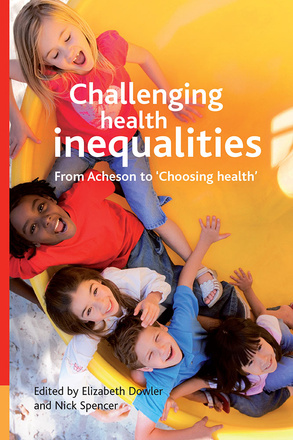
Challenging health inequalities, a new book edited by Elizabeth Dowler and Nick J. Spencer

This book offers a unique multi-disciplinary perspective on tackling health inequalities in a rich country, examining the New Labour policy agenda for tackling health inequalities and its inherent challenges. 

The book presents an overview of progress since the publication of the seminal and ambitious 1998 Acheson Inquiry into health inequalities, and the theoretical and methodological issues underpinning health inequalities. The contributors consider the determinants of inequality – for example, early childhood experience and ethnicity – the factors that mediate the relationship between determinants and health – nutrition, housing and health behaviour – and the sectoral policy interventions in user involvement, local area partnership working and social work.

Challenging health inequalities offers a combination of broad analysis of progress from differing perspectives and will be key reading to academics, students and policy makers. find more about the book and its publisher at https://www.policypress.org.uk/catalog/product_info.php?cPath=&products_id=1109