Study reveals austerity’s harmful impact on health in Greece

Findings are ‘much worse than we imagined,’ researcher says

In one of the most detailed studies of its kind, a team of Greek and U.S. researchers have vividly chronicled the harmful public health impacts of the economic austerity measures imposed on Greece’s population in the wake of the global economic crisis.

Writing in today’s American Journal of Public Health, the researchers cite data showing the economic recession and subsequent austerity policies in Greece have led to a sharp deterioration of health services and health outcomes.

Researchers at the Aristotle University of Thessaloniki in Greece and the University of New Mexico in the United States studied current data on economic and social conditions, utilization of health services, and health outcomes.

They found that key public health indicators declined in tandem with the recession and austerity policies that reduced public services.

For example, between 2007 and 2009, suicide and homicide mortality rates among men increased by 22.7 percent and 27.6 percent, respectively. Mental disorders, substance abuse, and infectious diseases showed worsening trends.

Despite deteriorating health conditions, cutbacks occurred in government financing of public services, as the Ministry of Health’s total expenditures fell by 23.7 percent between 2009 and 2011.

Meanwhile, due to unemployment and loss of personal income, patients decreased their use of private medical facilities, and utilization of already-stressed public inpatient and primary care services rose by 6.2 percent and 21.9 percent, respectively, over a two-year period.

Dr. Elias Kondilis, lead author of the study and a researcher at Aristotle University, commented from London, “We were expecting that these austerity policies would negatively affect health services and health outcomes, but the results were much worse than we imagined.”

Based on their findings, the authors criticize austerity policies that are likely to cause deteriorating health conditions in other European countries and in the United States.

The U.S.-based researcher on the team, Dr. Howard Waitzkin, distinguished professor emeritus of sociology and medicine at the University of New Mexico, said: “The policies of cutbacks currently proposed in the United States for Medicare and Social Security will lead to similar devastating effects on health services and outcomes. Instead of austerity policies, we need increased public sector spending to stimulate our failing economy and to protect the health of our people.”

In contrast to the Greek experience, the authors point to several Latin American countries that have resisted demands to reduce public investments in health services. Such policies, they argue, have led to improved economic and health indicators.

The senior researchers of the study were Dr. Howard Waitzkin on the U.S. side and Dr. Alexis Benos in Greece. Both are readily available for comment.

*****

“Economic crisis, restrictive policies, and the population’s health and health care: The Greek case,” Elias Kondilis, M.D., Ph.D., Stathis Giannakopoulos, M.D., Ph.D., Magda Gavana, M.D., Ph.D., Ioanna Ierodiakonou, M.D., Ph.D., Howard Waitzkin, M.D., Ph.D., and Alexis Benos, M.D., Ph.D., American Journal of Public Health, April 18, 2013 (online ahead of print). For AJPH reprint and subscription information, visit www.ajph.org.

A copy of the study is available at www.pnhp.org/kondilis.

*****

Physicians for a National Health Program (www.pnhp.org) is a nonprofit research and education organization of more than 18,000 doctors who advocate for single-payer national health insurance, an improved Medicare for all. Dr. Howard Waitzkin is a founding member of PNHP; Dr. Alexis Benos spoke to PNHP’s Annual Meeting in San Francisco in October. PNHP had no role in funding or otherwise supporting the study described above. To speak with a physician/spokesperson in your area, visitwww.pnhp.org/stateactions or call (312) 782-6006.

from the PNHP website:

http://www.pnhp.org/news/2013/april/study-reveals-austerity%E2%80%99s-harmful-impact-on-health-in-greece 

Un estudio revela los efectos nocivos de la austeridad en la salud en Grecia
Los resultados son “mucho peor de lo que imaginábamos”, afirman los investigadores
 
En uno de los estudios más detallados de este tipo, un equipo de investigadores estadounidenses y griegos han descripto  vívidamente los impactos  nocivos en la salud pública de las medidas económicas de austeridad impuestas a la población de Grecia a raíz de la crisis económica global.
En una publicación actual del Jueves, 18 de abril del American Journal of Public Health, los investigadores citan datos que muestran de qué manera  la política de austeridad en Grecia y la cnsecuente recesión económica  han provocado un fuerte deterioro de los servicios de salud e impactado en los resultados sanitarios.
Los investigadores de la Universidad Aristóteles de Tesalonia ,Grecia y de la Universidad de Nuevo México de los Estados Unidos estudiaron los datos actuales sobre las condiciones económicas y sociales, la utilización de los servicios sanitarios y resultados en salud.
They found that key public health indicators declined in tandem with the recession and austerity policies that reduced public services.
Encontraron  indicadores clave de  delinación de las condiciones de  salud concomitantes con las políticas de recesión y austeridad que han reducido los servicios públicos.
Por ejemplo, entre 2007 y 2009, el suicidio y las tasas de mortalidad por homicidio entre los hombres aumentó en un 22,7 por ciento y 27,6 por ciento, respectivamente. Los trastornos mentales, abuso de sustancias, y las enfermedades infecciosas mostraron empeoramiento de las tendencias.
A pesar de deterioro de las condiciones de salud, se produjeron  recortes en el financiamiento gubernamental de los servicios públicos en salud, los gastos totales de Ministerio de Salud se redujeron  en un 23,7 por ciento entre 2009 y 2011.
Mientras tanto, debido al desempleo y la pérdida de los ingresos personales, los pacientes redujeron su uso de los servicios médicos privados, incrementando la utilización de los servicios públicos sobrecargados. La hospitalización pública y la utilización de servicios de atención primaria se elevaron un 6,2 por ciento y 21,9 por ciento, respectivamente, durante un período de dos años.
El Dr. Elias Kondilis, autor principal del estudio e investigador en la Universidad de Aristóteles, comentó desde Londres: “Nosotros suponíamos que estas políticas de austeridad podrían afectar negativamente a los servicios de salud y los resultados sanitarios, pero los resultados  del estudio fueron mucho peor de lo que imaginábamos”.
Con base en sus hallazgos, los autores critican las políticas de austeridad que pueden provocar el deterioro de las condiciones de salud de otros países europeos y en Estados Unidos.
Otro investigador del  equipo, el Dr. Howard Waitzkin, distinguido profesor emérito de sociología y medicina en la Universidad de Nuevo México, dijo: “Las políticas de recortes que se proponen actualmente en los Estados Unidos para el Medicare y la Seguridad Social darán lugar a similares efectos devastadores sobre los servicios de salud y los resultados. En lugar de las políticas de austeridad, necesitamos aumentar el gasto público para estimular nuestra economía en crisis y para proteger la salud de nuestro pueblo “.
A diferencia de la experiencia griega, los autores señalan varios países de América Latina que han resistido la exigencia de  reducir las inversiones públicas en servicios de salud. Estas políticas, dicen, han dado lugar a la mejora de los indicadores económicos y la salud.

Los investigadores principales del estudio fueron el Dr. Howard Waitzkin en el lado de EE.UU. y el Dr. Alexis Benos en Grecia. Ambos están disponibles para hacer comentarios.

The Correa ‘phenomenon’ in Ecuador: between ‘buen vivir’ and neo-developmentalism, by Mauricio Torres & Pol de Vos

One of the initial decisions of Correa was the convening of a Constituent National Assembly. The new constitution was officially launched in July 2008 and ratified through a popular referendum in September of that year.
The new Constitution defines Ecuador as a sovereign, independent, intercultural, multi-national and secular country, committed to a development model based on the (indigenous people) idea of “buen vivir”. In ancient Quechua, the term “Sumak Kawsay” means “good living” in harmony with our communities, ourselves, and most importantly, our living, breathing environment. According to Ariruma Kowii, an Ecuadorian (indigenous) writer and poet and also a leader of the indigenous movement,  Sumak Kawsay is “an ancient Andean conception of life that has remained in force in many indigenous communities until now. Sumak means the ideal, the beautiful, the good, the realization, while Kawsay represents the life, in reference to a decent life, in harmony and balance with the universe and human beings. In sum, Sumak Kawsay means to live the fullness of life”.


Read more here

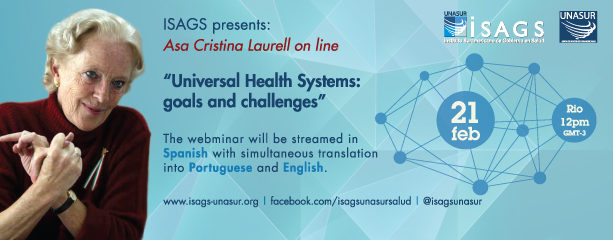
Asa Cristina Laurell Conference on Universal Health Coverage 21 February 2013

INVITACION
ALAMES se une a la invitación del Instituto Suramericano de Gobierno en Salud (ISAGS) para la conferencia de Cristina Laurell
sobre los Retos y Desafíos de los Sistemas Universales de Salud, que será transmitida en tiempo real por internet,
el jueves 21 de febrero a las 12 del mediodía hora Río de Janeiro, Brasil.

La exposición presentará los dos modelos de reformas que se vienen proponiendo para alcanzar la “cobertura universal de salud”: el sistema público universal de salud (SUS), basado en el Estado Social y redistributivo; y el modelo de aseguramiento universal de inspiración neoclásico-neoliberal. Se presentará una revisión comparativa entre los dos  modelos, y se revisaran los logros y los problemas de cada uno de ellos.  La participación por internet permitirá hacer comentarios y preguntas.

Postgrado en Prevención Cardiovascular

Postgrado Transdisciplinario en Prevención Cardiovascular
Grupo de Estudio en Cardiologia Transdisciplinaria
Sociedad de Cardiología del Oeste Bonaerense
Federación Argentina de Cardiología

SOLICITAMOS AUSPICIOS, APOYOS, RECOMENDACIONES

Amigos: estamos trabajando en la creación del primer Postgrado Transdisciplinario en Prevención Cardiovascular y nos gustaría contar con opiniones, críticas, sugerencias de aquellas personas cuya opinión nos resulta significativa para enriquecer el proyecto. Ojalá tengan ganas de dedicarnos unos pocos minutos, nos enriqueceremos mucho con ello.

Se trata de una actividad académica común a Médicos, Psicólogos, Bioquímos, Nutricionistas, Antropologos, Sociólogos, Trabajadores Sociales, Licenciados en Enfermería, etc.

Su propuesta se basa en la evidencia epidemiológica contundente acerca de la epidemia contemporánea de este tipo de enfermedades y en algunos documentos recientes que recomiendan la formación de especialistas en prevención CV:

33° Conferencia de Bethesda, Informe OMS Dinamarca, Informe Canadiense, AHA, ACC, etc.

Hemos diseñado los objetivos, fundamentos, perfiles del aspirante y del egresado y una currícula preliminar. Se propone el abordaje de la problemática cardiovascular desde múltiples perspectivas, con una mirada crítica y creativa.

¿Qué opinan?
¿Existe la necesidad de una actividad como esta?
¿Les parece viable, de interés profesional, social, comunitario?
¿Les interesa participar como alumno, docente, colaborador, asesor, etc?

Esperamos tus propuestas.

Gracias por estar allí.
Daniel Flichtentrei.

Síntesis Curricular:
Concepto de Prevención, teorías preventivistas.
Bases de Epidemiología teórica.
Epidemiología de las enfermedades CV.
Bases del conocimiento científico y epistemología médica.
Fundamentos de Teoría de la Complejidad y Transdisciplina.
Fundamentos de Metodología de la Investigación Científica.
Investigación Cualitativa y Cuantitativa en Salud.
Aspectos Sociales de las enfermedades CV.
Aspectos Antropológicos de las enfermedades CV.
Aspectos Psicológicos de las enfermedades CV.
Aspectos Médicos de las enfermedades CV.
Aspectos Bioquímicos de las enfermedades CV.
Aspectos Nutricionales de las enfermedades CV.
Aspectos Económicos de las enfermedades CV.
Concepto de Factores de Riesgo.
La perspectiva de género ens alud CV.
Reemplazo hormonal: perspectiva antropológica y de género.
Lo genético y lo cultural en las enfermedades CV.
Herencia cromosómica, herencia cultural.
Análisis de proyectos comunitarios internacionales:
Estudio Framingham, EEUU.
Proyecto North Karelia, Finlandia.
Proyecto Cienfuegos, Cuba.
Proyecto Gap 10/90
Aterogénesis, dislipidemias, Diabetes, HTA, Factores emergentes.
Lipidología actual. Smes. Metabólicos.
Abordaje transdisciplinario de la Obesidad.
Diabetes y enfermedades CV.
Abordaje transdisciplinario del Tabaquismo.
Abordaje transdisciplinario del climaterio femenino.
La ATC como enfermedad sistémica.
Aspectos nutricionales y farmacológicos del tratamiento.
Rehabilitación Cardiovascular.
La formación del Equipo de Prevención CV.
Disciplinas, roles, articulación: obstáculos y perspectivas para la
integración.
Concepto de equidad en salud.
Modelo Médico Hegemónico.
Modelos asistenciales: curativos y preventivos.
Análisis y discusión de los documentos más importantes desde distintas
perspectivas teóricas.

Seminarios:
Investigación Transdisciplinaria en Salud.
Laboratorio Bioquímico en Prevención CV.
Los enfermeros y técnicos en Prevención CV.
Formación de divulgadores comunitarios en Prevención CV.
Rol del Psicólogo en el equipo de Prevención CV.
Rol del Nutricionista en el equipo de Prevención CV.
Seminario Taller común a profesionales y pacientes: “Las enfermedades CV desde ambas orillas.”
“Pensar distinto: las otras miradas”. Las perspectivas de las Ciencias
Sociales sobre el trabajo médico.
“Ser médico hoy”: Crisis y transformaciones del rol profesional.

Requisitos para la aprobación del Curso de Postgrado:
Asistencia no menor al 75% de las horas cátedra previstas.
Aprobación de las evaluaciones parciales y finales previstas.
Aprobación de un Seminario Optativo.
Producción de un trabajo Monográfico o de Investigación original y que
represente un aporte concreto al tema en nuestro país.
Realización de una actividad comunitaria preventiva como trabajo de campo por cada grupo de cuatro alumnos.

Conférence européenne en défense de la santé et de la protection sociale publique et universelle 12 et 13 Mai 2012 à Paris

scroll down for english and spanish version 

INVITATION

Conférence européenne en défense de la santé et de la protection sociale publique et universelle 12 et 13 Mai 2012 à Paris

Chers amis et camarades,

L’appel de la conférence européenne consacrée à la défense des dispositifs de santé publique et de protection sociale, qui s’est tenue à Katowice en Pologne les 19 et 20 novembre 2012 (voir document ci-contre) avait décidé de poursuivre ses travaux par une nouvelle conférence en 2012 à Paris pour poursuivre la réflexion engagée et dégager des axes de mobilisation communs. Cette nouvelle conférence aura lieu les 12 et 13 mai 2012 à Paris. Sachant votre attachement aux services publics de santé et votre volonté de construire des mobilisations contre la privatisation des systèmes de santé et de protection sociale en Europe nous vous invitons à y participer et à prendre contact avec le comité d’organisation qui s’est mis en place.

Nous vous proposons également de nous faire parvenir pour la faire circuler toute contribution écrite que vous estimerez utile à la préparation de cette conférence.

Contacts :

[1] Mme Françoise NAY

Tél.: ++33 (0) 607890657

Mail: jean.rostandivry@wanadoo.fr

Pour la Coordination nationale des comités de défense

des hôpitaux et maternités de proximité.

[1] Mr Bruno PERCEBOIS

Tél.: ++33 (0) 670343587

Mail: perceboisbruno@club-internet.fr

médecin de PMI (protection maternelle et infantile)

[1] Mme BINOT Fabienne

Tel.: ++33 (0) 683204807

Mail: fbinot@sud-sante.org

et

Mr Vladimir NIEDDU

Tel.: ++33 (0) 603403079

Mail: nieddubacle@free.fr

pour la fédération syndicale SUD Santé Sociaux

[1] Mr Jan MALEWSKI

Tel.: ++33 (0) 634734875

Mail: janmalewski@free.fr

correspondant en France de WZZ «Sierpien 80»

(Syndicat libre « Août 80 », Pologne).

Appel de la deuxième conférence en défense du service public de la santé P artout en Europe, la crise de la dette souveraine est utilisée comme prétexte à des attaques concertées contre l’hôpital public et la protection sociale, les malades, les professionnels de santé. Cela se traduit par la remise en cause de l’accès aux soins pour tous, des fermetures brutales de lits, de services, d’hôpitaux, par une accélération d’un processus de privatisations des hôpitaux, la taxation des malades, voire comme en Pologne la suppression du statut de salariés au profit de statuts d’autoentrepreneur ou de divers “contrats-poubelles”, hors code du travail. C’est aussi la mise en cause des systèmes de financements publics ou de sécurité sociale au profit des assurances privées. En Angleterre cela se fait par l’introduction d’une « réforme » qui menace de casser le service public de santé en créant un marché concurrentiel en généralisant les privatisations, de pair avec une réduction de 20 milliards de livres sterling du budget de l’Etat.

Dans chaque pays d’Europe, sous des formes différentes, les plans d’austérité sur la santé visent au démantèlement de systèmes solidaires et égalitaires. C’est un exemple de plus comment les gouvernements font payer la crise aux travailleurs et à la société. Cela indique aussi l’importance d’agir au-delà des frontières pour organiser une résistance aux privatisations et aux plans d’austérité.

La décision du gouvernement polonais de supprimer le statut de salariés des hôpitaux publics et de remplacer par un statut d’auto-entrepreneur constitue une menace pour tous les salariés polonais mais aussi un laboratoire d’expérimentation qui menacerait, si cette mesure s’étendait, le statut de tous les salariés d’Europe. Cela nécessite une action concertée des professionnels de santé, des malades, de tous les citoyens, cela suppose une mise en commun   des expériences des luttes nationales en défense de la santé publique et de la sécurité sociale, l’organisation d’une solidarité concrète lors des luttes, la réflexion sur la construction d’initiatives internationales pour la défense d’une santé publique universelle, égalitaire et solidaire.

Entre les banquiers et la santé — l’accès universel et gratuit des sociétés aux soins de santé — il faut choisir. Pour notre part, c’est la voie d’un égal accès à la santé, de la gratuité des soins, la démocratie sanitaire, un financement public et collectif qu’il faut promouvoir, pas les profits des banquiers et des propriétaires privés. Les moyens publics ne peuvent plus servir les profits privés des actionnaires des établissements de santé.

A l’issue de notre conférence de Katowice (Pologne), qui a eu lieu les 19 et 20 Novembre 2011, les participants issus des syndicats et des associations de luttes pour la défense de la santé et de la protection sociale, défendant un système de santé publique de haut niveau dans toute l’Europe, se sont prononcé en faveur de l’organisation d’une nouvelle conférence mi 2012 en France.

Les participants de la conférence: Syndicat libre “Août 80” (Pologne), Syndicat national des infirmières et sages femmes OZZPiP – région de Silésie (Pologne), SUD Santé-Sociaux (France). Cet appel est aussi signé : en Angleterre par l’association Health Emergency; en Pologne le syndicat OZZPSR (Syndicat national des travailleurs du service d’urgence) et le syndicat KZZPRM (Syndicat national des salariés du secours médical); en Grèce par l’Initiative femmes contre la dette, la Fédération des médecins hospitaliers de Grèce (ONTE) et People Health Movement (PHM); en Turquie par l’Association médicale Turque (Türk Tip Dernegi); en France par la Coordination nationale des comités de défense des hôpitaux et maternités de proximité, la Coordination santé solidarité de Gironde (COSS 33) et l’Union syndicale de la Psychiatrie (USP).

Bulletin d’inscription

Pays: Organisation: Nom, prénom, adresse, téléphone, mail des membres de la délégation:

Organisation matérielle

Date et heure d’arrivée:

Date et heure de départ:

Besoin de moyen de transport:

oui non

Besoin de couchage:

oui non

Langue(s) comprises:

Langues parlées (pour intervenir):

Nombre de repas:

Samedi midi Samedi midi

 Dimanche midi Dimanche soir

——————————————————————————————————————-

——————————————————————————————————————-


INVITATION

European Conference in defence of public and universal health service and social protection 12th and 13th of May 2012 in Paris

L ast November in Katowice (Poland), a European conference was held on the defence of public health and social care systems. It was decided call a new conference May 2012 in Paris, to continue our analysis and establish joint mobilizations (See attachment : “Second appeal in defence of public health service”).

This new conference will be held on the 12th and 13th of May 2012 in Paris. Everywhere in Europe, the crisis of national debts is used as an excuse to damage public hospital, welfare, patients, and health workers. As a result we see difficulties of access to health care for the poorest, savage closures of beds, services, and even hospitals, acceleration of hospital privatization, increase taxation of patients, or like in Poland, replacing of employee status with self-employed status or imposing ‘garbage contracts’ outside of labour legislation. This means the rejection of public finance system and social security in favour of private insurance benefits.

In England, the sweeping “reform” will break up the National Health Service and create a competitive market and far-reaching privatisation, alongside £20 billion cuts in the health budget.

In all European countries, different austerity measures in health services aim at dismantling the egalitarian solidarity systems. This is one further example of how governments make the workers and the society pay for the economic crisis they have created. This proves the importance of an international resistance to privatizations and austerity policies.

The Polish government’s decision to replace of employee status with self-employed status is a danger for all Polish workers but it also represents an laboratory test which could spread over all European countries.

This situation needs a common action by health workers, patients, citizens, national resistance and solidarity in defence of public health and social security system, and international initiatives to defend universal access to an egalitarian solidarity health system.

There is a choice between the needs of a public health service and those of private bankers. We have already chosen: equal access to a free health system, the democracy of a public health system, public finances instead of private profits.

The appeal for this conference is supported by: Free Trade-Union ‘August 1980’ (Poland), National Trade-Union of Nurse and Midwife OZZPiP – Silesia (Poland), OZZPSR – National Trade Union of Workers of the Emergency Service (Poland), KZZPRM – Trade Union of Medical Rescue Employees (Poland), ‘SUD Santé Sociaux’ trade-union (France), Health Emergency (Britain), National Coordination of Committees to Defend Hospitals and Maternities of Proximity (France), Coordination Santé Solidarité Gironde (France), Union Syndicale des Psychiatres – Trade Union of Psychiatrists (France), Initiative of Women against the Debt (Greece), Federation of the Hospital Doctors of Greece (ONTE), People Health Movement (PHM), Tip Dernegi – Medical Association (Turkey) If interested, please contact the organization committee below:

Mme Françoise NAY

Tel.: ++33607890657

Mail: jean.rostandivry@wanadoo.fr

for the National coordination of the defense committees of the hospitals and maternities of proximity (Coordination nationale des comités de défense des hôpitaux et maternités de proximité).

Mr Bruno PERCEBOIS

Tel.: ++33670343587

Mail: perceboisbruno@club-internet.fr

PMI doctor (médecin de PMI – protection maternelle et infantile)

Mme BINOT Fabienne

Tel.: ++33683204807

Mail: fbinot@sud-sante.org

and

Mr Vladimir NIEDDU

Tel.: ++33603403079

Mail: nieddubacle@free.fr

for the French trade-union SUD Santé Sociaux

Mr Jan MALEWSKI

Tel.: ++33634734875

Mail: janmalewski@free.fr

correspondent in France of WZZ «Sierpien 80»

(Free Trade Union « August 80 », Poland).

Second appeal in defence of public health service

E verywhere in Europe, the crisis of national debts is used as an excuse to damage public hospital, welfare, patients, and health workers. As a result we can see : difficulties on access to health care for the poorest, brutal closedowns of beds, services, even hospitals, acceleration of hospitals privatization, patients taxation, or like in Poland, abolition of worker status in aid of self entrepreneur status or some bage contracts’ out of labour legislation.

This means the rejection of public finance system and general security system for private insurance benefits. In England it’s with a sweeping “reform” which threatens to break up the National Health Service and create a competitive market and far-reaching privatisation, alongside o £20 billion sqeeze on finances.

In all European countries, different austerity measures on health aim at dismantling of egalitarian solidarity systems. This is one further example of how governments make the workers and the society pay for the economic crisis they have provoked. These facts proved the importance of an international resistance to privatizations and austerity policies.

The Polish government ‘s decision to replace workers status by self entrepreneurs is a danger for all Polish workers but it also represents an experimentation laboratory which could spread over all European countries.

This situation needs a common action of health workers, patients, citizens, a shared experience of national resistances in defence of public health and social security system, the organization of a concrete solidarity, and the thought on international initiatives to protect universal access to an egalitarian solidarity health system.

This is a choice between real health policy and bankers.

We have already choose: an equal access on a free health system, sanitary democracy, public finances instead of private owners benefits. Public finances cannot serve particular profits and shareholders anymore.

After Katowice (Poland) meeting, on the 19 and 20 November 2011, the trade unions and the non-profit making organizations for health and social security system have decided to organize a new conference in mid 2012 in France in order to fight for a high health system level.

The participants in the congress:

Free trade-union ‘August 1980’ (Poland), OZZPiP – National trade-union of nurse and midwife – Silesia (Poland), French trade-union ‘SUD Santé Sociaux’

This call is also signed:

in England by association Health Emergency;

in Poland by the Trade union OZZPSR (National union of workers of the emergency service) and the Trade union KZZPRM (National union of the employees

of the medical help);

in Greece by the Initiative women against the debt, the Federation of the hospital doctors of Greece (ONTE) and

People Health Movement (PHM);

in Turkey by Turkish Medical Association (Turkish Tip Dernegi);

in France by the National coordination of the defense committees of the hospitals and maternities of proximity, the Coordination health-solidarity of Gironde (COSS 33) and Trade Union of Psychiatry (USP).

Registration form

Country: Organization:

Name, address, phone, email of members of the delegation:

Material issues

Date and hour of arrival:

Date and hour of departure:

Transportation needed: yes no

Accomodation required: yes no

idioms understood:

idioms used for oral interventions:

Meal : saturday lunch saturday supper  sunday lunch sunday supper

INVITACIÓN

Conferencia europea en defensa de la salud y de la protección social pública y universal 12 y 13 de mayo en París

Queridos compañeros y compañeras, El llamamiento de la conferencia europea consagrada a la defensa de los dispositivos de salud pública y de protección social celebrada en Katowice, Polonia, los días 19 y 20 de noviembre de 2012 (ver documento ajunto) había decidido proseguir sus trabajos mediante una nueva conferencia a comienzos de 2012 en París para avanzar la reflexión emprendida y procurar ejes de movilización comunes.

Esta nueva conferencia tendrá lugar los días 12 y 13 de mayo en París.

Conociendo vuestra defensa de los servicios públicos de salud y vuestra voluntad de construir movilizaciones contra la privatización de los sistemas de salud y de protección social en Europa os invitamos a participar en ella y a tomar contacto con el comité de organización que se ha creado. Os proponemos igualmente hacernos llegar para hacerla circular cualquier contribución escrita que estiméis útil para la preparación de esta conferencia.

Contactos:

Mme Françoise NAY

Tél.: ++33 (0) 607890657

Mail: jean.rostandivry@wanadoo.fr

Coordinación nacional de los comités de defensa

de los hospitales y de las maternidades de proximidad.

Mr Bruno PERCEBOIS

Tél.: ++33 (0) 670343587

Mail: perceboisbruno@club-internet.fr

Médico de PMI (Protección maternal e infantil)

Mme BINOT Fabienne

Tel.: ++33 (0) 683204807

Mail: fbinot@sud-sante.org

y

Mr Vladimir NIEDDU

Tel.: ++33 (0) 603403079

Mail: nieddubacle@free.fr

Federación sindical SUD Santé Sociaux

Mr Jan MALEWSKI

Tel.: ++33 (0) 634734875

Mail: janmalewski@free.fr

corresponsal en Francia de WZZ «Sierpien 80»

(Syndicato libre «Agosto 80», Polonia).

Llamada de la segunda conferencia de defesa del servicio público de la sanidad

De todas partes en Europa la crisis de la deuda es utilizada para justificar atacas en contra del hospital público, la protección social, los enfermos, los profesionales de la sanidad. Esto se traduce con problemas de acceso a la sanidad para todos, diminución de camas en los hospitales, servicios de hospitales que cierran, hospitales que cierran y una aceleración de la privatización de los hospitales, hacer pagar los enfermos y como en Polonia la supresión del statu de empleado y la aparición del auto –empresa o varios contratos” basuras “que no se sitúan en el cuadro de las leyes del trabajo. Es también la acusación del sistema de finanza pública o de seguridad social al provecho de las seguranzas privadas. En Inglaterra eso se hace por la introducción de una “reforma” que amenaza con romper el servicio público de salud creando un mercado competitivo y generalizando las privatizaciones, junto con una reducción de 20 mil millones de libras esterlinas del presupuesto del Estado. En cada país d’Europa, sobre formas diferentes, los proyectos de austeridad sobre la sanidad quieren desmangar los sistemas de solidaridad y de igualdad. Es un ejemplo que muestra como los gobiernos hacen pagar la crisis a los trabajadores de la sociedad. Esto también indica la importancia de reaccionar tras las fronteras para organizar una resistencia a la privatización y a la austeridad. La decisión del gobierno polonés de hacer desaparecer el statu de empleado de los hospitales públicos y de remplazarlo por un statu de autoempresa constituye una amenaza para todos los empleados poloneses pero representa también un laboratorio experimental que amenazaría, si esta medida se extendiera, para el statu de todos los  empleados de Europa. Esto necesita una acción concertada de los profesionales de la sanidad, de los enfermos, de toda la población, esto necesita que pongamos en común las experiencias de luchas nacionales para la defensa de la sanidad pública y de la seguridad social, para la organización de una solidaridad concreta cuando luchas aparecen, para la reflexión sobre la construcción iniciativas internacionales por la defensa de una sanidad pública que sea universal igualitaria y solidaria Entre los banqueros y la sanidad – el acceso universal y gratuito de las sociedades a la sanidad hay que elegir. Parra nosotros es la vía de un acceso igualitario a la sanidad, es ser atendido gratuitamente, es la democracia sanitaria, con finanzas publicas y colectivas que tenemos que sostener y no los beneficios de los banqueros y de los propietarios privados. Las finanzas públicas no pueden mas servir los beneficios de los accionarios de los establecimientos de sanidad. Siguiendo nuestra conferencia en Katowice (Polonia) que se desarrollo el 19 y 20 de noviembre 2011 los participantes cuyos venían de sindicatos o de asociaciones de lucha por la defensa de la sanidad y de la protección social, defendiendo un sistema de sanidad pública de alto nivel en toda Europa, dijeron que eran favorables a la organización de una nueva conferencia en Francia en 2012. Los participantes de la conferencia: Sindicato libre “Agosto 80” (Polonia), Sindicato nacional de las enfermeras y comadronas OZZPiP – región de Silesie (Polonia), SUD Santé Sociaux (Francia) Esta llamada también se firma: en Inglaterra por la asociación Health Emergency; en Polonia por el sindicato OZZPSR (Sindicato nacional de los trabajadores del servicio urgentes) y el sindicato KZZPRM (Sindicato nacional de los asalariados de la ayuda médica); en Grecia por la Iniciativa de mujeres contra la deuda, la Federación de los médicos hospitalarios de Grecia (ONTE) y People Health Movement (PHM); en Turquía por la Asociación médica Turca (Türk Tip Dernegi); en Francia por la Coordinación nacional de los Comités de defensa de los hospitales y maternidades de proximidad, la Coordinación salud-solidaridad de Gironda (COSS 33) y la Unión sindical de la Psiquiatría (USP).  

Boletín de inscripción 

País :

Organización:

Nombre, apellido, dirección, teléfono, mail de los miembros de la delegación:

Organización material

Fecha y hora de la llegada:

Fecha y hora de la salida:

Necesidad de medio de transporte: si no

Necesidad de alojamiento: si no

Idiomas entiende:

idiomas utilizados para las intervenciones orales:

Número de comidas: sábado comida sábado cena

domingo comida domingo cena

Attacks on Physician Self-Governance in Turkey

The Turkish governement is completing its attack against the Turkish Medical Association!

Following the global trend of the neoliberal policies the turkish governement is rebuilding a totalitarian and antidemocratic legal framework in order to force to silence “enoying voices”, as this of the Turkish Medical Association.

The World Medical Association.expressed its concern and has raised strong objections to the Turkish Government’s attempt to dismantle basic functions and roles of the Turkish Medical Association.

In a letter to its member national medical associations entitled ‘Attacks on Physician Self-Governance in Turkey’, the WMA’s Secretary General Dr. Otmar Kloiber said the Turkish Medical Association had sought the help of the WMA in resisting the Turkish Government’s takeover of its functions.

In a letter to the WMA, the Turkish Medical Association said that under a Turkish Government decree adopted in November the medical association had been stripped of many of its functions, in particular the provision to ensure that the medical profession was practiced and promoted in line with public and individual wellbeing and benefit.

The decree also created a new Health Professions Board, to which the Ministry of Health was empowered to appoint the overwhelming majority of members. This Board had been given many of the powers that used to be exercised by the medical association, including giving opinion on the curricula of education and training in health, employment and ethical issues, investigating alleged ethical violations by physicians and applying disciplinary sanctions.

The Turkish Medical Association’s letter added: ‘The act of unconstitutionally issuing a decree in force of law in disregard of the authority of the legislative body gives rise to concerns about the totalitarian tendency of the ruling Government not compatible with any understanding of democracy.

‘Amendments in constituting laws of the Turkish Medical Association and other professional organisations as well as new arrangements regarding higher education institutions in the field of health and medicine aim at intimidating and eliminating the pressure group functions of professional organisations and academics who are not in line with existing Government policies’.

Feride Aksu Tanik, secretary general of the Turkish Medical Association, told the BMJ that the government decree has amended laws that affect not just the association but other medicine related organisations and medical schools. She said that the legal changes are aimed at “intimidating and eliminating the pressure group functions of professional organisations and academics who are not in line with existing government policies.” 

The need for an international movement of solidarity for our turkish colleagues is more than obvious! These policies are implemented with a tremendous homogeneity to all the world.

Solidarity is the first necessary move towards another humane and democratic society where people are over profits.

See more on this issue at:  

http://www.wma.net/en/40news/20archives/2012/2012_01/index.html

http://www.bmj.com/content/344/bmj.e529?etoc 

XVIth Conference of IAHP with ALAMES & RED AMERICAS, Uruguay, 3 to 8 November 2012

Crisis, acceleration, and plunder in global capitalism: progress and setbacks in the struggle for universal health and rights. 

Subthemes:

1. Capitalism, environment and social determination of health.

2. Social medicine and collective health in the struggle of movements and progressive socio-political processes: progress and new challenges.

3. Confronting policies of dismantling systems of social protection and social security. 

The Latin American Social Medicine Association, the International Association of Health Policy and the Network of Local Health Actors of theAmericas invite you to share five and a half days of exchange,

learning, debate and reflection on the impact of the global crisis on the right to health.

The integration of three conferences in one, charged with solidarity and internationalism, seeks to create synergy between the participating organizations and networks, and also to promote diversity and quality in the debate and the realization of the proposals.

The broad outlines of the schedule and major activities are summarized in the Program chart. Uruguay will host the Congress, with the headquarters in Montevideo (the capital) and Maldonado.

The Pre-Congress will take place in one location, and the Congress and Assembly of ALAMES in the other.

more at:   Confence leaflet 

How European governments are privatising our health care. Α new IAHPE book


Europe’s Health for Sale: the heavy cost of privatisation

Edited by John Lister

Libri Press, £19.95, http://www.libripublishing.co.uk


Book Launch

Thursday June 23, 5.30pm

Ellen Terry Building, Coventry University

Jordan Well, Coventry CV1 5RW.


David Cameron keeps insisting that Andrew Lansley’s controversial Health and Social Care Bill does not mean privatisation of health services.

But this new collection of articles from a number of European countries points to the covert methods that are increasingly being used to do just that, though the development of competitive market systems.

Markets are a more expensive way to organise health care. They are less efficient, less equitable, and less accountable to the wider public than planned, publicly-funded systems, and can be more expensive: all of the evidence confirms this view.  

So why are marketising reforms continuing, even in the midst of today’s a dramatic onslaught on public sector spending? Taking examples from Britain, Germany, Greece, Turkey, Spain and elsewhere, Europe’s Health for Sale sets out to explain why profitable services are being contracted out – and other services put at risk – by the expansion of the private sector.

It shows that the attraction of this type of market reform for private sector providers is that it funnels generous profits from the public purse and social insurance into the hands of private companies.

The papers were presented at a 2009 conference of the International Association of Health Policy in Europe, hosted at Coventry University: but the issues are just as relevant and immediate today.

Chapters on elderly care and mental health underline the negative impact on quality and equity of services. And chapters on media coverage show that the lack of specialist training in health journalism, and the dumbing-down of much reporting and thinning out of newrooms in press and broadcast media leave the public unaware of the changes taking place, and exposed to skilled manipulation by the wealthy PR departments of drug companies and the private sector.

Editor John Lister, a veteran health campaigner who now also teaches health journalism at Coventry University, said:

“The notion of conspiracy is sometimes exaggerated: but this book shows a concerted drive by a number of governments along similar lines, sponsoring a new private sector which can only exist because of public funding.

“Since these studies were written, even more countries have followed down similar paths.

Europe’s Health for Sale aims to put fresh arguments and evidence in the hands of those who are challenging and resisting similar policies around the world.”

The book is to be launched on June 23, in the middle of the first major European Conference on Health Journalism, which is being held in Coventry University on June 23-24.

Prof. Onur Hamzaoglu, Chair of Public Health Department at Kocaeli University is under investigation

An international movement of solidarity is urgently needed!

A scientist, Prof. Dr. Onur Hamzaoglu, Chair of Public Health Department at Kocaeli University Faculty of Medicine is under investigation.

Why?Just because he fulfills his dutiestowards the society as a human, a physician and an academician.

Prof Dr. Onur Hamzaoglu deals with seriousenvironmental and health problems that have been encountered in Kocaeli region, for many years.

He published the results of his study,namely, The Causes of Deaths in Industry-Dense Areas: Example of Dilovası in 2005and demonstrated the excessive number of cancer-related deaths. Heshared his findings with local and national academic societies and politicalauthorities. He also offered his solutions to Turkish Grand National Assemblyin 2006.

What has changed since that day? Nothing!

Prof. Dr Onur Hamzaoglu recently presentedthe results of a new study, which he has managed, to publicise through the media.

The demands for investigation and trialbegan to occur after this statement.

In this study, which has been conducted by Onur Hamzaoglu together with the academicians from the Departments of Public Health, Child Health and Diseases and Medical Genetics at Kocaeli Universityand supported by the scientific research fund of University, certain heavymetals and trace elements have been detected in colostrum and meconium from theparticipants.

Prof. Dr. Onur Hamzaoglu, as a scientist who has a sense of responsibility, announced this information to public.

After a short period of time followingthis statement, Mayors of Kocaeli Metropolitan Municipality and Dilovası Municipality submitted a lawsuit petition to Kocaeli Public Prosecution Office, demanding the trial of Prof. Dr. Onur Hamzaoglu. They claimed that“he hadbrought the issue into the notice of large mass of people by saying ‘We havedetected zinc, iron, aluminium, lead and cadmium even in maternal breast milkin addition to blood and feces samples, thus, there is an enormous danger’andemployed the results of the research with the intention of causing panic amongthe people’. Prosecution Office forwarded the file to Kocaeli University Rectorate in order that they examine mentioned act.

If the university permits,Prof. Dr. Onur Hamzaoglu will be on trial with the request for 2-4 years imprisonment inaccordance with Article 213 of Turkish Penal Code (TCK),

The criminal investigation conducted by Kocaeli University for this reason is ongoing.

However, a disciplinary proceeding waslaunched by Kocaeli University against Prof. Dr. Onur Hamzaoglu after TheCancer Control Directorate of Turkish Ministry of Health has sent an officalletter to The Council of Higher Education and the Council  has submitted this letter for the review ofKocaeli University Rectorate and urged the Rectorate to take necessary actionin this direction.

What was the issue investigated byOnur Hamzaoglu? Why it caused a disturbance?

It is a known fact that the seriousenvironmental and health problems generated by Dilovası Organized IndustrialZone have been encountered in Kocaeli region. New organized industrial zones,which were planned to establish, brought the discussions on this issuetothe  public agenda.

“Growth and Development Patterns inInfants Exposed to Heavy Metal, Who Born to MothersLiving in Dilovası and Kandıra Districts” is being investigatedwithin the recent research project, which has been designed with theparticipation of the academicians from the Departments of Public Health, Child Health and Diseases and Medical Genetics at Kocaeli University and conducted by Onur Hamzaoglu and supported by the scientific research fund of thisUniversity. According to the final results obtained in this research, certainheavy metals and trace elements have been detected in colostrum and meconiumfrom the participants.

Prof Dr. Onur Hamzaoglu has announced theunusual and scary findings of this study to public and experienced the sametrouble as the honest and brave scientist from all over the world,who havestrong sense of responsibility: Annoyance!

Actually, we know these annoyances very well.

Dr. Irving Selikoff had experienced the same annoyance since he hadstated in 1964 that asbestosis was hazardous for human health.

Dr. Herbert Needleman had experienced the same annoyance in 1970, when hehad announced the harmfulness of lead for children’s health.

Dr. Takeshi Nirayama had encountered the same annoyancein 1981 when he had stated that passive smoking causes lung cancer.

Dr. Benjamin Santer had experienced the same annoyance in 1996, when hehad reported his findings onclimate change.

Dr. Ignacio Chapela had encountered the same annoyance in  2000, when he had stated the danger with genetically modified Mexico corn.

Now, the time comes for OnurHamzaoglu…

Those who prioritize political andeconomic interests over human health are on one side and the public health,honorable scientists and Onur Hamzaoglu are on the other side.

The side that we take is apparent.

The people of Dilovası are our beloved.

Prof. Dr. Onur Hamzaoglu is ourpride.

We do not let anybody lay a fingeron Onur Hamzaoglu.

We protect our mothers’ breast milkand our babies’poo.

express your support by informing that you sign the above and writing your Name, title, workplace, city atFeride Aksu Tanik

Systematic Usurpation of salaries by Marfin Investment Group (Hygeia) in Turkey

Istanbul Chamber of Physicians made a press declaration in front of the hospital building onFebruary 7, 2011 to support our colleagues striking against the conditions ofthe physicians who have not received their salaries for months while working at JFK Hospital that owned by Şafak HospitalsGroup and Marfin Investment Group (HYGEIA) partnership and at the otherhospitals.

Prof. Dr. TanerGören, President of Istanbul Chamber of Physicians, Dr. Lale Tırtıl and Dr.Hasan Oğan, Istanbul Chamber of Physicians Executive Board Members, Dr. PelinTaşkıran, Coordinator of Istanbul Chamber of Physicians Private Practice Committee and Dr. Osman Öztürk, Turkish Medical Association Central Council Member joined the meeting besides a large number of physicians working at JFK and other hospitals.

Prof. Dr. TanerGören, President of Istanbul Chamber of Physicians, stated in his speech thatthe physicians practicing at JFK for the sake of patients have not been paidfor months.   Besides, he said that thesalaries of the physicians have been usurped by giving lame excuses; the moneyearned by these hospitals is being utilized for the investments into differentsectors and this is unethical.

Prof. Gören remarkedthat this problem occurred in consequence of Health Transformation Program thathad been sped up in 2002 by AKP (Justice and Development Party) government. Healso clarified that Turkish Medical Association and its largest chamber; Istanbul Chamber of Physicians will closely monitor the issue.

Dr. Osman Öztürk,Turkish Medical Association Central Council Member, added, “This is anhistorical moment. This is the first time in which health services aren’tprovided in private practice since 1980 military coup, in other words, after 30years. The physicians are striking by using their forces of production, becausethey can’t get paid.”

Dr. Öztürk remindedthat Şafak Hospitals Group has been sold to a Greek investor, to MarfinInvestment Group (Hygeia). He stated depending upon the information from themeeting with hospital administration that the salaries didn’t paid due to theselling of the Hospital or similar excuses. Dr. Öztürk said they have got noresult through the interviews both within the country and abroad.

Dr. Öztürkhighlighted that Ministry of Health has to come up with a solution immediatelyto this issue and added: “There is an Health Minister serving for eight yearsand all of the health workers of the country are on the streets. This is anindicator of the circumstances of health workers emerged in consequence ofHealth Transformation Program.  Not onlythe health workers, but also the entire people are aggrieved. Measles casesthat have not occurred for many years began to climb again; one of our citizensdied due to diphtheria recently; 2.5-mount-old baby starved to death. No wordfrom Minister of Health. We, Turkish Medical Association and Istanbul Chamber of Physicians will be persistent to track either the Minister of Health or the Health Transformation Program.

Istanbul Chamber of Physicians Executive Board Member Dr. Tırtıl, who red the press declaration, stated that Istanbul Chamber of Physicians will continue the struggle againstsystematic usurpation of salaries at private sector and they gathered todeclare their determination. She added: “We support our colleagues who couldnot receive their payments for months. The salaries that they deserved have notbeen paid despite the meetings held with hospital administration for threemonths. The physicians have kept their promises and treated their patientsmeticulously. However, JFK hospital has broken its promise and has not paid thesalaries. Today, the physicians working in JFK Hospitalare hopeless and angry. Most significant obstacle that prevents thesephysicians from conducting good medical practice at the hospital is unkeptpromises by hospital owners. Today, the physicians will not examine thepatients and will not perform surgeries worrying about not ensuring goodmedical practice. We want to call public attention to the hospital administrationthat behaves disrespectfully towards the physicians, doesn’t pays the salariesthey deserved.”