A note for the IAHP’s History, by Vinçen Navarro

Dear Colleagues and Friends of the International Association of Health Policy:

It gives me enormous pleasure to see that the International Association of Health Policy (IAHP) has now completed its XIV Conference in Salvador de Bolivia, Brazil. When many, many years ago, a few of us got together in Amsterdam at the European Center of the Institute for Policy Studies to establish the Association, we had no idea that it would become so large and so productive. It makes me think that maybe “history is on our side,” as we used to say many years ago.

The IAHP was started when several of us were tired of attending mainstream conferences where the conventional wisdom was produced and reproduced for public consumption. At these conferences, progressive scholars were ignored or marginalized in a dominant discourse that saw disease primarily as a biological and individual phenomenon and medicine as a biological intervention. Few of us challenged that ideological position, presented as a scientific one. We saw health and disease as a population-based phenomenon that was politically, socially, economically, and culturally determined. While of different political traditions, all the founders of the IAHP believed – as our ancestors from Engels to Virchow said – that the main interventions to promote the health and quality of life of our populations are those aimed at transforming class–as well as gender and race­–power relations in our societies and in the world at large. We were in a very small minority indeed. And while wanting to continue the ideological struggle in the mainstream forums and conferences, denouncing the dominant ideology, we also felt the need to have our own meetings where we could discuss our own work in constructive debate among colleagues and friends who shared these views. That need was widely felt.

I sent a note to several colleagues (some I knew personally, others I did not) and then spoke with my friend Len Rodberg, who was working in a progressive think tank in Washington, D.C., the Institute for Policy Studies (IPS), and made two requests – both of which the IPS granted. One was to get money to cover the travel expenses of our colleagues coming from developing countries. The other was to find a place to hold the first meeting. This place should be outside the U.S., since the U.S. government at that time would not grant visas to many of our colleagues from other countries. The IPS offered its European Center in Amsterdam, and this is how and why we met in Amsterdam. On a rainy day, we started three exciting days during which the IAHP was established. It was from June 28th to July 2nd of 1976, more than thirty years ago.

We soon chose three objectives for the IAHP. The first was to create a forum for progressive scholars (of many different political persuasions) who would critically analyze the world as a necessary step to changing it. Our commitment was to optimize the health of our populations through the elimination of class, as well as gender and race, exploitation. We were indeed creatures of the 60’s, and we had to speak quite loudly in order to be heard in a suffocatingly conservative academic environment. To give you an idea of how conservative the academic environment was at that time, I could relate some of the negative reviews that some of our work received in mainstream journals. One of them, Social Science and Medicine, accepted a paper of mine on the condition that I drop the use of terms such as “working class,” as too ideological! This was the environment in which we had to struggle in the 70’s. I did not abide by SSM’s request, and the article was not published. It was published later in the International Journal of Health Services (IJHS). We spoke loud and clear through the instruments we had at our disposal, of which the IJHS was the best known. Actually, most of the critical analyses and the debates among progressive scholars in the English-speaking world during those years (and this continues today) were found in the IJHS. All the board members of the IAHP were also members of the IJHS editorial board.

The second objective of the IAHP was to promote and support the work of progressive scholars. The overwhelming dominance of conservative thinking, reproduced through networks that systematically excluded critical thinkers, made the promotion of progressive scholarship particularly difficult. Here again, the International Journal of Health Services played a critical role, as one of the few forums where progressive thinking was welcome. Even though its title, “Health Services,” seemed to indicate a preference for subjects specifically on this topic, the contents of the journal have always reflected its broader subtitle: health and social policy, political economy and sociology, history and philosophy, and ethics and law.

The third objective of the IAHP was to provide support of all types for our comrades struggling to improve the health of their people against horrible dictatorships in Latin America and on other continents at that time. This explains why, in the beginning, the IAHP was not an association open to everyone. Candidates for membership had to be sponsored by two current members, in order to avoid infiltration by repressive forces. We lived through some tense moments and meetings because of this. I was elected the first president of the IAHP, and re-elected several times, which forced me to do a lot of traveling to several countries to help our comrades in situations of stress and need. We established a committee within the IAHP (chaired by Sally Guttmacher from the U.S.) to assist our international solidarity work. I should stress that the task of solidarity was, of course, part of our commitment to becoming involved not only as individuals but also as an association in supporting and participating in progressive struggles around the world, working to optimize the health of our populations.

To our pleasant surprise, the IAHP grew very quickly, even on continents where the growth had to take place under almost clandestine conditions. The Latin American chapter became particularly active. And the European chapter was soon to follow.

Did the IAHP influence the evolution of events?

Our objective was not just to analyze the world; we wanted to change it. We saw ourselves as scientists and intellectuals supporting the struggle for change in our own countries and in the world. How does one evaluate the work of a group of committed intellectuals? One way is to look at their impact and influence in changing the themes and subjects that are discussed in national and international debates. From that perspective, we can affirm that we did have an impact, and a major one. Many of the issues we raised in the 60’s, 70’s, and 80’s (such as the effects of class, gender, and race exploitation on health; the consequences for health of social inequalities; the social determinants of health; the impact of neoliberalism, and globalization on health – and many others) became the major issues of the 90’s, and now of the new century. We showed, once again, that to be radical is to think ten or twenty years ahead. The historical task of radical scholarship has always been to raise the unwelcome questions that the dominant ideology puts aside in order to strengthen class, gender, and race exploitation in a world where one child dies of hunger every other second. Some of our work has appeared in Baywood Publishing’s Health Policy series, such as the Political Economy of Social Inequalities: Consequences for Health and Quality of Life; and The Political and Economic Determinants of Population Health (co-edited with Carles Muntaner); and more recently, Neoliberalism, Globalization and Inequalities: Consequences for Health and Quality of Life. (I would appreciate it, incidentally, if the IAHP could promote these volumes; many of their contributors are members of the IAHP. I’m enclosing an attachment with promotional material of these books).

The responses of the international and national establishments to our critiques have been predictable. The first response was to ignore us, but when that could no longer be sustained, the response became enormous hostility. (Some of our colleagues lost their jobs in academia, and some even committed suicide. The ideological struggle has its own casualties.) And Social Science and Medicine, (whose editor had vetoed the use of the term “work class” in my article) published as a leading article an abrasive insult to several of us, although focusing in a large degree on my work, defining our position as “a disease” concluding that human liberation called for the elimination of that disease (Vol. 19 and my reply Vol. 20). We had to assume that the author meant intellectual rather than physical elimination. This abusive article precipitated the resignation, as a protest, from that journal’s Executive Board of Professor Howard Waitzkin, at that time of the University of California. That was the level of hostility, but we kept moving on, and when the reality of exploitation became so clear and obvious, as it is now, the establishments tried to co-opt the subject (see the huge literature on inequalities and health in mainstream academic journals), if not the authors, thus depoliticizing it. These mainstream studies on inequalities, for example, never touch on the power relations that determine them. Concepts and terms such as exploitation rarely “contaminates” their writings. In these mainstream analyses, power and politics are systematically ignored, transforming the analyses into apolitical, ahistorical descriptive studies. In this dominant intellectual climate, the solution of the world’s health problems is presented as a matter of providing “more aid to the poor” or better managing existing resources–but never referring to the political, economic, social, and cultural institutions that support an overwhelming class, gender, race, and national exploitation, the primary cause of the worldwide health problems. We have seen, for example, the farce of transforming the important and urgent struggle to end exploitation into an international strategy to reduce poverty through the UN Millennium Program, in which the solution promoted by the proponents of that program is for the rich countries to provide more aid to the poor ones (accompanied by the songs of Bono). Meanwhile, the same promoters of the Millennium Program are extremely hostile toward the few countries that are indeed trying to resolve their health problems. The recent hostility toward the Venezuelan Government is just the latest example. The Millennium folks (as the IMF and the World Bank did before) continue to promote Mexico’s health insurance as a shining example for other countries to follow, but as Cristina Laurell shows in a recent issue of the IJHS, the Mexican program has been an authentic disaster for the health of the Mexican people.

I mention all these points not only to relate some of our own history but also to renew a call to arms since we are again in a dark period where the forces of reaction dominate many national and international agencies (including WHO). I am all in favor of optimizing our influence in international forums, becoming also more structured and more formal. I find the suggestions made in that direction helpful and important. But, let’s never forget that our objective should be–as Karl once proposed-“To be uncompromising in our critical evaluation of all that exists, uncompromising in the sense that our criticism fears neither its own results nor the conflict with the powers that be.” I am sure you agree.

Warmly yours,
Vicente Navarro.
A founder of the IAHP

The Political and Social Contexts of Health, by Vicente Navarro

This analysis of the political and social forces that shape the well-being and quality of life of populations in developed capitalist countries is written by scholars based in several different countries. The book shows how the varying political traditions in the developed world—social democratic, Christian democratic, conservative, and liberal traditions—have affected populations’ health and quality of life in the western democracies.

The contributors also analyze the public and social policies derived from each of these political traditions that have affected levels of social inequality (through changes in the welfare states and labor markets) and on health and quality of life.

Find more information about the book, its contents and authors at http://baywood.com/books/previewbook.asp?id=0-89503-296-1

Political and Economic Determinants of Population Health & Well-Being:Controversies & Developments, by V. Navarro & C. Muntaner

The field of social inequalities in health continues its vigorous growth in the early years of the 21st century. This volume following in the footsteps of Vicente Navarro’s edited collection of The Political Economy of Social Inequalities, is a compilation of recent contributions to the area of social epidemiology, health disparities, health economics and health services research.

The overarching theme is to describe and explain the evergrowing health inequalities across social class, race and gender as well as neighborhood, city, region, country and continent. The approach in this book is distinctly multi-, trans-, and interdisciplinary: the fields of public health, population health, epidemiology, economics, sociology, political science, philosophy, medicine and history are all represented here.

Find more information on the book content, the authors and direct contact with the publishing editor at http://baywood.com/books/previewbook.asp?id=0-89503-278-3

Universal Health Care Systems (UHCS) on the Periphery of Capitalism, by H.U. Deppe

Hans-Ulrich Deppe, MD

Professor for Medical Sociology and Social Medicine

J.W. Goethe-University of Frankfurt/ Germany

Ulrich.Deppe@em.uni-frankfurt.de

X Congreso Latinoamerikano de Medicina Social, IV Congresso Brasileiro de Ciencias Sociais e Humanas em Saude, XI Congress of the International Assotiarion of Health Policy , Equidade, Etica e Direito a Saude: Desafios a Saude Coletiva na Mundializacao vom 12. bis 18. Juli 2007 in Savador de Bahia/ Brasilien

To speak about UHCS on the periphery of capitalism in this general form is not easy. The countries on the periphery of capitalism are different. I want to outline some questions and problems with thesis.

1. Health care systems in general are always determined by the structure and development of a country.Health care systems are not isolated social constructions. They are rooted deeply in the structure, the culture and the history of their societies. They are embedded in a society. They are often one pre-condition for social peace inside contradictory societies. In opposite to the increasing globalisation of capital health care systems are strongly connected with the national states. The transformation of health care systems implies more than mere technological changes. The structural change of health care systems is always the result of social and political struggles. Often it is the result of the social compromise between capital and labour – especially in times of social and political crises. This means that a special health care system has to be fought for. In the history in many parts of the world health care systems changed structurally after revolutions and wars, after the defeat of fascist and military dictatorships or after the collapse of the socialist countries. And the struggle for a health care system is not a single action but it is a permanent fight. A health care system is the mirror of a society. It reflects its history and its character. Because of that every country needs to develop its own health care system.

An empirical example fort this is the difficult current process in the European Union which follows the formula: Economic/currency union – political union – social union.

2. Before we go on it makes sense to explain what I understand under universal health care systems.

Universal health care is characteristic for a health care system in which all residents of a country have access to health care, regardless of medical condition. Medicine in UHCS is orientated to the need – to that what is medically necessary. The majority of universal health systems are funded primarily by tax revenues (like in Denmark, Sweden or Canada.) If universal health care systems are funded primarily by taxes we have to look exactly how the national tax policy is structured and who will be favoured or discriminated by it. We have to look if it is based on solidarity or if it supports social privileges. Other nations (like Germany, France or Japan) have a universal health care system in which health care is funded by private and public contributions. Universal health care systems vary in what services are covered completely, covered partially, or not covered at all.

3. UHCS on the periphery of capitalism have different histories:

– Some have a colonial heritage. Until today some of them have relevant elements of their former colonial power. As examples we can mention South Africa or states in India.

– Others are the result of a revolutionary process. It is interesting to see that health and education are main aims in revolutionary movements. The most important country in this sense is Cuba with its famous health care system. It was the model for many other health care systems.

– And some UHCS are the result of the struggle for democracy against military dictatorships. Here I think at Brazil and other Latin-American countries. Today in Brazilhealth as a social right is enacted in the constitution. And the state is obliged to guarantee a general access to health care.

These different origins of UHCS help to understand how strong the people identify themselves with their health care system and how strong it is rooted in the consciousness and culture of the population.

4. In general we can say that in the countries on the periphery of capitalism the class character of health care is more developed than in rich capitalist states – even if they have UHCS or not. UHCS in the most countries on the periphery of capitalism offer health care to the lower social classes. Often they have serious deficits in the supply of benefits and their quality. Sometimes they exclude relevant parts of the population such from the informal sector and urban areas. There is not enough money for health care – especially in economic or financial crises. But the distribution of money for social matters is a political decision. Other political activities have obviously priority. The budget is strongly limited. Some times tax raising is ineffective. Or corruption and lack of control are a hindrance.

In many countries parallel with the UHCS is a broad private sector. It is an increasing sector supported by the governments with laws and taxes – and taxes mean collective money. Often the working class pays more taxes than the dominating class. In the private sector the medical institutions have a high technological level. It is used mainly by the upper classes – but meanwhile also by the middle classes.

5. At this time almost all countries are confronted with the processes of globalisation, deregulation and privatisation. And inside the countries the public sector – especially universal health care – is heavily confronted with these developments. Structural adjustment programs, with their social austerity policies, have done a lot of damage to the infrastructure of health services in countries on the periphery of capitalism.

Globalisation – the international expansion of capital accumulation – is an amorphous concept. Some authors speak from a new imperialism. During the last two decades worldwide the process of capital accumulation got a relevant push by the collapse of the socialist states and the development of the productive forces, triggered off by the micro-electronic technology. Most aggressive in the process of globalisation is thefinancial capital – supported by the global money institutions like the World Bank, the International Monetary Fund and the World Trade Organisation. This sector meanwhile dictates how other sectors of the society shall be structured and what they have to do. Fore that they use as instruments financial credits with special conditions. And these conditions are mainly combined with the obligation to privatise public property in the social sector. Market and competition shall regulate more social relations. The thinking in categories of business management penetrates and subsumes all social niches. And – as we know – the first aim of business management is always to make profit. As one result we can register a worldwide rise of instability, uncertainty and social polarisation – not only between the rich and the developing countries but also inside the countries. The social question is marginalized on the political agenda and becomes irresponsibly neglected. Poverty increased in many parts of the world.

6. In general UHCS on the periphery of capitalism are public institutions. They are paid by the governments. And the governments need money. As a result of a weak and complicated economic development and a special tax policy they are in a chronic financial deficit. Most of them are dependent from financial credits. Insofar the World Bank and the IMF had and have a light game to force through their strategic aims. And that means especially for the UHCS a pressure in the direction of privatisation. One example for this is the privatisation of public hospitals. It was a general tendency in many Latin-American countries. Not only in the hospital sector but also in other sectors of health care we can see this tendency: inTurkey last year the IMF gave a credit to the government (10 Billion US$) with the obligation to privatise its 1600 public policlinics and to privatise the public retirement insurance. In Argentine the privatisation of the public retirement insurance was too a demand of the IMF combined with a credit.

Meanwhile we can say: The main idea that privatisation leads to lower costs and better quality of health care was empirically wrong. It sourced out solely costs from the public sector. Privatisation made more difficult the access to health care. It lead to greater inequalities in health service utilisation and opened the door for more inequity and discriminations. One country on the periphery of capitalism where neo-liberalism got an extraordinary strong impact is South Africa. It has an extremely high Gini-Coefficient. Here it is especially relevant because South Africa is the country with the highest rates of HIV infected residents. And that is not only a cultural question.

Even if they want, the states on the periphery of capitalism have not so much power to resist the international money organisations like rich capitalist countries with welfare states p. E. in western Europe. But in these countries too we can register the strong pressure of neo-liberalism on the UHCS. This strategy of the World Bank and the IMF increased poverty and social inequality. In some countries on the periphery of capitalism the retreat of the state – which is a neo-liberal demand for 10 to 15 years – affects meanwhile the economic productivity and the process of capital accumulation. The expected results of economic growth were for a long time weak. The rate of unemployment remained on a high level and poverty is going on. The de-stabilisation of social structures is a disaster for the people living in such countries. This empirical experience meanwhile is becoming aware for some experts in international organisations. And national governments especially in Latin-America think about the relevance of state intervention and state regulation. The preferred sectors are health care and education. Meanwhile it is possible to discuss a sustainable and social equal financing of public health care by the state. The neo-liberal dominance of the market becomes slowly but more and more supplemented by policy This is a sad empirical example therefore what happens when powerful global and national institutions fail with their concepts and strategies. Now some authors speak from a break or the beginning end of the neo-liberal hegemony. But others are sceptical and speak from the “reorganisation of the bourgeois hegemony”. I will not elaborate these different positions here and now.

7. Resistance

The basis for this change in the consciousness of national elites in countries on the periphery of capitalism were – beside the economic disappointment with the neo-liberal regime – increasing social conflicts, which appeared in organised forms as social movements, but also in the form of criminality and violence in the cities. Social mass-movements with anti-neo-liberal orientation revived and got their force from the concrete deficits of the neo-liberal regime. In this context we have to mention among others.

– the Zapatist movement in Chiapas in Mexico;

– the movement of the Piqueteros in Argentine against unemployment,

– further the movement of landless people in Brazil,

– the local rebellion in Arequipa in Peru against the privatisation of the electric power station (2002),

– the referendum against the privatisation of water in Uruguay (2004),

– the protests and strikes in Bolivia against the privatisation of water and natural gas. – And last but not at least the broad movement in El Salvador against the privatisation of the public health care system (2002) which was also a condition of a credit from the IMF.

Over this we have worldwide international mass-movements like the Social Forum, the Peoples Health movement or in Europe attac which are mobilising against the privatisation of basic social needs.

In the most countries these mobilisations remained more marginal and temporary. Until now it did not lead effectively to a fundamental correction of the neo-liberal course in the mentioned countries. The main question is if it is possible to point out the real origins and causes, the centres of the power and if it is possible to create a real power against this.

8. What is my message on the basis of or empirical and theoretical researches?

This set of problems draws the conclusion that a society must have protected sectors which are oriented towards the common welfare and cannot be entrusted to the blind power of the market and the deregulating strength of competition. I am deeply convinced that we have relevant sectors in our societies which should not be privatised and commercialised, because it will counteract and destroy the humane and social values of our societies. We have to respect and to keep on areas in our societies, in which the communication and co-operation is not commercialised, where services have not the character of a commodity. Such protected sectors refer to the way vulnerable groups are dealt with (children, elderly, psychiatric patients etc.), to vulnerable social goals such as solidarity and equity, or to vulnerablecommunication structures –especially such which are based on confidence like the physician-patient-relationship. Indeed, these protected social sectors form the basis of a human social model which should be a fundament of a UHCS. This quality – to have protected sectors – needs to be accepted. It must achieve again the hegemony in the civil society. The quantity, the magnitude and the extent of such a welfare-oriented safety net, is dependent on the existing strengths of political organisations and social mass-movements which articulate the mood in the populations. The fields of illness and health are by no means peripheral or marginal societal phenomena. In fact, the right to health is a human right. Therefore the UN proclaimed their program “Health for all” in the seventies of the last century in Alma Ata. Occasionally, the shameless instrumentalisation of basic social values for disguised private interests leads to the false assumption, that the meaning of human rights lies in their abuse.

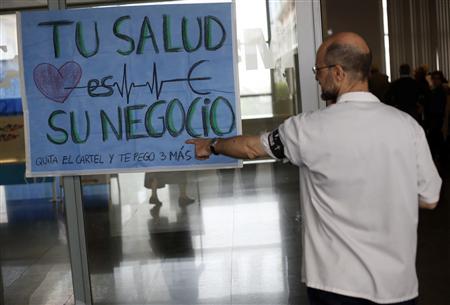
But I think human rights are not to be commercialized; they don’t lend themselves to be marketed, without destroying their meaning. And that means for health in general – formulated as a political parole and also basic scientific knowledge: Health is no commodity! Health is not for sale!

Literature:

Boris, St. Schmalz, A. Tittor (Hrsg.), Lateinamerika: Verfall neoliberaler Hegemonie? Hamburg 2005, besonders S.40-68 und 270-282.

Giovanella, M. Firpo de Souza Porto, Gesundheitswesen und Gesundheitspolitik in Brasilien, Arbeitspapiere aus dem Institut für Medizinische Soziologie, Nr. 25, 2004

Ch. Holden, Privatization and trade in health services: A review of the evidence, in: IJHS, Vol. 35, Bd. 4, S. 675-689, besonders S. 681 ff.

Urgente manifestacion por la democracia en Venezuela

Estimad@s Companer@s de ALAMES,

en un momento critico para el proyecto democratico en America Latina, donde hay un golpe en marcha contra el Gobierno Constitucional de Venezuela y en contra del pueblo pobre y los sectores comprometidos por la justicia social en aquel pais, es nuestra obligacion manifestarmos nuestra repulsa con los hechos perpetrados por la oposicion golpista y manifestarnos en Favor del respecto a la Constitucion Bolivariana.

En este sentido se impone una amplia y resoluta movilizacion informativa, militante y diplomatica en favor del gobierno constitucional y del pueblo trabajador de Venezuela, desmistificando el “paro civico” que hace la oposicion elitista y apoyado por las grandes cadenas de comunicacion, por el gobierno norte americano y la misma OEA. Lo que vemos en Venezuela es un golpe en curso, disfrazado de “democracia”, donde buscan victimizar la oposicion y demonizar el gobierno y sus apoyadores, y lo mas grave es que no hay manifestacion internacionales claras de repudio a las agresiones a la Constitucion y a los derechos del pueblo, se practica una inversion de discurso que busca permanentemente comunicar un imagen tiranico del Presidente Chavez y disenar una oposicion violada en sus derechos. Ya hemos visto este tipo de trama, lo hemos visto en Santiago de Chile en el golpe contra Salvador Allende, no podemos permitir que se repita…esto esta en nuestras manos…

Lo que les pido, con maxima urgencia, es la busqueda de articulacion politica que permita manifestaciones politicas de los partidos, de los gobiernos, de los movimientos sociales en cada Pais y que estos ocupen espacio en los medios de comunicacion para construir otra perspectiva para los hechos de Venezuela. Les pido que busquen contactar las Embajadas Venezolanas en cada uno de los paises y se pongan en contacto para transmitirles el informe de sus movimientos y apoyos con la mayor brevedad posible.

En comunicacion telefonica con la Ministra de Salud y Desarrollo Social de Venezuela, Cra. Maria Urbaneja, ella me transmitio su confianza en la superacion de las dificultades, la victoria contra el paro y la continuidad de los esfuerzos para construir la salud como un derecho universal para tod@s Venezolan@s. No podemos defraudarla en su confianza en nuestra solidaridad y en nuestra fuerza. Es importante que le comuniquemos nuestras iniciativas al mail

Les pido, finalmente , que nos manden copias de sus informes de iniciativas y textos de declaraciones y mensajes, para esta coordinacion general y para nuestra secretaria ejecutiva armandon@portoweb.com.br ; alames@movinet.com.uy

Referencia como subsidio para este labor politico en defensa de la democracia latinoamericana, el texto del Cro. Oscar Feo que nos habla desde Venezuela y el editorial del periodico mexicano La Jornada, el cual es una fuente confiable de informacion en internet.

Espero simplesmente el maximo de cada un@ de ustedes a la maxima brevedad.

Un saludo de fraternidad y lucha latinoamericana,

Armando De Negri Filho, Coordinador General de la Asociacion Latinoamericana de Medicina Social – ALAMES

The World Bank-false financial and statistical accounts in malaria treatment

The World Bank has an annual budget of US$20 billion, and is the largest organisation operating with a mission to reduce poverty worldwide. Malaria destroys about 1 million lives a year; the disease is the leading parasitic cause of death for Africa’s children and impoverishment for their families. Here we examine how these factors meet in the new Global Strategy & Booster Program, which is the Bank’s plan for controlling that disease in 2005–10.1 We believe this plan is inadequate to reverse the Bank’s troubling history of neglect for malaria. In the past 5 years, the Bank has failed to uphold a pledge to increase funding for malaria control in Africa, has claimed success in its malaria programmes by promulgating false epidemiological statistics, and has approved clinically obsolete treatments for a potentially deadly form of malaria.

We believe this plan is inadequate to reverse the Bank’s troubling history of neglect for malaria. In the past 5 years, the Bank has failed to uphold a pledge to increase funding for malaria control in Africa, has claimed success in its malaria programmes by promulgating false epidemiological statistics, and has approved clinically obsolete treatments for a potentially deadly form of malaria.

La Directiva Bolkestein, Ramon Serna

La Directiva Bolkenstein y el recorte de los servicios publicos en Europa

Ramon Serna, Intersindical Alternativa de Catalunya

– El proyecto de la directiva que se conoce con este nombre fue adoptado por la Comisi?n Europea en enero de este a?o y pretende empezar a aplicarse a partir del pr?ximo a?o, despu?s de que sea adoptada por el Parlamento y por el Consejo europeos. La aplicaci?n ser?a gradual y concluir?a (es decir, se aplicar?an plenamente todas las prohibiciones que establece) el 31 de diciembre de 2008, de manera que ya se podr?an observar sus frutos el 1 de enero de 2010, sin ning?n retraso sobre lo decidido en Lisboa.

– No hace falta decir que, como todas las iniciativas en el mismo sentido, la directiva se ha debatido en secreto, secuestrando al debate p?blico un tema tan importante. La poca oposici?n p?blica que hasta el momento ha tenido se debe a este secuestro. Lo m?s descarado y antidemocr?tico, es que pretende imponerse a?n en el caso de que triunfara en las urnas el NO a la Constituci?n.

Por qu? es tan perversa y monstruosa la Directiva Bolkenstein?

1.- Porque, en el proceso de liberalizaci?n de la econom?a, va mucho m?s all? de lo que estipula el Acuerdo General del Comercio de Servicios. As?, si ?ste “se limita” a exigir que los estados deben tratar a los prestadores de servicios extranjeros igual que a los nacionales, la directiva da un trato de privilegio a estos prestadores por medio del “principio del pa?s de origen” (art?culo 16 de la directiva), seg?n el cual un Estado Miembro no puede aplicar su legislaci?n a los prestadores extranjeros sino que ?stos se regir?n por las normas y leyes de su pa?s de origen (o mejor digamos, el pa?s donde, de manera oportunista han situado su sede) y s?lo ese Estado Miembro de origen los podr? controlar. La perversidad es evidente porque a ver qui?n explica, primero, qu? inter?s puede tener un estado en controlar las empresas que le est?n proporcionando beneficios econ?micos y, segundo, con qu? potestad puede controlar “in situ” la actividad que esas empresas realizan en otro estado.

2.- Porque favorece la vida empresarial a costa de la disminuci?n de la fiscalidad (o m?s a?n, fomentando el fraude fiscal), a costa de la calidad de los servicios prestados (a costa de la calidad de la asistencia sanitaria en nuestro caso), a costa de la equidad en el acceso a los servicios y a costa de la reducci?n dr?stica de derechos laborales.

En efecto, seg?n el “principio del pa?s de origen”, las empresas multinacionales que se registren en un Estado Miembro y realizan su actividad en otro no est?n obligadas ni a registrarse en ?ste, ni ellas ni sus trabajadores (que podr?n ser del pa?s de origen con salarios y condiciones de trabajo del correspondiente pa?s de origen o tambi?n podr?n provenir de pa?ses extracomunitarios), ni a respetar sus normas de acreditaci?n sanitarias ni profesionales, ni los convenios laborales del sector, ” El fraude a la Seguridad Social est? servido. El acceso a contratos administrativos se ve favorecido por el hecho de que sus costos laborales son mucho menores. La disminuci?n de los est?ndares m?nimos de prestaci?n del servicio tambi?n est? garantizada.

3.- El sistema de reembolso de costes (art. 23.2.3 i 4), finalmente, garantiza que todos los sistemas p?blicos de cobertura sanitaria, estar?n obligados a reembolsar a sus afiliados cualquier tratamiento no hospitalario practicado en otro pa?s miembro sin autorizaci?n previa alguna i por el mismo coste que se financie en el respectivo territorio nacional, lo mismo que los tratamientos hospitalarios que un estado miembro no pueda prestar al paciente en un plazo aceptable desde el “punto de vista m?dico” (con la desaparici?n de controles i limitaciones establecidas en los art. 9, 10, 11 i 13). Cualquier prestador de servicios podr? justificar dicha necesidad i convencer al paciente para que se someta al tratamiento que en su pa?s o servicio de salud se demorar?a mucho. De esta manera el prestador presionara por una parte sobre el presupuesto p?blico a trav?s del paciente i por otra a ?ste imponi?ndole una tarifa superior al posible reembolso p?blico (el art. 15 impide la regulaci?n de tarifas m?nimas i m?ximas). Una diferencia de tarifa que todos los pacientes no podr?n pagar y discriminar? el acceso a los servicios.

En conclusi?n:

La directiva permitir? a un prestador instalarse en origen en un pa?s miembro con baja fiscalidad i bajos salarios i desarrollar la actividad en otros de mayor nivel de vida a los cuales exprimir?n hasta el agotamiento i derrumbe de sus sistemas p?blicos en un proceso m?s o menos r?pido de reducci?n de prestaciones p?blicas i traslado al mercado, dejando a cuenta de cada cual la compra de “servicios de salud”.

Las consecuencias sobre el mercado laboral sanitario, es decir, sobre el conjunto de los trabajadores sanitarios, no ser?n menos dram?tico con la consiguiente paralizaci?n i retroceso de los salarios (ya existen ejemplos en otros sectores liberalizados, empresas que han planteado ya a sus trabajadores dos a?os de congelaci?n i un 30% menos a los nuevos empleados, paralelamente a los recortes sociales del gobierno alem?n) y una perspectiva de desempleo masivo.

Un ejemplo ser?a que ADESLAS, mutua sanitaria del grupo Aguas de BCN, se registrara en Polonia para continuar prestando servicios en Espa?a con condiciones laborales polacas pero con trabajadores asi?ticos a los que podr?a tener en r?gimen de semiesclavitud.

Cabe establecer muchos supuestos, pero lo importante es que veamos y sepamos explicar la relaci?n entre LIBERALIZACI?N, PRIVATIZACI?N, AUMENTO DE BENEFICIOS, DISMINUCI?N DE LA CALIDAD ASISTENCIAL Y DE LA EQUIDAD EN EL ACCESO A LOS SERVICIOS Y PRECARIZACI?N LABORAL.

XIV Conference of the International Association of Health Policy (IAHP) and the Latin-American Association of Social Medicine (ALAMES)

HEALTH, ETHICS Y EQUITY: A CALL FOR POLICIES AND ACTION

Salvador – Brazil 15 to 18 July, 2007

PRESENTATION The Congress of IAHP and ALAMES held in Salvador between 15 and 18 July of 2007, was an opportunity for a necessary reflection about relevant themes on the realm of health policy and social medicine to all researcher workers, professors, health professionals, members of the non-governmental organizations and public health officials and managers.

Structural and conjunctural social and economic questions that shape our present health problems expresses their impact in countries in all continents, affect people with greater or minor intensity in all countries and, especially, discriminate, exclude or treat differently workers, ethnic groups, immigrants, and women, regarding health rights and life with dignity. A critical analysis of the historical evolution of the current scenario and prospect of the health systems ask for the definition of new targets and strategies to create opportunities to guarantee for the current and new generations the right to live in a world where human potential can be fully developed. An analysis of the determinants of the current and future health sector structure either in poor or rich countries, from the north or the south, from the east or west, must include questions related to the production of scientific knowledge in health, to environment, economy, social policy and ethics. Thus, we are organizing the Congresses of IAHP and ALAMES as a democratic space of discussion of relevant themes on collective health that will allow the understanding of the processes that has structured the health sector, in many countries, in the last decades. The Congresses ultimate our goal is to propose strategies for policy and action that will put forward the universal movement for health, life and peace and justice to find ethical alternatives to reach this goal.
Conference webpage

X CONGRESO DE LA ASOCIACION LATINOAMERICANA DE MEDICINA SOCIAL (ALAMES)

XIV CONGRESO DE LA ASOCIACIÓN INTERNACIONAL DE POLITICAS DE SALUD (IAPH)

IV CONGRESO DE CIENCIAS SOCIALES Y SALUD DE LA ASOCIACION BRASILERA DE POSTGRADUADOS EN SALUD COLECTIVA (ABRASCO)

Salvador de Bahía – Brasil Julio 15 al 18 de 2007 Hotel Pestana

“EQUIDAD Y DERECHO A LA SALUD: UN IMPERATIVO ÉTICO GLOBAL”

PRIMER LLAMADO
Desde hace más de dos décadas la Asociación Internacional de Políticas de Salud (IAHP), la Asociación Latinoamericana de Medicina Social (ALAMES) y la Asociación Brasilera de Postgraduados en Salud Colectiva (ABRASCO) vienen realizando acciones conjuntamente. En esta ocasión realizaremos conjuntamente el XIV Congreso de le IAPH, el X Congreso de ALAMES y el IV Congreso de Ciencias Sociales y Salud de ABRASCO, en la ciudad de Salvador – Brasil, del 15 al 18 de Julio de 2007. Estos Congresos representan una oportunidad muy valiosa para reflexionar sobre temas sanitarios relevantes para el continente latinoamericano y para el mundo. Hoy es un imperativo analizar como los cambios sociales, económicos y políticos globales afectan la equidad sanitaria y la realización del derecho a la salud y a la vida; como afectan a las personas en mayor o menor intensidad; como discriminan, excluyen o tratan desigualmente a los trabajador@s, a los grupos étnicos, a los inmigrantes y a las mujeres y como definen sus perfiles de salud y calidad de vida. Igualmente, un análisis critico de la evolución histórica y del escenario actual de la conformación de los sistemas de salud se hace necesaria para definir nuevos objetivos y estrategias que garanticen para las nuevas generaciones el derecho a vivir en un mundo en el que las potencialidades del ser humano sean desarrolladas y realizadas. Por otra parte un análisis sobre los actuales escenarios de la salud en los países pobres y ricos desde el norte hasta el sur desde el oriente hasta el occidente que incluya cuestiones relacionadas al conocimiento científico, a la economía, a la política y a la ética. Con los Congresos de la IAHP, de la ALAMES y de Ciencias Sociales de ABRASCO, abrimos escenarios democráticos de discusión sobre los temas señalados, para comprender mejor los procesos que vienen siendo estructurados en el sector de la salud durante las últimas décadas y para proponer políticas y acciones para fortalecer el movimiento universal por la salud, por la vida y por la paz, con el fin de encontrar alternativas solidarias y éticas. Con este primer llamado l@ estam@s invitando a cada un@ de ustedes: investigad@r, profes@r, profesional de la salud, miembr@ de una organización social o de un movimiento social, estudiante o simplemente en su condición de ciudadan@, para que se programe, para que piense en como va a participar en estos escenarios, sume a su organización y difunda esta iniciativa de encuentro regional y mundial para seguir avanzando en la ruta para hacer realidad el derecho a la salud en el continente y en el mundo. Para mayores informes comunicarse con:

secretariat
and ALAMES webpage

and Conference webpage

Sebastião Loureiro Coordinador Congresos
Madel Luz Coordinadora Región ALAMES Brasil – Vicepresidente ABRASCO
Mauricio Torres Coordinador General ALAMES
José Joaquim O’Shanahan Presidente IAPH

Maria Urbaneja: Un mensaje sobre Sergio Aruca

Amigos y amigas de la Salud Colectiva de América Latina, amigos y amigas de ALAMES

Se nos fue Sergio amigo, compañero de sueños y de luchas por la defensa de la Salud como Derecho y como Bien Publico. Conocí a Sergio en aquella reunión de Ariccia, Roma en 1979 y desde ahí se tejió una amistad y un compartir de amigos, compañeros, maestro. Sergio me invito a Brasil a estudiar en la ENSP, lo que solidifico los vínculos.

Seguí muy de cerca sus aportes en diferentes campos a los procesos políticos de la Salud en Brasil. Siempre siguiendo el proceso de construcción del Sistema Publico de Salud de Brasil (SUS) proceso del cual el fue actor fundamental desde los diferentes espacios que le toco accionar como integrante del movimiento sanitario. Recientemente hablo de la necesidad de transformar el SUS, de colocar en la centralidad de su accionar la promoción de la calidad de vida.
Hoy desde aquí, desde esta trinchera de lucha en este proceso bolivariano su ausencia es un vacío enorme, pero al mismo tiempo un renovar compromiso para continuar en esta tarea, esa inmensa tarea que en nuestros países significa construir e implementar Políticas Publicas donde la dignidad de la vida, la promoción de calidad de vida y la garantía de derechos este en el centro del accionar publico, de la nueva institucionalidad publica.

Sigamos pues tejiendo sueños, fortaleciendo el movimiento de la Salud Colectiva en nuestro continente, con Sergio, con todos y todas…..

Un abrazo grande. Amiga de siempre

Maria Urbaneja

Health Policy Reform: Driving the wrong way?, by John Lister

Health Policy Reform: Driving the wrong way? – A critical guide to the global ‘health reform’ industry

author: John Lister

Published July 5 2005
ISBN 1 904750 45 1 £25pb

“This is an excellent book for students and policy makers and provides a useful overview of health care restructuring across the world. I recommend it.”

Allyson Pollock, Chair of Health Policy & Health Services Research, UCL

“John Lister has provided the definitive critique of market-oriented health care ‘reforms’ that the World Bank has been promoting at least since 1993. His book is a crucial contribution to the struggle for equity-oriented, rights-based approaches to health systems in rich and poor countries alike.”

Ronald Labonte, Canada Research Chair (Tier I) and Ted Schrecker, Senior Policy Researcher, Institute of Population Health, University of Ottawa (co-authors, Fatal Indifference: The G8, Africa and Global Health)

“John Lister’s book is a powerful, readable, worldwide critique of the costs and contradictions of market-style reforms and privatization which UNISON has opposed in Britain. It is a valuable resource for campaigners and health workers everywhere.”

Karen Jennings, Head of Health, UNISON (Britain’s largest public service union)

find more about this book and its author :choose “health policy” in the document manager

online purchasing